Axios Phoenix

April 07, 2024

😎 Hi, Sunday!
The total solar eclipse is almost here, and we are over the Moon! Axios reporters Jacob, Carly, Analis and Troy wrote a special newsletter to help you properly align so you don't spend the next 20 years wishing you were better prepared.
- Your local team will be back in your inbox tomorrow morning.
Today's newsletter is 877 words — a 3½-minute read.
1 big thing: The totality of what's happening
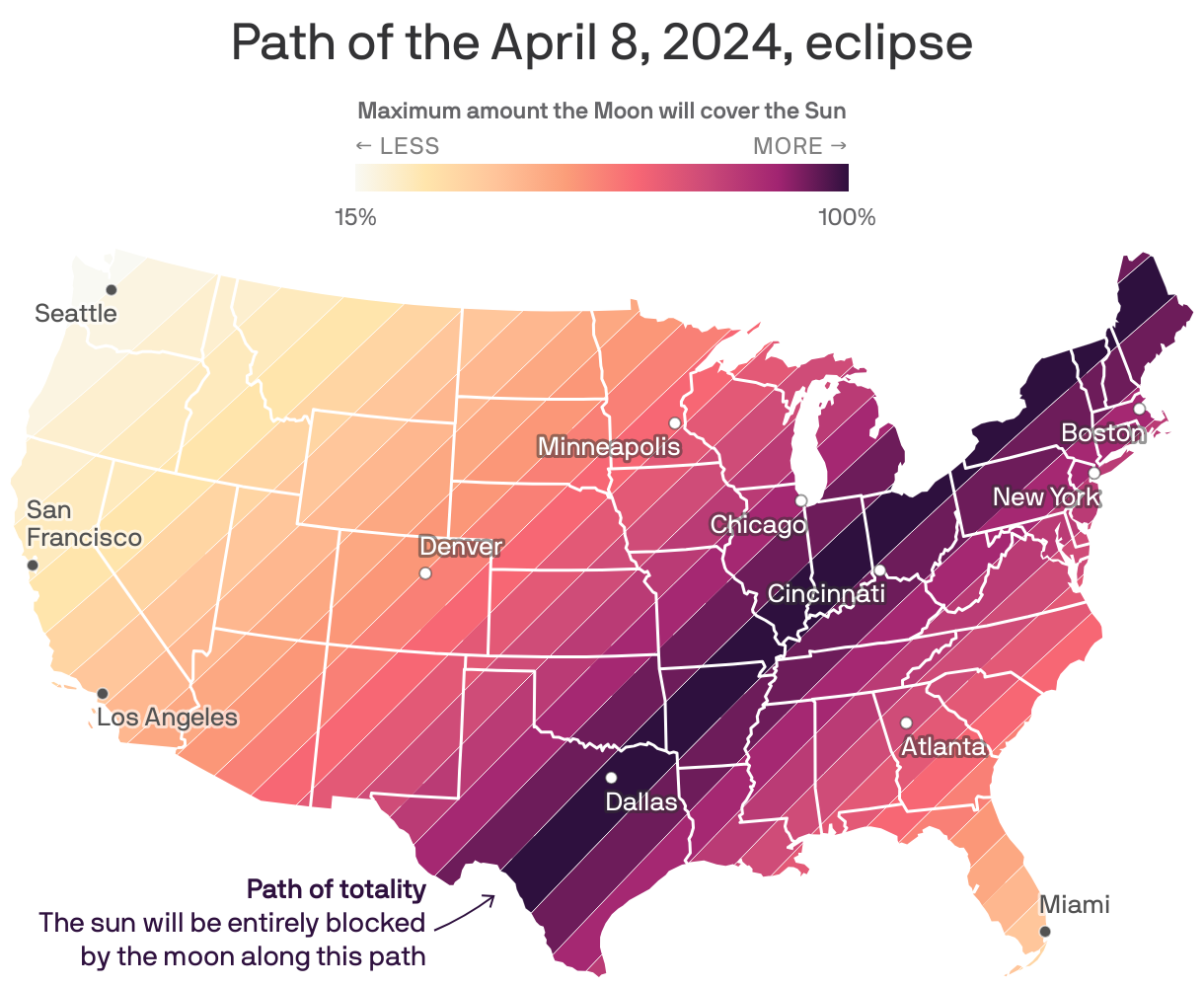
Tomorrow, most people in the U.S. should be able to see the Moon partially or totally block the Sun, weather permitting, according to NASA.
Why it matters: It will be the first total solar eclipse visible in the U.S. since 2017, and in many ways, it will overshadow that previous celestial event.
By the numbers: Because the Moon will be closer to Earth than it was in 2017, this year's path of totality will be significantly broader (108–122 miles wide) and will pass over far more people.
- Totality — or when the Moon completely blocks the Sun — will also last almost twice as long as it did in 2017. Totality will remain over four minutes long from Texas to eastern Indiana.
How it works: During a total solar eclipse, the Sun, Moon and Earth are in syzygy, or near-perfect alignment, with the Moon moving between the Sun and the Earth.
- The Moon during a total solar eclipse will cover the Sun, darkening the sky and leaving only the outermost layer of the Sun's atmosphere — its corona — visible.
- That will only be the case for those in the path of totality. Most people outside the path will instead see a partial eclipse, which makes the Sun look like a crescent.
The big picture: Solar activity will be at or near maximum during the eclipse, which should give viewers a better chance to see solar phenomena, like a solar prominence or, if they're lucky, coronal mass ejections.
2. 🤔 Who's studying the sky
NASA has funded at least five research projects during the eclipse.
Why it matters: The observations will help researchers understand the myriad ways the Sun influences Earth and the life upon it.
✈️ Chasing the eclipse with NASA's high-altitude research planes:
- Teams led by Southwest Research Institute will take pictures of the eclipse while flying NASA research aircraft to study the Sun's corona.
📻 Ham Radio Science Citizen Investigation
- A University of Scranton-led initiative will invite ham radio operators around the country to send and receive signals to see how the eclipse affects Earth's ionosphere, a part of the upper atmosphere that's critical for communications and navigation.
☀️ SuperDARN:
- Using the Super Dual Auroral Radar Network, researchers led by Virginia Polytechnic Institute and State University will study how solar radiation impacts the ionosphere.
🔭 GAVRT Solar Patrol:
- Scientists from NASA's Jet Propulsion Laboratory and the Lewis Center for Education Research will use the Goldstone Apple Valley Radio Telescope to measure subtle changes in solar radio emissions as the Moon eclipses active regions of the Sun.
🚀 Atmospheric Perturbations around the eclipse path:
- A University in Daytona Beach-led team will launch a succession of three rockets from eastern Virginia before, during and after the eclipse to measure electric, magnetic, temperature and density changes in Earth's upper atmosphere.
Go deeper: NASA also funded three massive citizen science investigations
3. 🧘🏽♂️ Looking inside instead of up
Instead of looking to the sky during the total solar eclipse, some will stay indoors with the curtains closed.
The big picture: For centuries, people have turned to rituals and mythology to honor and make sense of the solar eclipse.
Zoom in: Members of the Navajo Nation traditionally treat the solar eclipse as a sacred time to stay inside and quietly meditate, Henry Fowler, a math educator at Navajo Technical University, tells Axios.
- He says that when the solar eclipse happens, it's believed that the Sun is dead, "but it's going to rejuvenate, rebirth itself in the cycle so that we're able to live in harmony with the natural laws again."
- To "honor the order of the cosmos," Fowler says Navajos don't drink water, eat, sleep or use the restroom during an eclipse.
The Navajo don't look at an eclipse out of respect and because they worry the powerful event could lead to "unbalance in that individual," Fowler says.
In other cultures, there are stories that the solar eclipse is caused by a supernatural creature or monster swallowing the Sun, James Deutsch, curator at the Smithsonian Center for Folklife and Cultural Heritage, tells Axios.
4. How to make a pinhole camera


To view the eclipse safely without glasses, make a pinhole viewing camera to project the eclipse onto a small piece of card stock.
Why it matters: Staring straight at the Sun without proper glasses could damage your vision.

5. 🎧 Playlist, ready
We've created the ultimate eclipse compilation to bring some sunshine to your ears during the darkness.
The vibe: Here's a sampling of the full playlist of 50 tunes on Spotify.
🎵 "Ain't No Sunshine," Bill Withers
- Essential eclipse lyric: "Ain't no sunshine when she's gone/ Only darkness every day."
☔ "Black Hole Sun," Soundgarden
- Essential eclipse lyric: "Black hole Sun, won't you come/ And wash away the rain?"
🖤 "Total Eclipse of the Heart," Bonnie Tyler
- Essential eclipse lyric: "I don't know what to do and I'm always in the dark/ We're living in a powder keg and giving off sparks."
6. Will you be watching?
We want to hear how you plan to watch the eclipse or honor it.
- Tell us if you're enjoying the event alone or traveling to a watch party.
- Do you participate in any eclipse traditions?
Reply to this email with your plans or photos, and you could be featured in an upcoming newsletter.
Our picks:
📖 Jacob is reading about the earliest known written record of a solar eclipse.
🐔 Carly is curious to see how her friend's chickens react to the eclipse.
💭 Analis is still thinking about when she watched the total solar eclipse in August 2017 from Columbia, South Carolina.
👓 Troy is hoping he remembers where he put his protective glasses before watching the eclipse with his three sons in Cleveland.
Thanks to our editor Ashley May and copy editor Sheryl Miller.
Sign up for Axios Phoenix


/2024/03/20/1710961415044.gif?w=3840)