Axios New Orleans

September 28, 2026


1 big thing: 🤰🏻Surrogacy goes mainstream



More Americans are turning to surrogacy to build their families.
Why it matters: As surrogacy becomes more visible and accessible, ethical, legal and cultural tensions become harder to ignore.
How it works: A surrogate carries a pregnancy for intended parents — typically via IVF with an embryo that uses a donor or the intended mother's egg.
- That's called gestational surrogacy, and the surrogate can be referred to as the gestational carrier. (When a surrogate uses her own egg, that's called traditional or genetic surrogacy.)
It's an option for people who want biological kids but can't carry a pregnancy.
- It's "not something I would recommend for somebody who doesn't have a medical indication or a reason to do it," says Laura Meyer, reproductive endocrinologist at Illume Fertility.
State of play: Surrogacy has undergone a quiet cultural transformation.
- What once seemed like an inaccessible or poorly understood method of family-building has become something more people picture for themselves as more public figures talk about pregnancy challenges and surrogacy, Meyer says.
- The topic has also migrated into pop culture, appearing on social media and as a central plot line on Apple TV+'s "Shrinking."
The latest: Olympic gold medal figure skater Alysa Liu was born via surrogacy. And singer Meghan Trainor recently shared that medical complications from her first two pregnancies led her family to surrogacy for their third child.
- But the headlines on surrogacy aren't all celebratory: Reaction to Trainor's baby news was mixed, and a recent criminal investigation involves the surrogate births of more than 20 children.
The bottom line: The topic of surrogacy remains fraught because it involves complex health and rights implications for everyone involved — surrogates, intended parents, donors and the children born.
3. 🏛️ Laws are all over the map
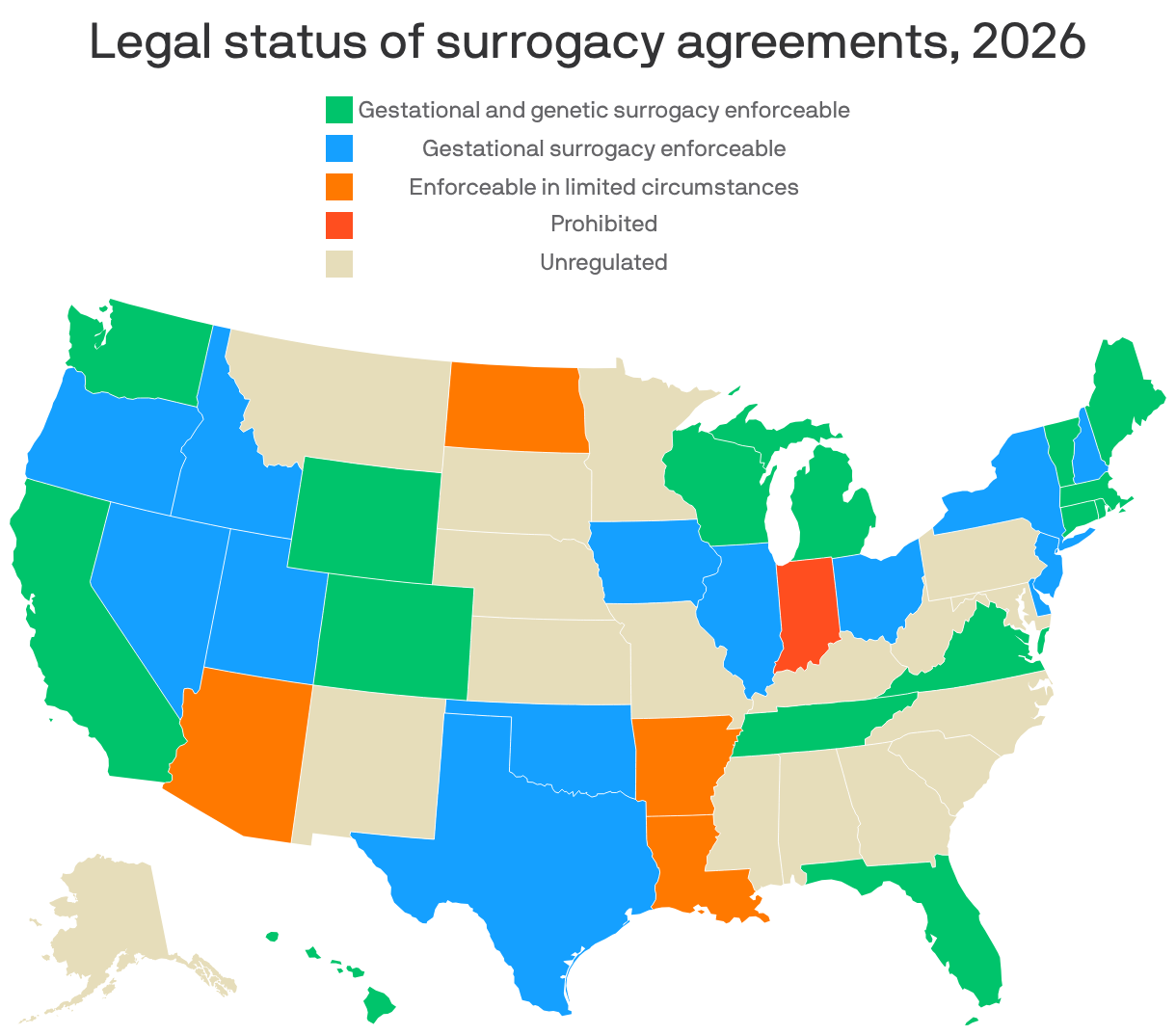
Without a federal law, surrogacy in the U.S. is governed by a patchwork of state regulations.
Why it matters: Confusing, varied local rules can determine everything from whether agreements are legally binding to who is recognized as a parent at birth.
By the numbers: As of 2026, surrogacy agreements are enforceable in 31 states (with some limitations), void in one, and unregulated in 17, Surrogacy360 tells Axios.
Major differences between state laws include:
- How a surrogate must be compensated (if not considered "altruistic").
- Who becomes the legal parents of a child born via surrogate.
- And whether genetic surrogacy (when the surrogate uses her own egg) is even allowed.
What they're saying: A growing number of lawyers "have begun to specialize in advising either intended parents or being the separate counsel for a surrogate," says Ming Wong, an attorney and the director of community justice and access at the National Center for LGBTQ Rights.
- Because contracts involve so many potential risks, like one party changing their mind midway through the process, "we always encourage people to at least talk to an attorney … even in a state where it's not criminalized," Wong says.
- In states without enforceable surrogacy rules, Wong says, there's a risk that agreements could look like a criminal act, similar to "baby-selling."
4. 💞 Born through surrogacy

Axios New Orleans
