Axios Navigate

January 08, 2021
Welcome back and happy New Year! (Though this week felt a lot like 2020).
Situational awareness: Transportation Secretary Elaine Chao yesterday became the first Cabinet official to resign in the wake of Wednesday's riots in Washington, saying she'll work with Pete Buttigieg on a peaceful transition.
- Sign up here or follow me on the Axios app. You can also drop me a line at [email protected].
Today's Smart Brevity count: 1,363 words, a 5-minute read.
1 big thing: how to solve the EV battery shortage
Illustration: Sarah Grillo/Axios
The electric vehicle era, barely underway, could soon be stifled by a shortage of batteries and raw materials that will require significant investments in U.S. manufacturing, mining and recycling.
Why it matters: President-elect Joe Biden has made vehicle electrification a core element of his energy and economic policy. But the U.S. is far behind in the global battery race, creating a potential supply chain bottleneck that could slow EV adoption for the next decade.
What's happening: Tesla's former battery chief, J.B. Straubel, who has seen the issue developing for years, envisions a long-term solution that would produce EV batteries from recycled lithium, nickel and cobalt salvaged from other cars, not mined from the earth.
- His new startup, Redwood Materials, is developing a closed-loop battery supply chain that he says would lead to cheaper electric vehicles — without harming the environment.
- The U.S. has plenty of lithium, he noted in an interview with Axios, but pulling it from the earth is expensive and difficult — defeating the thesis behind affordable EVs.
- Recycling, he said, "is staring us right in the face as the obvious answer to this," says Straubel. In a closed-loop system, mines won't be needed, he says.
The catch: There aren't enough used EVs hitting the junkyard yet. So for now, Redwood is perfecting its processes using batteries stripped from consumer electronics as well as scrapped battery materials from Panasonic, Tesla's joint venture partner in its Nevada gigafactory.
- It's currently taking in 2 GWh worth of used batteries for processing — equivalent to 30,000 cars — and will scale as fast as it can as more EVs hit the end of their life cycle, says Straubel.
How it works: In ovens reaching 2,700°F, Redwood turns the batteries into hot liquid metal and then uses other chemical processes to reduce that metal into highly concentrated forms of lithium, nickel and cobalt.
- In the process, it must remove parts that can't be recycled while taking care to neutralize hazardous materials.
- Learning how to "un-manufacture" batteries at scale is difficult, Straubel says, but it's still easier, cheaper and more sustainable than extracting it from the soil.
"It's the world’s highest quality ore and you don’t have to go digging for it. People have it tucked in their junk drawers."— Celina Mikolajczak, vice president of battery technology at Panasonic
Yes, but: Battery recycling is still at least three years away from being a serious business, says Simon Moores, managing director of research firm Benchmark Minerals. Nor does he see it as a silver bullet.
- At best, he projects, recycling will account for 10% of global lithium demand by 2030.
- "It won't come close to replacing the need for mined material."
The intrigue: Despite the clear demand for raw materials, financing for new mines is hard to secure because of the long-term investment horizon and potential price volatility, Moores said.
- Yet, Wall Street speculators are willing to bet on EV startups, assigning gigantic valuations to companies that have yet to produce any vehicles — or profits.
The bottom line: Mikolajczak of Panasonic just wants to get her hands on more raw materials.
- "Bringing a nickel mine into production is a five- to 10-year endeavor. If I can work with Redwood and in three years' time have nickel precursor, I'm doing great."
Bonus: Understanding EV supply chain problems


Until more battery factories, mines and recycling operations come online, EV makers will likely face supply chain volatility.
- "No matter how bullish or conservative you are on EVs, the next 10 years are going to be a form of chaos for the industry," Moores says.
- Just as automakers 100 years ago had to build new supply chains "this whole EV blueprint from the mine to battery cells is being built from scratch."
The big picture: Right now, the U.S. is almost entirely dependent on Asia for batteries and the raw materials needed to manufacture them.
What's happening: Tesla, GM and others are building enormous new battery factories in the U.S., but America still lags far behind the rest of the world on battery manufacturing capacity.
- Since 2017, China announced plans for at least 107 battery factories, up from nine, with 53 already in production, according to Benchmark.
- The U.S. has just three battery factories, with six more planned, but needs at least 30 by 2030 to meet EV demand, Moores notes.
2. Boeing's criminal penalty: $2.5 billion
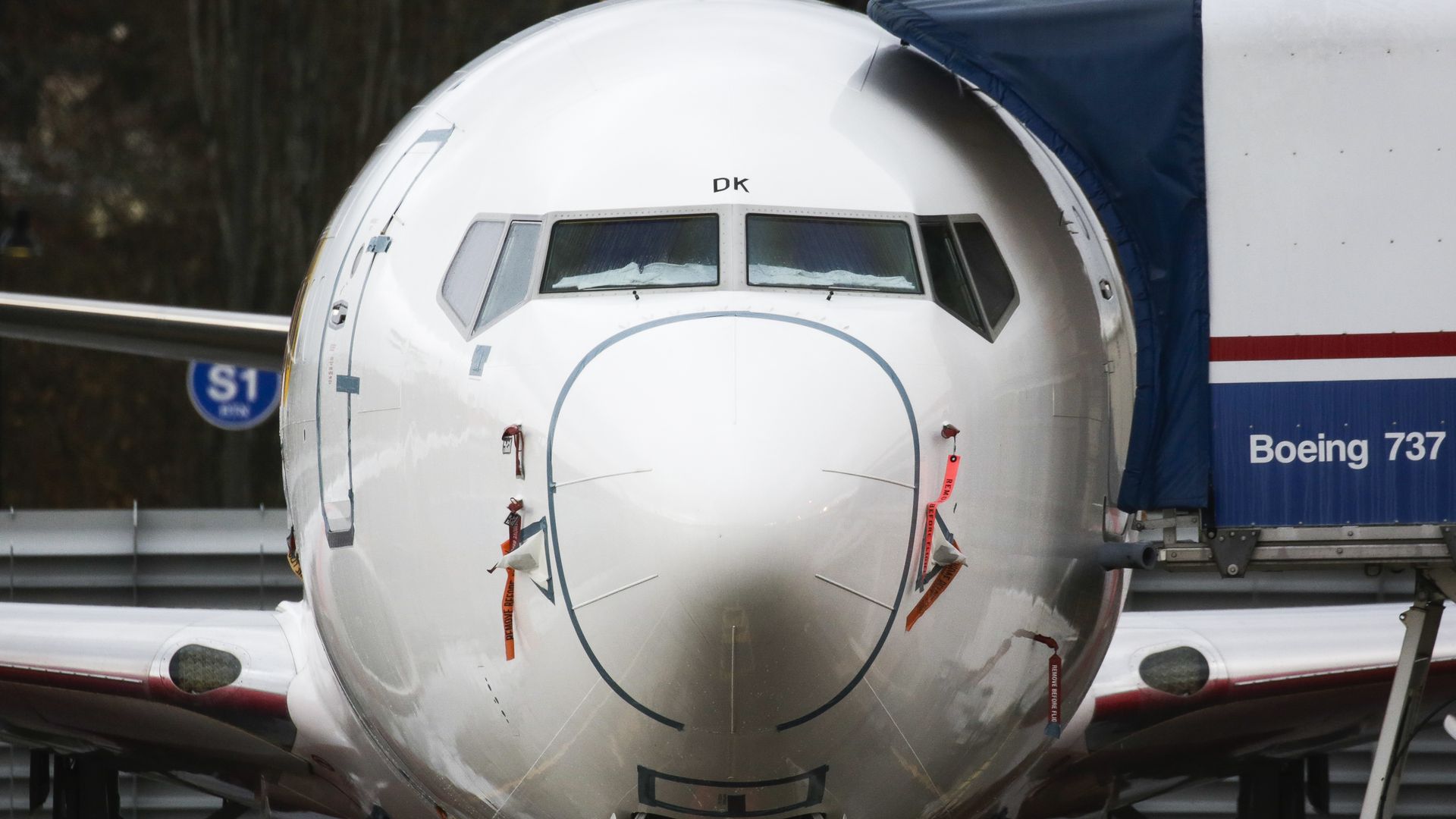
A Boeing 737 MAX airliner is pictured at the Boeing Factory in Renton, Wash. Photo: Jason Redmond/AFP via Getty Images
Boeing agreed to pay more than $2.5 billion to settle U.S. criminal charges that it defrauded the Federal Aviation Administration in its investigation into safety issues involving its most popular plane, Axios' Orion Rummler writes.
Why it matters: Two Boeing 737 MAX crashes killed a total of 346 people in 2018 and 2019 and highlighted massive oversight and safety lapses on the part of the airline manufacturer.
What they're saying: "The misleading statements, half-truths, and omissions communicated by Boeing employees to the FAA impeded the government's ability to ensure the safety of the flying public," U.S. Attorney Erin Nealy Cox for the Northern District of Texas said in a statement.
Details: Boeing's $2.5 billion fine includes a criminal penalty of $243.6 million, plus $1.77 billion in compensation payments to Boeing's 737 MAX airline customers — which the company says it has already set aside — and the creation of a $500 million crash-victim beneficiaries fund.
- The company expects to incur earnings charges equal to the remaining $743.6 million in the fourth quarter of 2020, per a Securities and Exchange Commission filing.
My thought bubble: Having just received permission to resume flights of the 737 MAX, Boeing is eager to put this shameful episode behind it, especially as it continues to deal with the collapse of air travel during the coronavirus pandemic.
3. Mobs on a plane
Photo: Jonathan Newton/The Washington Post via Getty Images
Flight attendants are asking the FAA to ban insurrectionists on flights out of Washington, D.C., after several incidents aboard D.C.-bound planes the day before a pro-Trump mob stormed the U.S. Capitol.
Why it matters: Pilots and flight attendants are trained to keep passengers safe in the air and, since 9/11, to be on the lookout for potential terrorists. But in these extraordinary times, their duties have expanded to include mask enforcement and mob control.
Driving the news: American Airlines is investigating an unruly and frightening episode on a flight from Dallas to Washington, D.C. the night before the riots.
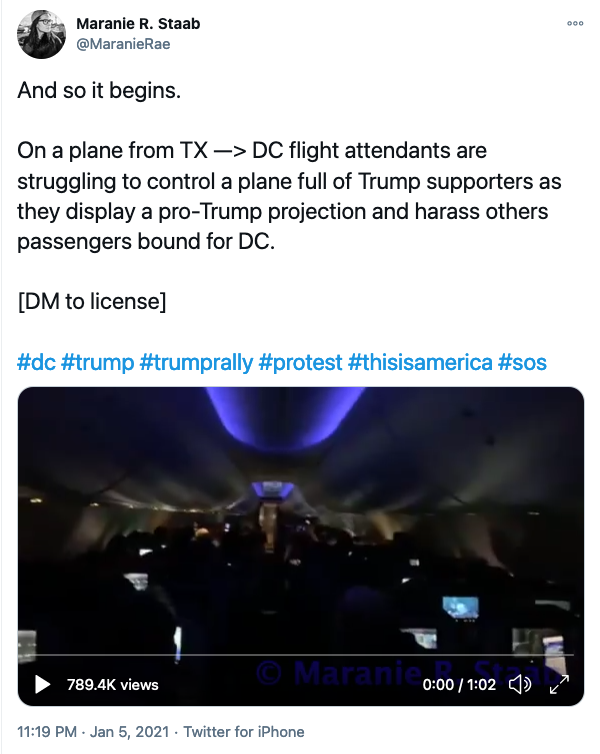
Details: In a darkened airplane cabin, passengers are heard shouting obscenities while a large Trump logo is projected on the plane's ceiling, according to a tweet posted by independent journalist Maranie Staab.
- After the cabin lights come on, one man wearing a camouflage cap is clearly heard saying: "These are the guys we came to f--king wipe out."
Of note: Sen. Mitt Romney (R-Utah) was heckled on a flight from Salt Lake City to Washington ahead of Wednesday's certification vote.
4. Driving the conversation
Cruise hires former Delta Air Lines exec to lead rollout of self-driving taxis (Joann Muller — Axios)
- Why it matters: Gil West, who retired as Delta's chief operating officer last year at age 59, will become COO at Cruise as it shifts from R&D to commercialization of autonomous vehicles. He'll report to CEO Dan Ammann.
U.S. to allow small drones to fly over people and at night (David Shepardson — Reuters)
- Why it matters: The long-awaited rule from the FAA is a significant step toward drone use for widespread commercial deliveries.
Who will win the self-driving car race? The clues lie in elevator history (Alex Roy — Ground Truth)
- Why it matters: Many entrepreneurs worked to perfect elevators before they became commonplace, Argo AI's new blog points out. And it took years before elevator operators disappeared.
5. What I'm driving
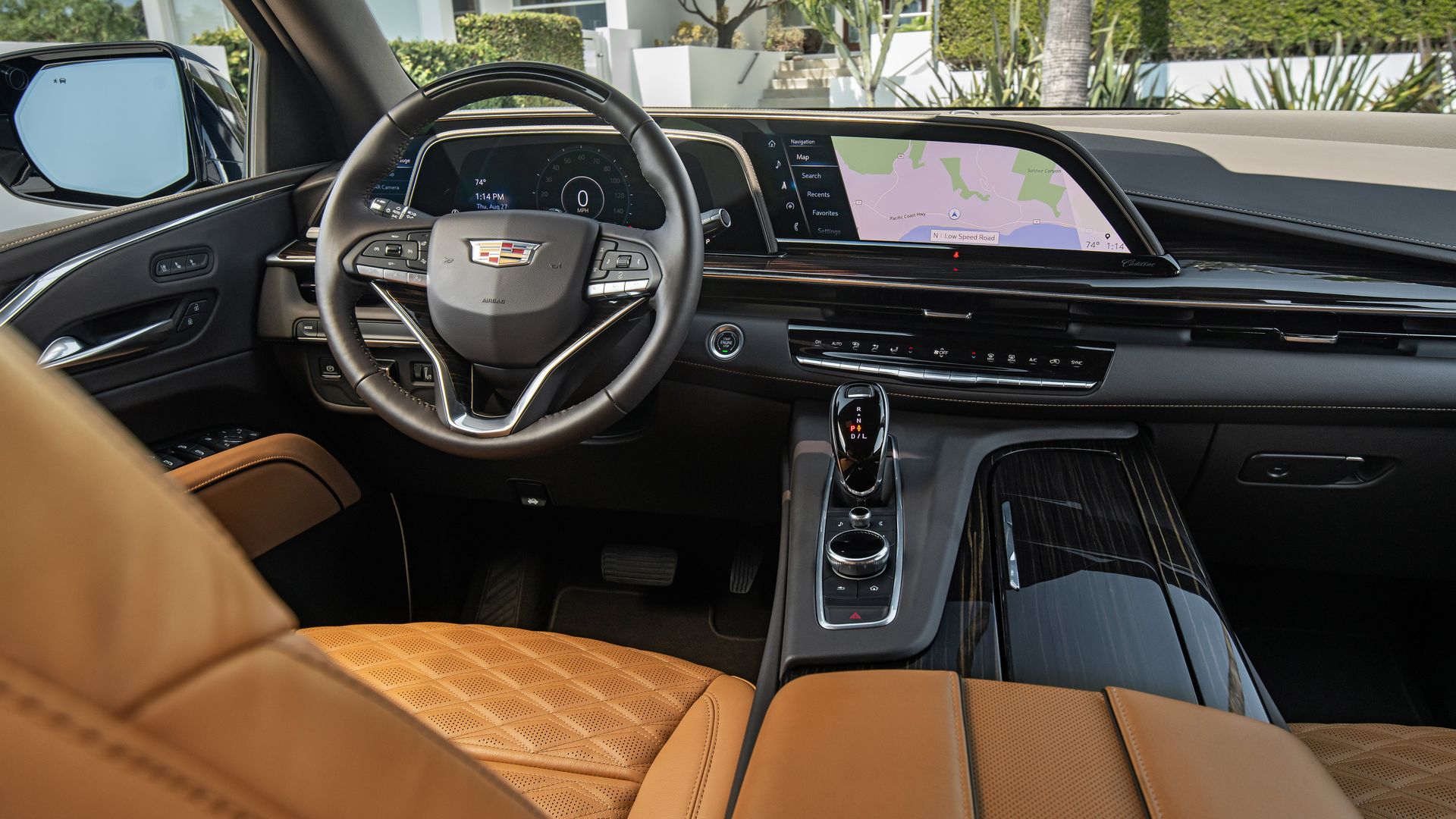
2021 Cadillac Escalade's exclusive curved OLED display. Photo: Cadilliac
The 2021 Cadillac Escalade is by far GM's best, boasting a stunning interior and impressive features that are worthy of a flagship luxury SUV.
The big picture: The Escalade, now in its fifth-generation, has long been popular with athletes and celebrities. But the 2021 model steps up its luxury game, big-time.
What's new: The dazzling digital dashboard is comprised of three curved OLED screens layered on top of one another providing 38 inches of vivid displays.
- The augmented-reality navigation system uses live street views overlaid with directions, while audio prompts to "turn left," for example, come from the left speakers.
- A new exclusive AKG audio system features up to 36 speakers in the highest Platinum trims, with a not-too-shabby 19 speakers standard on other models.
For the first time, the Escalade offers Cadillac's optional Super Cruise driver-assistance technology for hands-free highway driving.
- The roughly $5,000 system can now perform automatic lane changes — checking first for traffic — similar to Tesla's AutoPilot.
- One Cadillac advantage that Tesla lacks is a driver monitoring system, which makes sure drivers are paying attention, even when their hands are not on the wheel.
Pricing: The Escalade starts at around $79,000. My Platinum test vehicle topped out at $112,000.
The bottom line: The 2021 Cadillac Escalade has definitely arrived in style.
Sign up for Axios Navigate

Follow transportation trends, policy and business