Axios Media Trends

November 17, 2026

1 big thing: 🎮 GTA defies entertainment economics
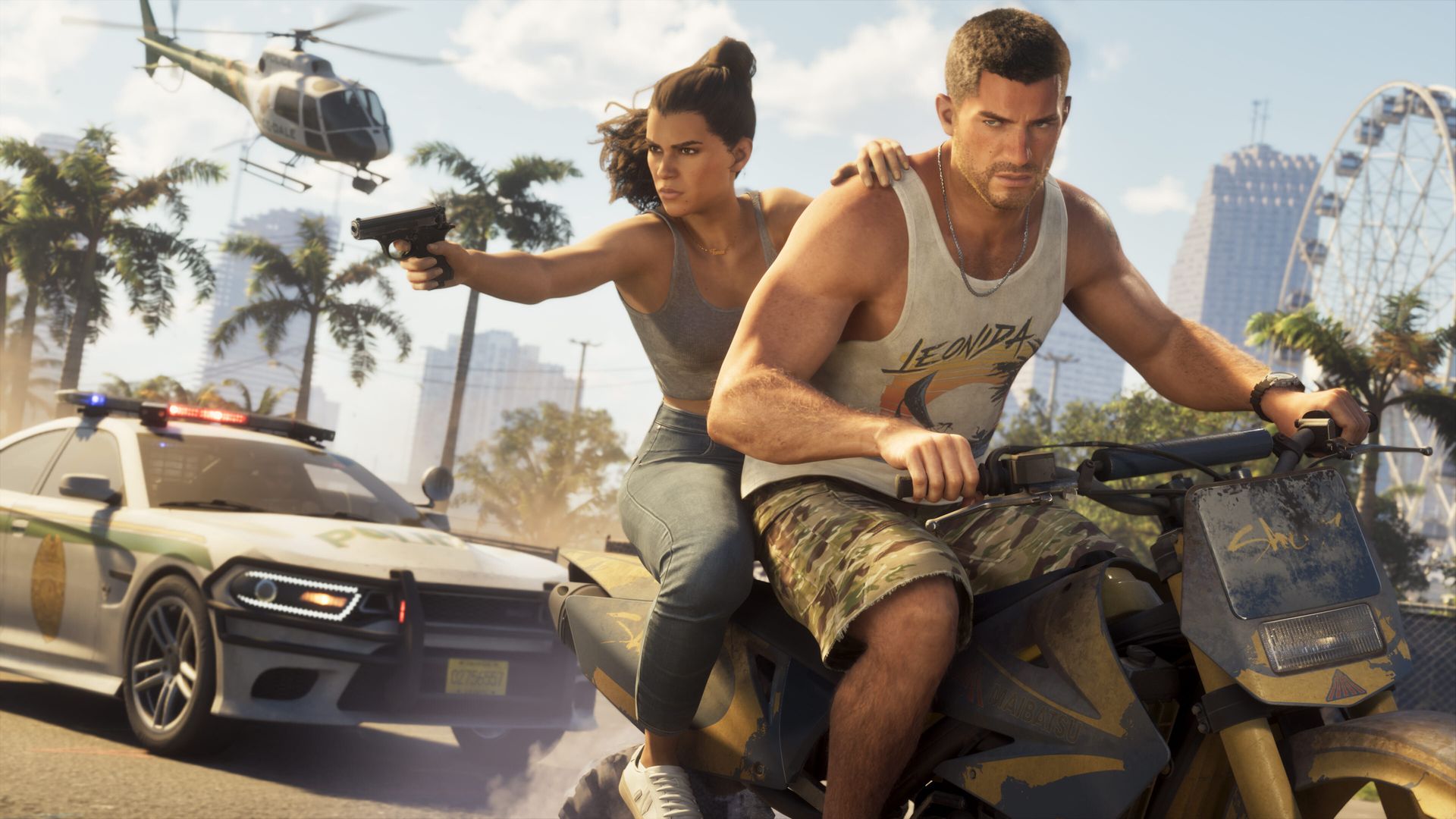
The debut of Grand Theft Auto VI on Thursday is expected to be so big that internet providers are already sounding the alarm about global bandwidth and traffic disruptions as fans begin pre-downloads.
Why it matters: The game, which returns after a 13-year hiatus, proves how much free expression can drive economic value, even when those ideas are provocative or controversial.
- It also underscores how rare it is for an entertainment franchise to recoup its return on such a massive development budget so quickly. GTA VI is likely the most expensive video game ever created.
Follow the money: GTA VI has netted nearly $1.5 billion in sales, according to Sensor Tower estimates, with nearly 15 million digital pre-order copies sold across Xbox and PlayStation devices.
- Early demand foreshadows another blockbuster hit for the franchise, which has generated more than $10 billion in revenue since the debut of GTA V in 2013, per a third-party analysis of financial filings from Take-Two Interactive, the parent of GTA publisher Rockstar Games.
State of play: Daily players on all other games are expected to decline by 10% in the month following launch, per Sensor Tower estimates, with the most impacted titles ranging from Fortnite to Call of Duty.
- The other side: Mobile user time spent on social media apps, such as YouTube, Instagram and Discord, is slated to rise by more than 60 million hours, or roughly four hours per GTA player.
Zoom out: The blockbuster success of the GTA franchise is driven by its unique ability to drive years-long revenue from a single release using interactive features and online updates that keep players engaged indefinitely.
- "Frankly, it's one of the reasons that the motion picture business is so compromised," Strauss Zelnick, chairman and CEO of Take-Two Interactive, said at a Business Insider event last month.
Flashback: GTA V's success transcended initial game sales through GTA Online, a multiplayer platform Rockstar introduced two weeks after the title was released.
- Doing so, "broke Rockstar's own formula" of releasing sequels or downloadable expansions, said Stephen Totilo, founder and editor of Game File.
- Take-Two executives have been mum about what the multiplayer experience will look like after the initial debut of GTA VI.
The big picture: The entertainment industry, inclusive of games, has struggled to make big-budget franchises reliably profitable in an era where production costs are higher and consumers have more choice.
- GTA, therefore, "is not representative of the video game industry," Totilo added. "This is an exception. They don't have to play by the rules everybody else has to play by."


Reality check: With streaming and theatrical revenues facing growth caps, Hollywood has looked to games as a way to expand their IP. But gaming has proven illusive and entertainment giants continue to mostly license games rather than invest in building them.
- Netflix has shuttered four of its gaming studios over the past three years and sold one back to its founders. The company is reportedly 10% behind its 2026 internal gaming targets.
- Warner Bros. Discovery closed three gaming studios in 2025 before it was acquired by Paramount.
- Amazon made major cuts to its video game division last year.
- Disney shuttered its in-house console gaming business a decade ago and has since invested in Fortnite maker Epic Games to build an interactive gaming universe around its own franchises.
The bottom line: "It's astounding that no one has bought Take Two," says LightShed Partners' Rich Greenfield, noting the company has no controlling shareholder.
- Asked why, he said, "I think a lot of these companies don't understand gaming."
2. Scoop: Lawmakers probe DOJ's AI ties
3. 💎 Scarcity bidding war


The following report is part of a briefing on the state of media deals sent to Media Trends Executive subscribers over the weekend. Subscribe to access the full report and data.
After a decade of failed megamergers, the media industry is finally facing a sobering reality: Scale doesn't necessarily drive value in an AI world.
Why it matters: Dealmakers want assets that AI can't commoditize, such as premium intellectual property, unique live experiences and proprietary consumer data.
State of play: Axios analyzed major media, tech and entertainment companies that own assets spanning books, streaming, audio, games, TV, social media, advertising and more.
- The full chart, which includes over 100 companies, shows how vastly distributed consumer attention has become.
Zoom in: In today's M&A landscape, rare assets are driving competition. Bloated companies are breaking up.
Reality check: The brand recognition from established franchises reduces the risk of developing expensive new original IP in the AI era.
Yes, but: Most major content libraries (20th Century Studios, Searchlight Pictures, MGM, etc.) have been gobbled up in recent years, making legacy franchises hard to come by.
Zoom out: With few available franchises, creators are emerging as a valuable source of Hollywood IP. In a saturated streaming environment, live sports and experiential entertainment also attract a premium because scarcity creates urgency and pricing power.
The big picture: AI is making content easier and cheaper to produce, but consumer attention remains finite.
- Assets that help companies control how audiences discover, consume and engage with their content are also valuable, like Fox's $22 billion acquisition of Roku and Walmart's $2.3 billion deal for Vizio.
What to watch: As part of our report, we identified a few of the hottest assets in play:
- 🏎️ Fenway Sports Group is among the parties reportedly discussing a stake in the Cadillac Formula One team.
- 🏁 Liberty Media is buying back shares from John Malone that could make a future sale of Formula 1 easier.
- 🏀 Billionaire Mark Walter is reportedly seeking more than $700 million for the Los Angeles Sparks.
- 🎬 IMAX has reportedly explored a sale amid growing demand for premium theatrical experiences and a larger share of box office revenue.
- 📡 DirecTV, which was spun out from AT&T fully last year, remains an independent company after failing to merge with satellite rival Dish.
- 🎞️ Lionsgate has attracted takeover interest, including a reported offer from Legendary.
- 📺 NBCUniversal is poised to become a buyer once it's spun out from Comcast, unless Brian Roberts entertains Netflix takeover talks.
- 🍿Letterboxd is reportedly in exclusive takeover talks with The New York Times.
- 🌐 Yahoo is poised for an exit, five years after Apollo took it over from Verizon.
4. 📈 Sports dealmaking triples
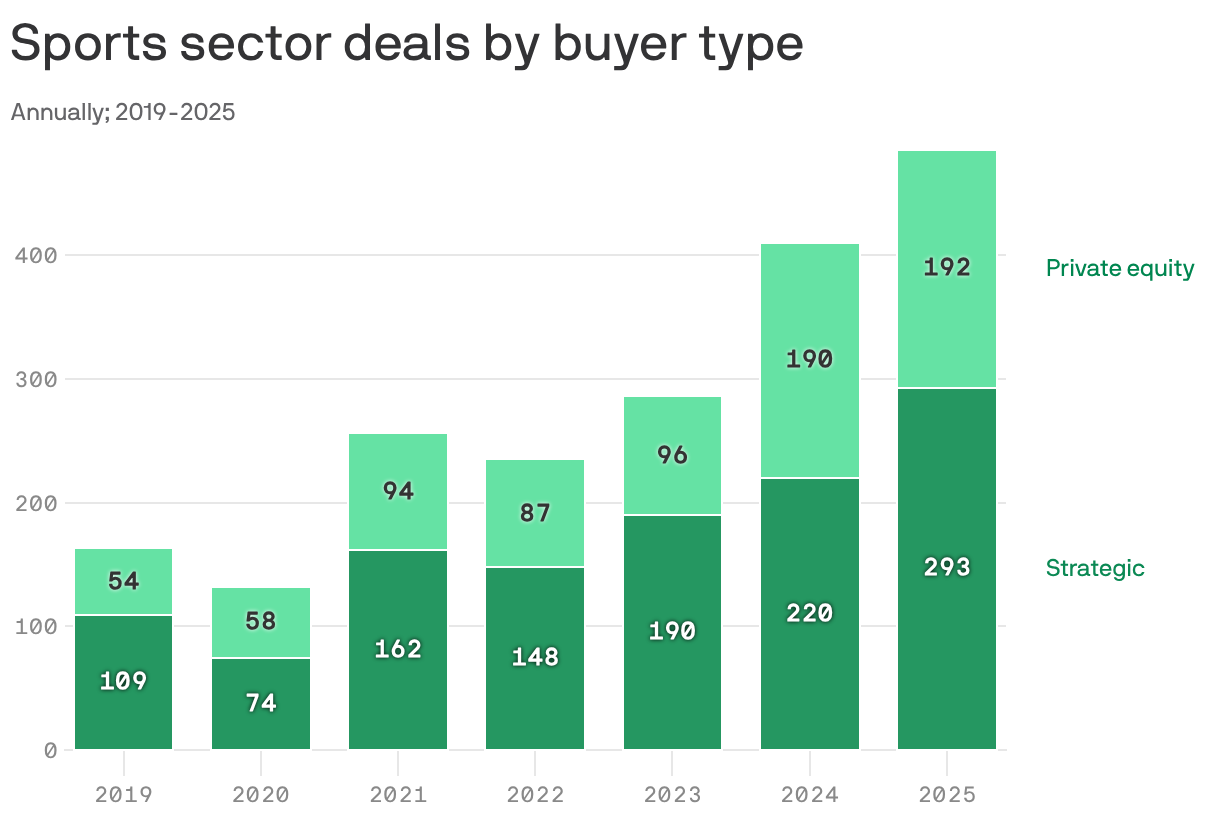
The number of sports deals has tripled since 2019 as more private equity firms, billionaires and strategic buyers pour money into the industry.
Why it matters: Sports offers an endless supply of premium content but with a finite number of franchises.
By the numbers: Global sports M&A reached 485 transactions in 2025, up from 163 in 2019, per Oaklins research citing Mergermarket.
- Private equity dealmaking in sports nearly quadrupled between 2018 and 2025, rising from 50 to 192 transactions annually, per Deloitte, largely because leagues relaxed ownership rules.
Zoom in: Teams, especially emerging women's franchises, are valued beyond what their cash flow justifies as investors bet on scarcity and long-term appreciation.
- Average sports franchise valuations grew at a 14% annualized rate from 2020 to 2025, according to a recent Goldman Sachs report.
The bottom line: "You've got billionaires that are popping up left, right, and center ... and you've got a fixed number of 'toys,'" says Carlos Jimenez, global head of media, sports and entertainment at Moelis, referring to sports teams.
5. 🍸 Bond's billion-dollar benchmark


In casting Robert Pattinson as the next James Bond, Amazon MGM Studios is betting on a household name with a proven box office record over a newcomer who could grow with the role and redefine the franchise for a new generation.
Zoom out: The next installment of Bond is a major test for Amazon, as it marks the first time it will distribute the film since acquiring MGM for $8.5 billion in 2022 and taking full creative control of the Bond franchise in 2025.
- Amazon hasn't announced an exact date but is aiming for a 2028 release of the next Bond installment.
- There hasn't been a Bond movie since Daniel Craig's last portrayal of 007 in 2021's "No Time to Die."
Zoom in: At 40, Pattinson is the first millennial to be cast as Bond and the seventh man to take on the role.
- The British actor got his start as a teen heartthrob in the Twilight saga before expanding to leading roles in films like Matt Reeves' "The Batman" and more recently Christopher Nolan's "The Odyssey."
Reality check: Suiting up for Bond comes with ample commercial pressure.
- Adjusted for inflation, each actor who portrayed Bond in more than two films has netted more than $1 billion in lifetime gross.
- Sean Connery's 007 films have grossed nearly $2 billion, while the most recent era featuring Daniel Craig drove $1.5 billion.
The bottom line: As The Ringer's Adam Nayman neatly puts it: "James Bond Needed Robert Pattinson, but Robert Pattinson Didn't Need James Bond."
6. 1 fun thing: PR blunders turn viral gold
Axios Media Trends

Sara Fischer’s inside look at the forces reshaping media.