
Axios Media Trends

October 07, 2025

Good afternoon. Today's Media Trends, edited by Christine Wang and copy edited by Sheryl Miller, is 2,087 words, an 8-minute read. Sign up.
📺 NEW: The latest episode of "The Axios Show" is out now, featuring bestselling author and podcaster Mel Robbins. Watch on Axios … Subscribe to our YouTube.
1 big thing: 🇬🇧 Scoop... Economist stake sale
British philanthropist and investor Lynn Forester de Rothschild has put her family's entire 26.7% stake in The Economist up for sale, a source familiar with the transaction process told Axios.
- The sale process officially kicked off in London Monday night, a source tied to the transaction said.
Why it matters: A sale would mark the biggest ownership shake-up for the 182-year-old publication in a decade.
State of play: Previous reports suggested she planned to only sell her part of the stake, around 20% of the company.
- The family's stake includes around 20% in voting shares, which is the cap for any single owner in the business.
💰 By the numbers: The sellers anticipate the family's full stake to be valued at up to £400 million, or $537 million, according to people familiar with the deal.
- At the high end, the stake sale could value the entire Economist Group at roughly £800 million, or around $1.1 billion, a source said.
By comparison, the last major transaction involving the company valued the outlet at roughly £1.1 billion, or around $1.5 billion.
- Pearson, a British education publisher, sold the majority of its 50% stake in the publication in 2015 to Exor, the holding group of the wealthy Italian Agnelli family, for £469 million, or $531 million.
- Today, Exor holds a roughly 43.4% stake in the company. Other shareholders, including The Economist Group itself, own 29.9%.
Between the lines: The Rothschild family's advisers are already engaged in conversations with U.S.- and U.K.-based buyers, mostly family offices, high-net-worth individuals or strategic investors that Rothschild believes would want to invest in the publication and maintain its editorial independence.
- The process is being led by the financial advisory and asset management firm Lazard, which was previously reported by Bloomberg.
- The sellers hope to complete the sale this year.
📕 Zoom out: Founded in 1843, The Economist Group has remained a crown jewel of independent business publishing throughout decades of digital disruption.
- The company now has 1.25 million subscribers, 66% of which are digital only. That's up from 1.1 million subscribers in 2021, but at that time, only 44% were digital only.
- In its latest public earnings report, the company reported annual revenue of roughly £369 million, or $495 million, and a profit margin of roughly 17%.
2. 👀 The Free Press payoff
It's unclear whether Paramount Skydance CEO David Ellison's rationale for buying The Free Press and naming its co-founder Bari Weiss the top editor of CBS News is personal, political or both.
- What we do know is that it's certainly not financial.
💸 By the numbers: The deal values The Free Press at $150 million, roughly 10x its annual revenue — an extraordinary multiple for a media startup built on Substack.
- ⏪ The last time a buzzy digital media startup sold at a 10x multiple was when German media giant Axel Springer bought Business Insider for $442 million in 2015.
Why it matters: There's no question that the deal — alongside a slew of other measures taken to shift CBS' editorial position further to the right — will prove useful as Ellison looks to pursue bigger deals, like a possible takeover of Warner Bros. Discovery.
Case in point: Wall Street analysts rarely have much to say about small-scale deals, but Raymond James analyst Ric Prentiss said in a note to clients yesterday that the acquisition "will continue to establish goodwill for PSKY within the Trump administration."
- "We believe this deal is another signal of PSKY's commitment to creating a news organization that in its view will be more fair and balanced, as well as less left-leaning," he wrote, noting the company's intention to buy Warner Bros. Discovery.
🤝 The big picture: Under pressure from Big Tech, media companies are consolidating to survive, but those deals are making smaller news assets vulnerable to being leveraged as political chess pieces.
- A few years ago, it would've been wild to imagine President Trump backing Univision, a onetime left-leaning voice for Latinos, in a pay-TV dispute with YouTube TV.
- But the company has ingratiated itself with the Trump administration after being taken over by Mexican media giant Televisa in 2022.
- Over the weekend, the president urged YouTube TV to restore access the network, calling it "VERY BAD for Republicans in the upcoming Midterms."
3. 📰 News cuts stabilize while broader media industry struggles
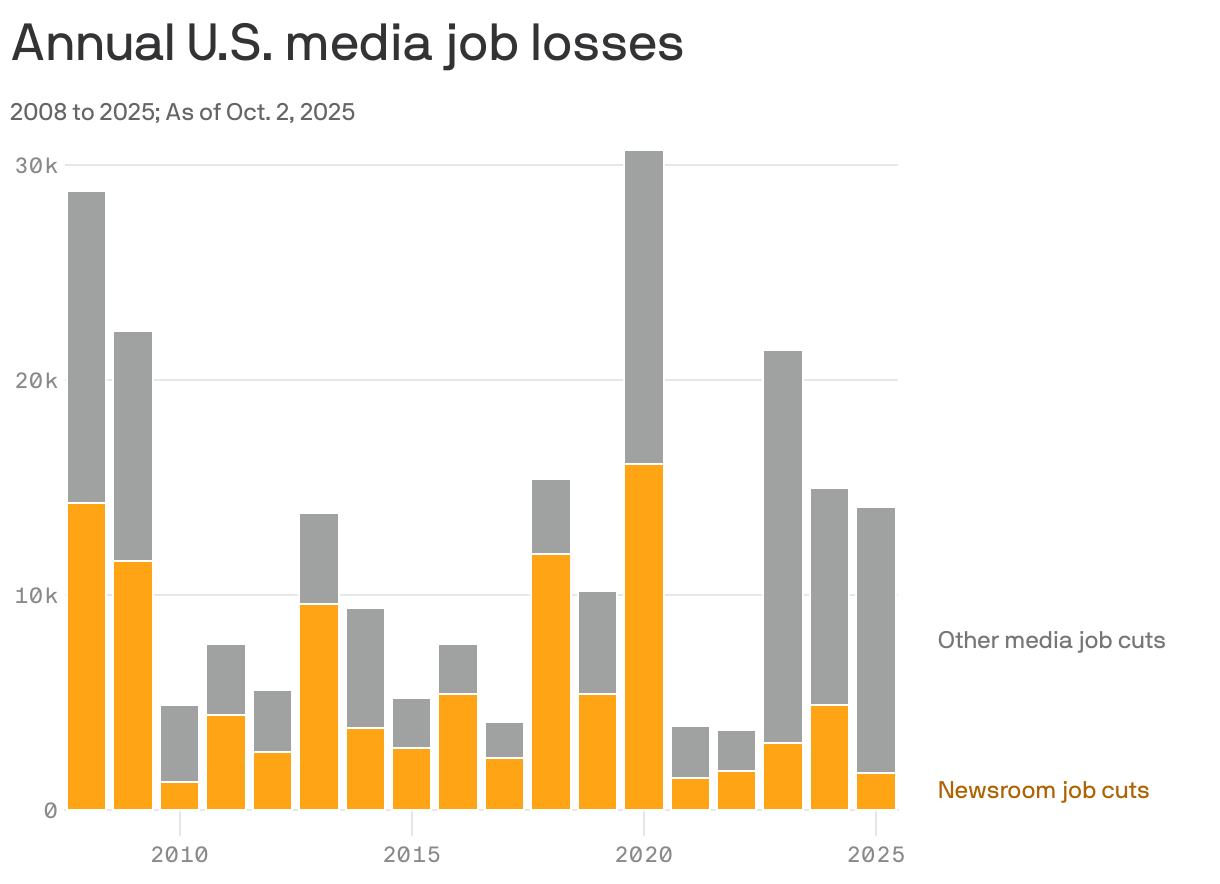
News media job cuts are much more tempered so far this year compared to last, despite a few outlier organizations that are being impacted by public funding cuts and looming layoffs tied to consolidation.
Why it matters: 2024 was a particularly brutal year for the news industry, as outlets raced to cut positions in an attempt to offset a weak ad market and get ahead of business disruptions from artificial intelligence.
By the numbers: News organizations have announced 1,738 cuts so far this year, down 49% from 3,402 cuts announced at the same point last year, according to a new count from executive business firm Challenger, Gray & Christmas.
- In total, more than 4,000 news jobs were lost in 2024. While that number was very high compared to the three years prior, it pales in comparison to the more than 16,000 jobs cut in 2000, a record high.
Between the lines: A huge portion of news job cuts can be attributed to Congress voting to cut public media funding.
- So far this year, more than 400 employees at public radio and TV stations have lost their jobs in response to federal funding cuts, per NPR.
Zoom out: Looking more broadly at the media industry — which includes roles at streamers, studios, news and more — job cuts are up.
- There have been more than 14,000 jobs so far this year, up 9% from this same point last year.
- Production challenges facing the film industry have made a huge dent in LA's entertainment workforce, per the Wall Street Journal. There were around 100,000 people working in the motion picture industry at the end of last year, compared to 142,000 two years prior.
What to watch: President Trump's announcement last week that he still plans to impose tariffs on foreign production could complicate media employment further.
- While the measure is meant to help bring movie production jobs back to the U.S., it could inadvertently cut off significant revenues to U.S. film studios, which in turn could mean more jobs lost.
4. 🇨🇳 China's propaganda machine

America's pullback from the global information war has left an opening for the Chinese Communist Party to ramp up investments in state-backed propaganda, Axios' Kerry Flynn and I report in a briefing for Axios Media Trends Executive members.
- Why it matters: For decades, China's propaganda efforts centered on spreading a positive image of the CCP. But post-COVID, the CCP has focused more on spreading disinformation by strategically targeting its adversaries, mirroring the approach long championed by Russia and Iran.
🇨🇳 State of play: China has been ramping up its investments in propaganda outside of the mainland for years, but it's faced challenges in Europe, Africa and the Global South trying to compete with U.S.-government-backed information and influence operations.
- At the same time, a slew of actions by the U.S. government and private sector are leaving the field wide open for exploitation. That includes the Trump administration's gutting of several agencies, including Voice of America and USAID, that aimed to counter Chinese propaganda.
📱 The Trump administration's decision not to enforce a law banning TikTok in the U.S. speaks to a broader unwillingness by the West to cut off Chinese consumer tech the way U.S. tech is throttled on China's mainland.
- That leaves U.S consumers and companies vulnerable to data security breaches and content manipulation.
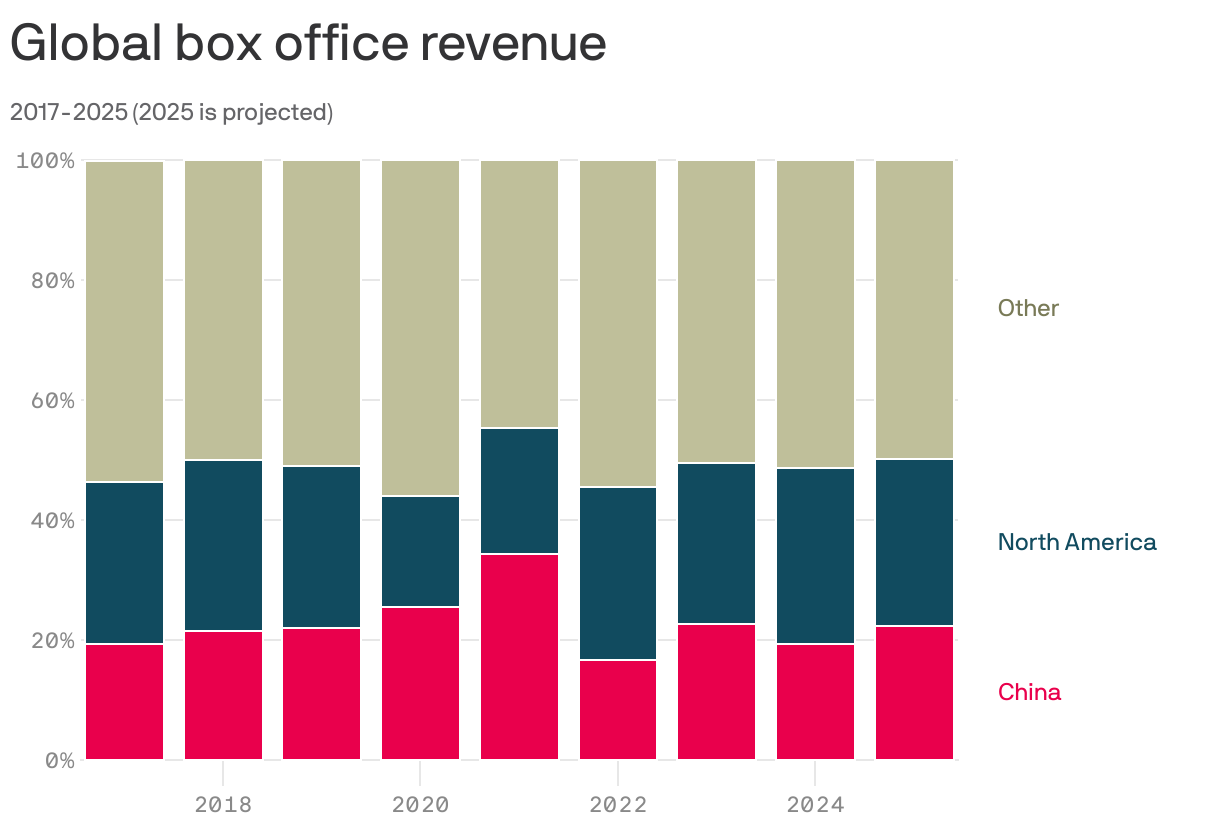
🎥 Film front: In just over a decade, China has proven it can sustain its box office with domestic productions and compete with Hollywood globally.
- The strategy has reshaped the global movie business and could grow even more complicated as the Trump administration threatens new tariffs on foreign films.
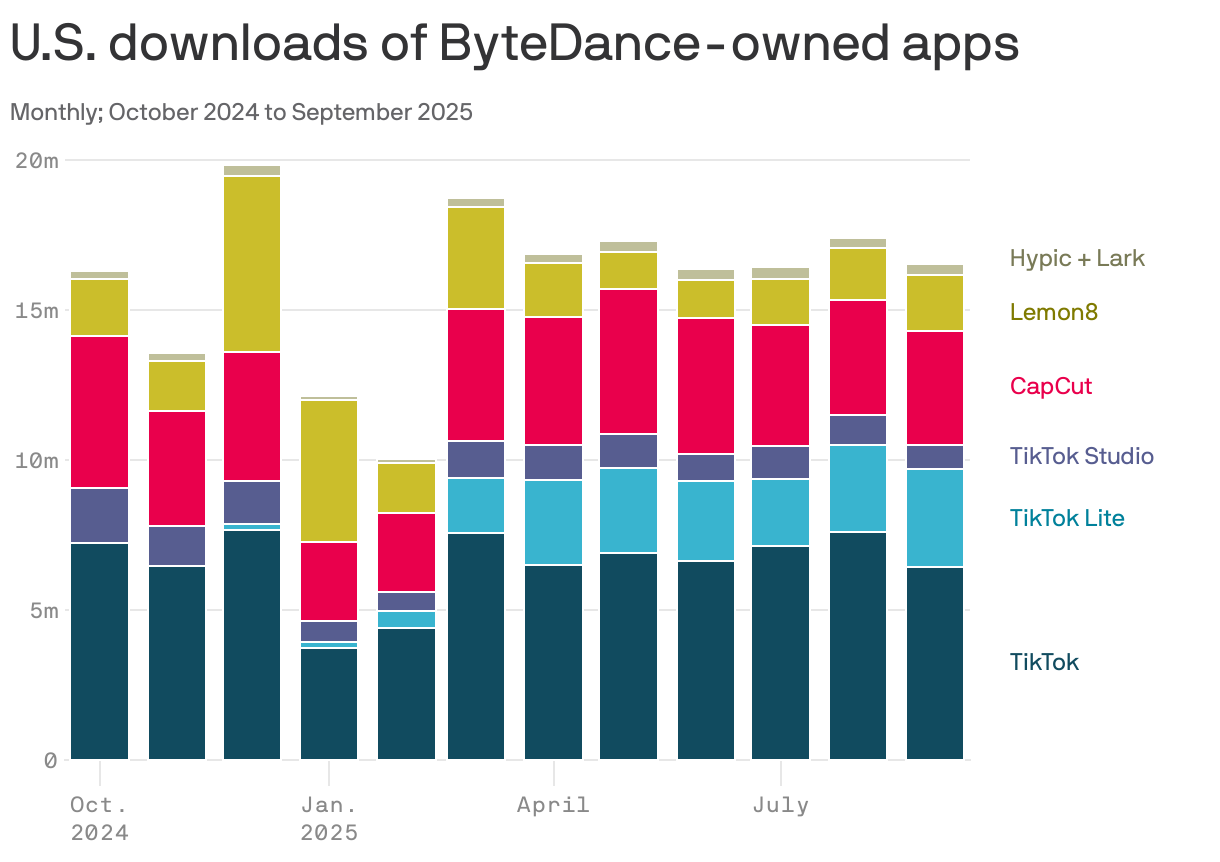
- Ban transcends TikTok: The majority of downloads of ByteDance-owned apps in the U.S. this year go beyond the main TikTok app, according to Apptopia data. These include TikTok Lite, the popular lifestyle-focused video and picture app Lemon8, and the video editing/design app CapCut.
📈 Ads ascending: China's digital ad industry continues to expand globally, fueled by mobile platforms that are innovating in live shopping and short-form entertainment.
👀 Get the data: Membership to Axios Media Trends Executive gives media leaders exclusive access to actionable data and intimate events.
- Join here to read the full members-only executive briefing on China's propaganda machine.
5. 🗣️ Shutdown talkers


Congressional leaders are not talking to each other during this government shutdown, but they're being extra chatty on the airwaves — especially House Speaker Mike Johnson (R-La.).
Why it matters: Both sides are adamant the other party is to blame for the shutdown.
- Convincing the American public is the best leverage any leader can have for shutdown-ending negotiations, Axios' Stef Kight writes.
Zoom in: Johnson has appeared in TV interviews at least twice as often as his three peers in the "Big Four."
- Fox News and MSNBC received the most leader love, with six leader "hits" since the shutdown.
- All six on Fox were by Republicans, while Johnson appeared once on MSNBC.
- CNN and Fox Business have had four appearances each.
6. 📉 Media trust hits new low
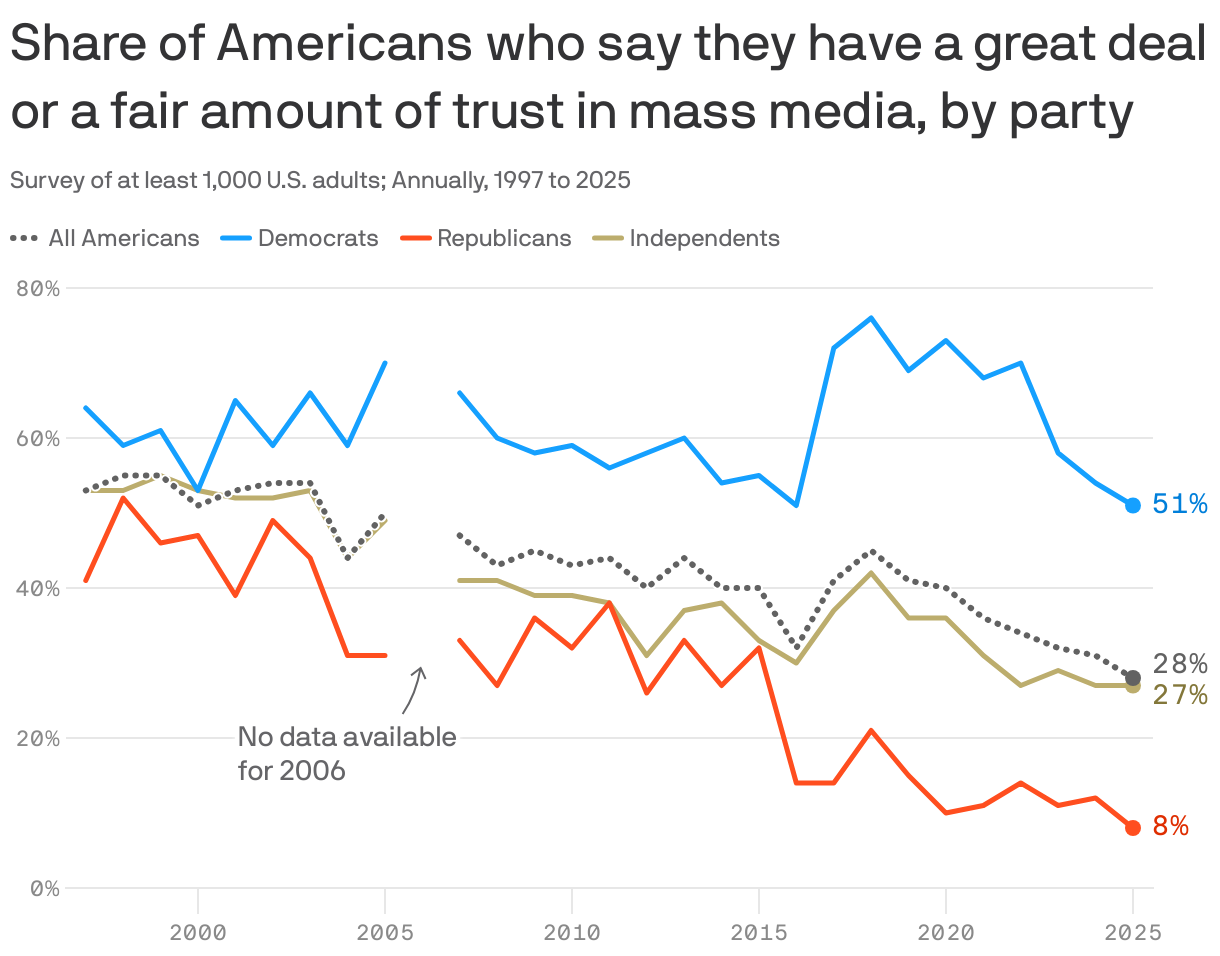
For the third year in a row, the share of Americans who say they have a great deal or a fair amount of trust in mass media has fallen to a record low, according to a recent Gallup survey.
- Only 28% say they have a great deal or a fair amount of trust in the mass media, down from 68% in 1972.
🗳️ Trump's 2016 election drove a historically wide gap between Democrats' and Republicans' trust in mass media.
- That gap has narrowed, as Americans across the spectrum now report record-low trust.
🧒 A steep fall in trust among partisans and younger people has driven most of the overall decline.
- In the past three years, trust in mass media has fallen by 19 percentage points among Democrats and 6 among Republicans.
- The share of Republicans who say they have "no trust at all" in the media has also risen sharply over the past few years, from less than 30% in 2015 to 62% in 2025.
🗞️ While trust in most civic institutions has fallen over the past two decades, media remains the least-trusted institution measured by Gallup.
7. 💫 Taylor's rare press blitz

Taylor Swift has been on a rare press blitz following the release of her new album, "The Life of a Showgirl," which has already broken streaming and theatrical records.
Why it matters: Swift is re-engaging in person with traditional media after years of speaking directly with her fans through her social media and on "The Eras Tour."
💃 Driving the news: Swift's interviews in the past week include "The Tonight Show Starring Jimmy Fallon," "Late Night with Seth Meyers," "The Graham Norton Show," BBC Radio 1, and "The Morning Mash Up" on SiriusXM 1.
- While Swift is not new to late-night TV or radio, these appearances have been the most concentrated round of interviews since "The Eras Tour" began in 2023.
🎤 Zoom in: During her appearance on Fallon, Swift addressed several rumors about her, including speculation that she had turned down the Super Bowl halftime show.
- "Jay-Z has always been very good to me," she said, noting that informal conversations sometimes come up between their teams.
💿 By the numbers: The album's release is breaking records, despite mixed reactions from critics.
- The album has already broken sales records, with 2.7 million digital and physical copies in 24 hours. That feat surpassed her previous record of 2.6 million units sold in the first day of release for her previous album, "The Tortured Poets Department."
- Spotify says her new hit, "The Fate of Ophelia," marked most-streamed song in a single day in the streaming service's history when it debuted Friday.
- "The Official Release Party of a Showgirl" — a theatrical event where Swift premiered a new music video, lyric videos and commentary for each track on the album — has brought in more than $50 million at the global box office this weekend, a record for a weekend release of an album-debut event, per AMC Theatres.
🎟️ The astounding success of the film is even more impressive, given that Swift only announced the three-day run a few weeks prior, leaving little time for marketing.
Sign up for Axios Media Trends