Axios Media Trends

September 08, 2026

Hello! Today's Media Trends, edited by Christine Wang and copy edited by Sheryl Miller, is 2,011 words, a 7½-minute read. Sign up.
NEW: Hearst CEO Steve Swartz will join us on stage at our annual Axios Media Trends Live event in NYC on Oct. 20.
- 🎙️ He'll join FCC commissioner Anna Gomez, Versant Media CEO Mark Lazarus, iHeartMedia chair and CEO Bob Pittman, WSJ editor-in-chief Emma Tucker, Anonymous Content president and CEO Darren Walker, and more to come.
- Purchase tickets here.
Situational awareness: The 59th season of "60 Minutes" returns this Sunday, marking a pivotal moment for CBS News editor-in-chief Bari Weiss and the program's newly installed executive producer Nick Bilton.
- The show has been on a hiring and promotion spree as new leadership looks to put their stamp on television's most storied news program. More details.
1 big thing: 🔒 Cable's paywall tribes

Cable news giants are broadening their pitch to paying subscribers beyond politics, building new products around lifestyle, identity and community.
Why it matters: As the cable business shifts from bundled distribution to individual subscriptions, political affinity alone may not be enough to get consumers to pay.
- Bundling lifestyle offerings with political identities can deepen loyalty but also risks furthering ideological entrenchment.
📺 Driving the news: The rollout of MS Now's new membership program tomorrow will mark the latest subscription program offered by a major cable news network, each focused on selling a very different lifestyle.
- The new offering, which will cost $7.99 monthly or $79.99 annually, is built to offer MS Now's progressive audience a safe space to engage with MS Now's talent and process high-paced news cycles.
- The membership will lean heavily into community events and exclusive Q&A's with on-air talent. It will include a partnership with the meditation app Calm to offer an exclusive collection of guided meditations created specifically for paid members.
🙏 Zoom out: Fox Nation, which debuted in 2018, is also focused on creating an exclusive space for its most passionate audiences, except its focus leans much more heavily into faith and family lifestyle programming.
- It launched a Fox Faith vertical in 2024 with exclusive programming that includes bible study hosted by on-air talent Ainsley Earhardt and a series from anchor Shannon Bream that uses biblical stories to discuss motherhood and family relationships.
- CNN launched its first of several expected lifestyle apps, CNN Weather, in May. Fox launched a weather app in 2021.
- CNBC launched its Investing Club With Jim Cramer subscription for retail investors in 2021. The business news network has indicated it will expand coverage of areas beyond financial markets, like sports, wealth and women's leadership, with dedicated newsletters.
The bottom line: Newspapers have used lifestyle coverage of things like games and sports to attract subscribers for years. Facing pressure to go direct to consumer, cable networks are borrowing from that playbook.
2. 📊 Don't get used to this

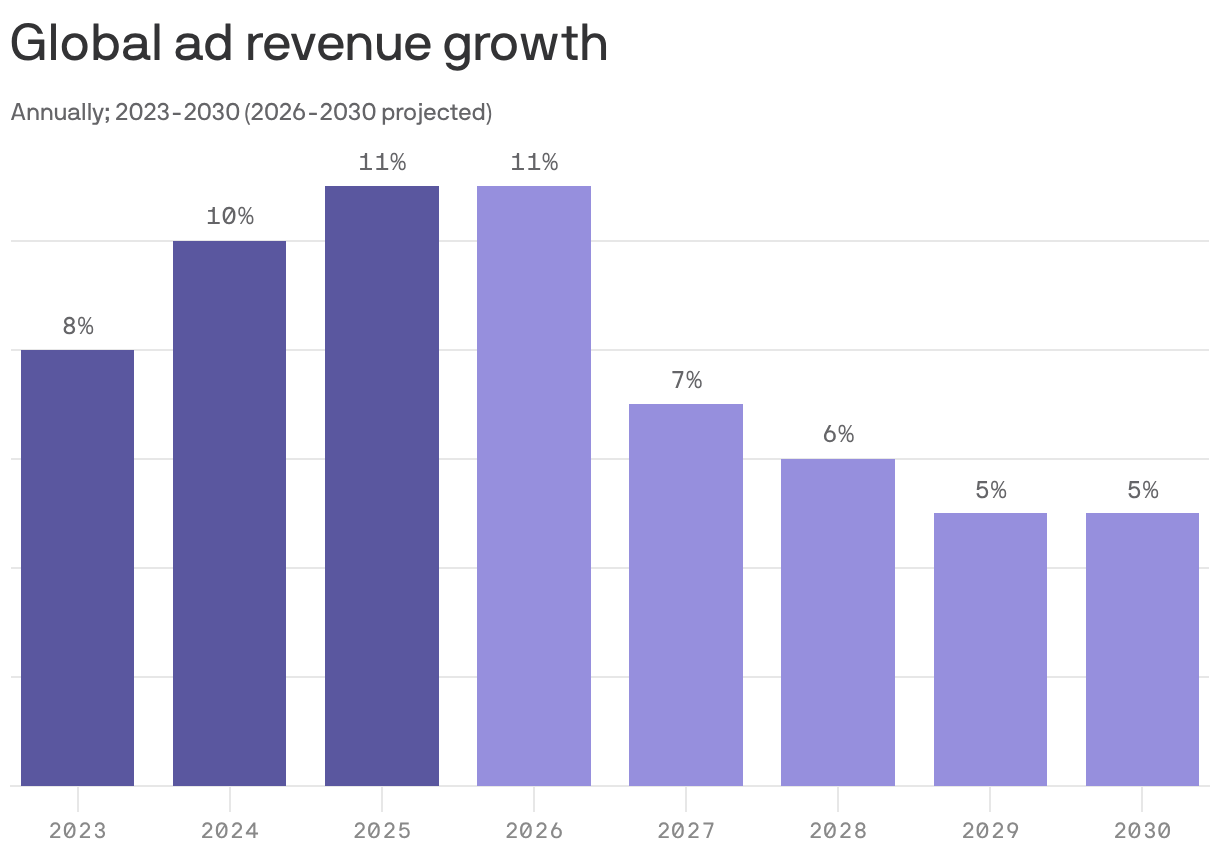
The global advertising market is growing at near-record levels, thanks to the onslaught of AI-driven ad investments, according to a new projection from analysts at Madison and Wall.
Why it matters: While those growth levels aren't sustainable, the market isn't expected to crash in coming years.
- "I don't know if I would call it a bubble, but we don't expect this kind of growth to persist in the future," said Luke Stillman, managing director at Madison and Wall.
💸 Zoom in: Stillman, alongside Madison and Wall CEO Brian Wieser and managing director James McDonald, believe some of the current enthusiasm around capital expenditures can create tougher conditions on the future ad market.
- Huge investments in AI by major advertising giants like Meta, Alphabet, Amazon and Microsoft could put pressure on long-term interest rates, which can hamper ad spending.
- And of course, any time there's outsized growth in the ad market, year-over-year comparisons become tougher.
🔭 Zoom out: Growth across the ad market was initially projected to stabilize and grow in the mid-single-digit percentages between 2026 and 2030 following a period of major volatility after the pandemic.
- Now, that period of normalized growth is expected a little later.
- While the AI advertising surge has been consistent for the past 18 months, optimistic projections last year were partially offset by concerns around tariffs and the global economy that never played out to worst fears.
What to watch: Wieser said tempered projections take into consideration the uncertainty in markets and the macroeconomic environment.
- From a planning perspective, a mid-single-digit percentage growth rate is what he said should be the "true north."
3. 👻 Exclusive: Snap biz shake-up

Snap Inc. today announced Ronan Harris, president of EMEA at Snap, would be promoted to a new role as chief commercial officer, replacing the company's outgoing chief business officer Ajit Mohan, according to CEO Evan Spiegel's note to employees.
Why it matters: Snap has experienced a lot of turnover in its top commercial role over the last few years, but it's posted strong growth recently amid improvements to its ads platform.
🤑 Zoom in: Harris, who has been with Snap since 2022, will report directly to Spiegel and will oversee all of the company's ad sales and go-to-market efforts.
- Under Harris' leadership, Snap has experienced 10 consecutive quarters of double-digit revenue growth in Europe, the company's second-largest market.
Zoom out: As part of the shake-up, Snap is restructuring some of its units to put a greater emphasis on engineering and ad products.
- According to a source familiar with the changes, ad product will move under engineering.
🕶️ What to watch: Snap will officially unveil its new Specs AR glasses next week at an event in California.
- In a letter to employees today, Spiegel said, "Growing our ads business faster will make us stronger and increase the odds of our asymmetric bet on SPECS paying off."
4. Historic NYT v. OpenAI copyright battle heats up

A landmark copyright lawsuit filed by the New York Times against OpenAI and Microsoft in 2023 moved into a critical new phase Friday, as all three parties presented their official arguments to a judge, with hopes of a favorable ruling ahead of a possible trial.
Why it matters: A ruling in favor of the Times could wreak havoc on the lucrative business models underpinning the AI industry.
- A ruling in favor of OpenAI and Microsoft would serve as a massive blow to the publishing industry, potentially undermining its ability to control and monetize how content is scraped and used by AI giants.
Zoom in: In its motion for summary judgment, the Times argued OpenAI and Microsoft copied its works at scale to build commercial substitutes, which it believes violates the law.
- OpenAI argued existing copyright laws and legal precedents allow tech giants to scrape publicly available works to train their large language models, and that reported facts are not protected by copyright law.
- It cited studies that suggest outputs to queries via ChatGPT do not create commercial substitutes of the Times' work. Microsoft made similar claims for its Copilot AI product.
Zoom out: Around the world, the case is being closely watched as a groundbreaking legal precedent that could shape the future of the AI industry.
- This is especially true for the Trump administration, which has publicly tied its national security and economic goals to the development of AI infrastructure.
- On Thursday, the Justice Department filed a brief supporting OpenAI in the case, arguing training large language models from millions of digital works delivers a transformative public benefit that offsets any competitive harm to the publishing industry.
What to watch: District Judge Sidney Stein is expected to rule in the coming months whether the case, or key portions of it, should move to trial next year.
Disclosure: Axios and OpenAI have a licensing and technology agreement that allows OpenAI to access part of Axios' story archives while helping fund the launch of Axios into several local cities and providing some AI tools. Axios has editorial independence.
5. ↩️ Publishers go full steam creator
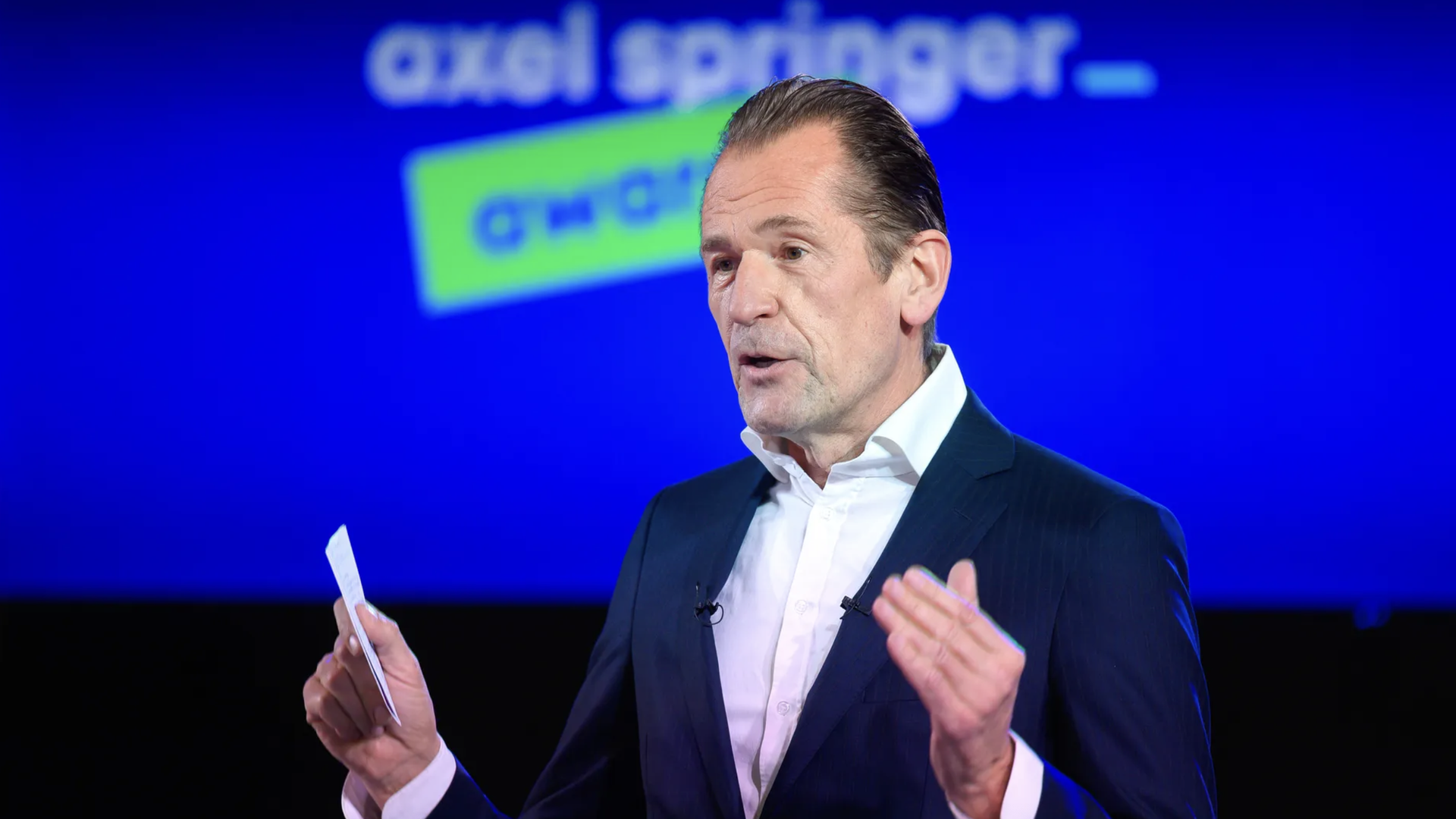
Mathias Döpfner, chair and CEO of German publishing giant Axel Springer, plans to pivot his media business into a "creator platform" over the next several years, he said in an interview today.
Why it matters: It's one of the strongest proclamations any publishing CEO has made to date about pivoting its business model to support individuals over newsrooms.
💿 Zoom in: Döpfner — a former music critic — believes publishing houses may eventually resemble record labels.
- "People follow the talent, but the label represents a certain quality and, in our case, a certain set of values," he wrote.
- "Axel Springer as a creator platform, what we internally call 'United Artists,' is one of the most important strategic transformation goals for our company."
Between the lines: The pivot is notable given how much money Axel Springer has spent acquiring large media brands.
- The company acquired The Telegraph in a £575 million cash deal earlier this year. It acquired Politico in a deal worth roughly $1 billion in 2021. It bought Business Insider for around $450 million in 2015.
Zoom out: Beyond Axel, more newsrooms are eyeing deals to co-create products with independent journalists.
- Yahoo Finance is partnering with former CNBC anchor Deirdre Bosa to launch a new, hourlong daily live video show focused on AI, she told Axios.
- Yahoo Finance will provide a dedicated staff for the show and will build a San Francisco-based studio to support it, said Sean Mills, Yahoo Finance vice president of content.
- The Washington Post last year announced a creator program.
- The Wall Street Journal launched The Talent Lab to help writers strengthen their personal IP.
The bottom line: Creator deals offer a new model for independent journalists that allows them to build their own brands without giving up the distribution, infrastructure and sales support that come with a larger outlet.
- "I could do this from my basement and slowly build an audience," Bosa told Axios. And with Yahoo, Bosa noted she gets access to more than 100 million readers and retail investors that Yahoo Finance says visit the site each month.
Editor's note: This item has been corrected to reflect Mathias Döpfner made his comments in an interview (not an investor note).
6. 1 fun thing: 🍿 Hollywood's hot summer turnaround


Hollywood had its biggest domestic box office haul ever this summer, marking a stunning reversal for an industry that's been plagued with setbacks since the pandemic.
Why it matters: A handful of massive hits have proved that moviegoers of all ages are still drawn to the big screen, as long as it's a cinematic experience or a fan-driven event.
🥇 By the numbers: The summer box office — the start of Memorial Day weekend through the end of Labor Day weekend — brought in $4.7 billion, per Rentrak, narrowly surpassing 2013's record.
- This summer marks the second time since the pandemic that the domestic box office has crossed $4 billion.
- Premium experiences are helping to drive some of that momentum. IMAX had its highest-grossing summer ever, up 73% from its previous record.
📈 Reality check: Most movies tend to trail off a few weeks after their debut, but $2 billion blockbusters drove sustained momentum throughout July and August.
- "Spider-Man: Brand New Day" is on track to bring in $1 billion domestically, and it's already earned $2.4 billion worldwide. Christopher Nolan's "The Odyssey" has surpassed $500 million in domestic sales and more than $1.6 billion worldwide.
- They join "The Super Mario Galaxy Movie," "Michael" and "Toy Story 5" in crossing the $1 billion mark this year — the most number of films to do so in a single year since before the pandemic.
Between the lines: Solid debuts for a few highly anticipated sequels, such as "Toy Story 5," "The Devil Wears Prada 2" and "Minions & Monsters" contributed to Hollywood's summer hot streak.
The big picture: Hollywood's commercial boom comes as the industry rides a few major political wins.
- President Trump last week endorsed a national tax incentive for movie and TV productions in the U.S., a major departure from his previous position of wanting to tax foreign productions.
- The Motion Picture Association struck a global deal with TikTok parent ByteDance to strengthen copyright protections and AI guardrails used in Seedance and Seedream video and image generation products.
🎬 What to watch: Analysts believe the domestic box office will surpass $9 billion this year, a record only achieved in 2023 since the pandemic.
- If it crosses $10 billion, it would represent a major comeback for the film industry.
Sign up for Axios Media Trends