Axios Media Trends

September 16, 2025

Good afternoon. Today's Media Trends, edited by Christine Wang and copy edited by Sheryl Miller, is 2,268 words, an 8½-minute read. Sign up.
🎟️ SOLD OUT: Tickets are gone for Axios' inaugural Media Trends Live event in NYC Thursday, but you can follow the breaking news on Axios.com and by using #MediaTrendsLive on social media.
- Speakers include: NYT executive editor Joseph Kahn, Redstone Family Foundation CEO and chair Shari Redstone, ESPN chair Jimmy Pitaro, actress Tracee Ellis Ross, Snap Inc. CEO Evan Spiegel, PBS CEO Paula Kerger, Condé Nast CEO Roger Lynch, IMAX CEO Richard Gelfond, and many more.
1 big thing: 📰 Free speech shift
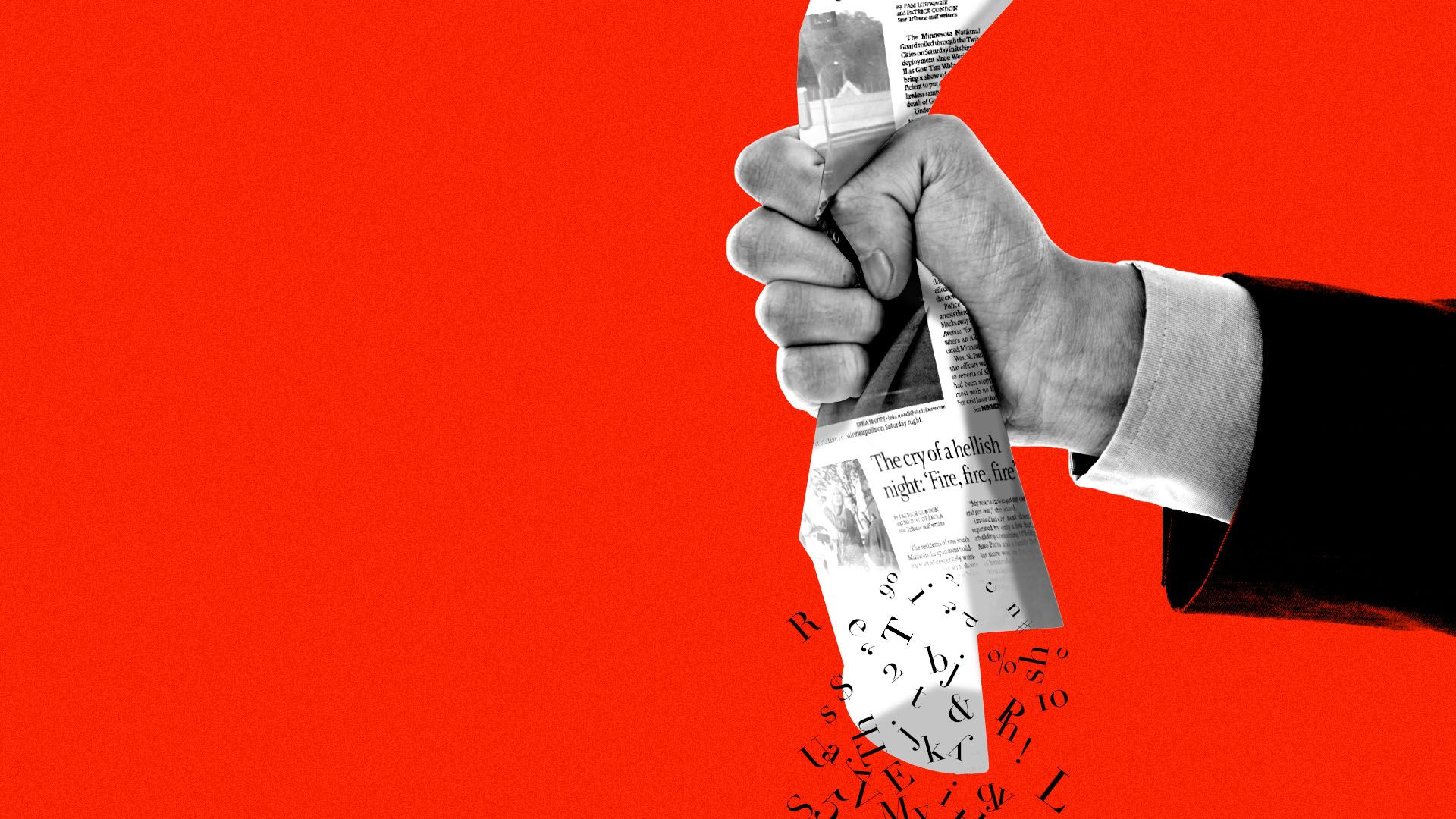
President Trump's $15 billion lawsuit against the New York Times — his fifth complaint against a major news company in the past two years — represents a notable shift in conservatives' approach to free speech issues.
Why it matters: For years, conservatives targeted Big Tech firms for alleged censorship, while criticizing newsrooms but mostly avoiding legal action against them.
- Now that President Trump has Silicon Valley in his corner, he and Republicans are shifting their free speech fight to individuals and news companies. The latter's editorial standards provide less flexibility for ad hoc policy changes.
⚖️ Driving the news: President Trump yesterday filed a defamation lawsuit against the New York Times and four of its reporters, claiming the paper is a "full-throated mouthpiece of the Democrat Party."
- The $15 billion figure is greater than the value of the Times on the public market and could cripple the company, but legal experts say the suit doesn't have merit.
Reality check: The Times — with more legal resources than most newsrooms— could fight the allegation aggressively in court, or it could settle the complaint, just as CBS and ABC News have done in the last year.
📢 Between the lines: While most major news companies have publicly defended themselves and their journalists in the wake of legal attacks, some outlets are taking precautions, possibly out of fear of being targeted by conservatives.
2. Scoop: TikTok yanks antisemitic items from shop

TikTok recently removed at least two articles of antisemitic gear from its TikTok Shop, a spokesperson confirmed to Axios.
🛍️ Why it matters: As the company pushes further into commerce, its content moderation challenges will only expand.
State of play: One T-shirt featured the word "Jews" in bold red lettering above a picture of large nose in an ocean barreling up toward the water's surface — like a shark — with a dollar bill floating in the water.
- Another featured characters in Nazi uniforms that resembled those from the "Minecraft" video game with the word "Neinkraft" underneath.
Zoom in: The T-shirts, viewed by Axios on TikTok Shop before they were pulled, were available for at least a week.
- The accounts selling those items are still listed as active on TikTok Shop. A TikTok spokesperson clarified that accounts that violate certain policies aren't always automatically banned but rather receive strikes.
- They noted that TikTok does take active measures to remove potentially hateful or harmful goods from TikTok Shop, having rejected more than 50 million listings for potential policy violations between June and December 2024.
Yes, but: TikTok isn't alone. Any marketplace company will inevitably face the same sort of whack-a-mole challenge when it comes to content or listing moderation.
- Amazon, for example, has taken heat for antisemitic books on its platform. The e-commerce giant also has a dedicated page explaining its approach to controversial products and content.
- Substack earlier this year apologized for an error that accidentally promoted a Nazi newsletter via a push notification.
Zoom out: TikTok is under enormous pressure to prove it can comply with U.S. safety and security laws. President Trump today again postponed the implementation of a law that bans the app.
What to watch: The Trump administration said yesterday the U.S. and China had reached a framework for a deal to sell the app to an American tech giant, which would keep the app up and running in the U.S.
- Treasury Secretary Scott Bessent said this morning that the president's willingness to let TikTok go dark in the U.S. pushed China to make a deal.
- The deal would see a group of U.S. investors, including private equity giant Silver Lake, venture fund Andreessen Horowitz and Oracle — which currently works with TikTok to secure and host its data in the U.S. — control TikTok's U.S. business, per WSJ. Those U.S. investors would reportedly hold a roughly 80% stake in the U.S. app, and Chinese shareholders would own the rest.
Editor's note: This item was updated with additional context.
3. 🎬 Hollywood studios sue Chinese AI giant

The Walt Disney Company, NBCUniversal and Warner Bros. Discovery filed a joint lawsuit against Chinese AI firm MiniMax today, alleging large-scale piracy of their respective studios' copyrighted works.
🎥 Why it matters: It's the second major AI lawsuit from the firms this year, suggesting Hollywood is starting to take a more aggressive stance in protecting its intellectual property.
- Disney and NBCUniversal teamed up to sue Midjourney, a generative AI company, for copyright infringement in June. WBD joined that legal copyright battle earlier this month.
Zoom in: In the lawsuit, filed in the U.S. District Court for the Central District of California, the companies argue MiniMax disregards U.S. copyright law by treating the studios' copyrighted characters like its own. The parties call MiniMax's copyright infringement "willful and brazen."
- The lawsuit also claims MiniMax used well-known copyrighted characters to advertise the capabilities of its popular image and video-generating service, Hailuo AI.
MiniMax filed for an IPO in Hong Kong in July with an estimated valuation of $4 billion.
4. 🏃♂️ Exclusive: Vox Media star goes independent
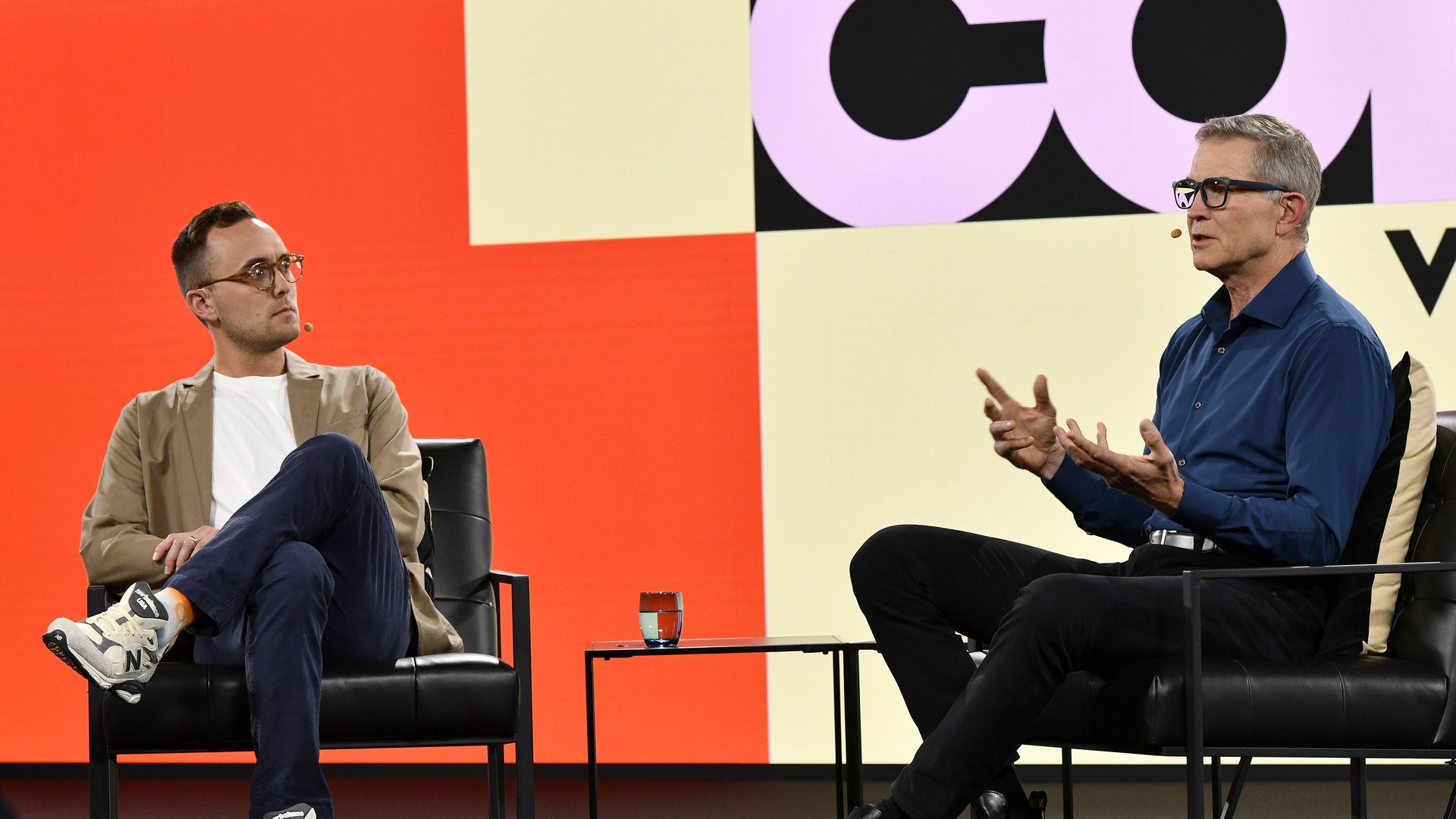
Alex Heath, star tech reporter for The Verge, is striking out on his own, launching a new Substack newsletter Wednesday called Sources, while maintaining a relationship with Vox Media through a new video podcast called "Access" that will be distributed through the Vox Media Podcast Network.
Why it matters: The agreement helps Vox Media maintain access to Heath's brand and journalism while giving him the freedom to grow and monetize his brand independently.
- "We see an enormous opportunity to build these talent-driven, multiplatform franchises," said Ray Chao, SVP and GM of audio and digital video at Vox Media. "We love being the preferred creative and business partner for people like Alex."
🎙️ Zoom in: Heath will co-host the new technology podcast with journalist-turned-tech-executive Ellis Hamburger, in partnership with Vox Media.
- The weekly show, launching Thursday, will feature conversations that bring audiences inside the mechanics of Big Tech companies, with a focus on artificial intelligence.
- The show, which will be available on all podcast platforms, has already landed several big-name interviews with executives such as Meta CEO Mark Zuckerberg and Figma CEO Dylan Field.
How it works: Vox Media will also help sell advertising for Sources and The Verge will syndicate the issue once per week for its subscribers.
- Heath will appear on The Verge's masthead as a contributing writer. He will have the ability to post to The Verge's website and may still join The Verge's podcast or live events.
⏪ Zoom out: Heath has been with The Verge full time since 2021. He has helmed The Verge's subscription tech newsletter, Command Line, since 2023. Hamburger left The Verge as a reporter a decade ago to join Silicon Valley tech startups, including Snap Inc.
The bottom line: "I've been wanting to build something, and it seems like a great time," Heath said. The new arrangement allows him to take advantage of Substack's newsletter support, while leveraging Vox Media's best-in-class podcast infrastructure.
- Being independent also allows him to partner with Hamburger on a podcast, who isn't a Verge journalist.
5. 📺 Prestige TV wars

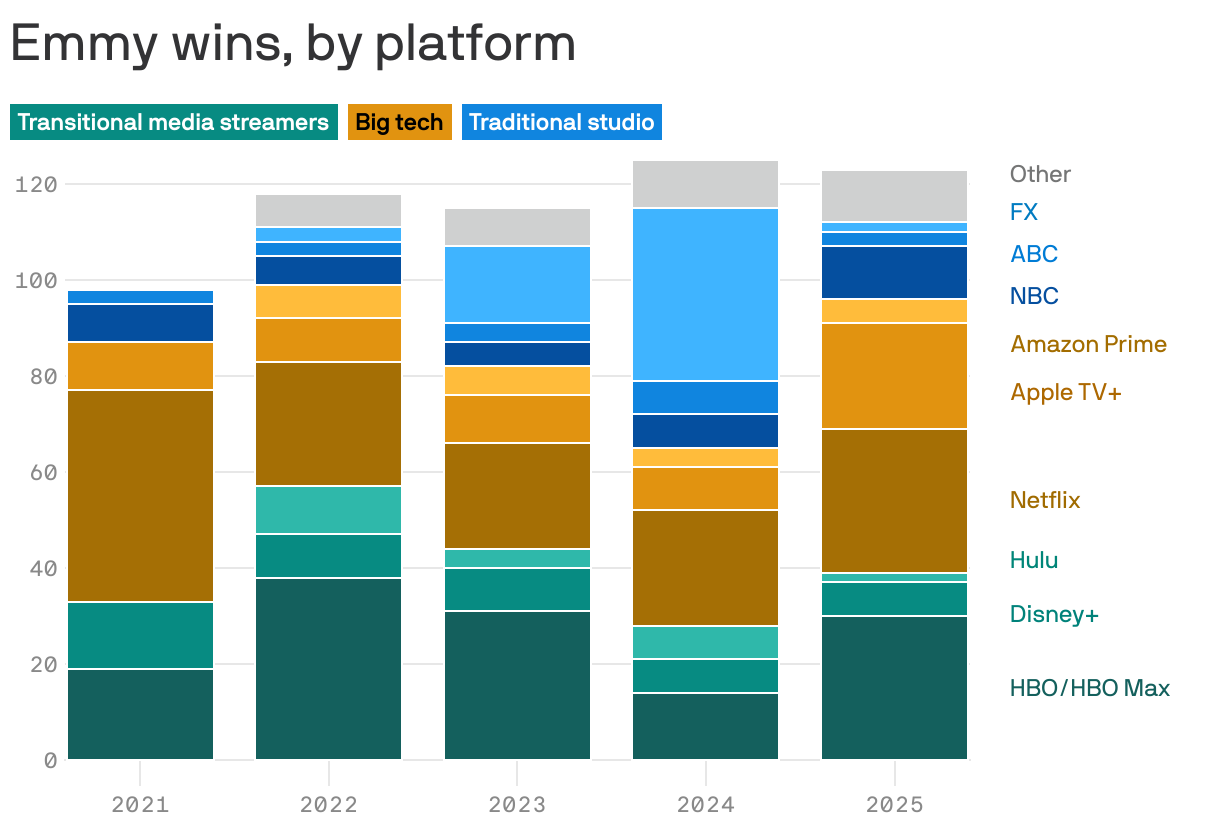
Netflix and Apple are beginning to put pressure on traditional studios for the crown of prestige TV's top producer, with 30 and 22 Emmy wins, respectively.
Why it matters: For years, HBO dominated the Emmys as the gold standard for prestige drama and comedy. But this year's results show power shifting toward Big Tech.
🏆 By the numbers: Apple's "The Studio" edged out HBO's "The Penguin" with the most wins with 13 and nine, respectively.
Yes, but: HBO is still a major force, tying Netflix with 30 awards in total in a significant uptick from last year when it secured only 14 wins.
Meanwhile, Emmy ratings are bouncing back.
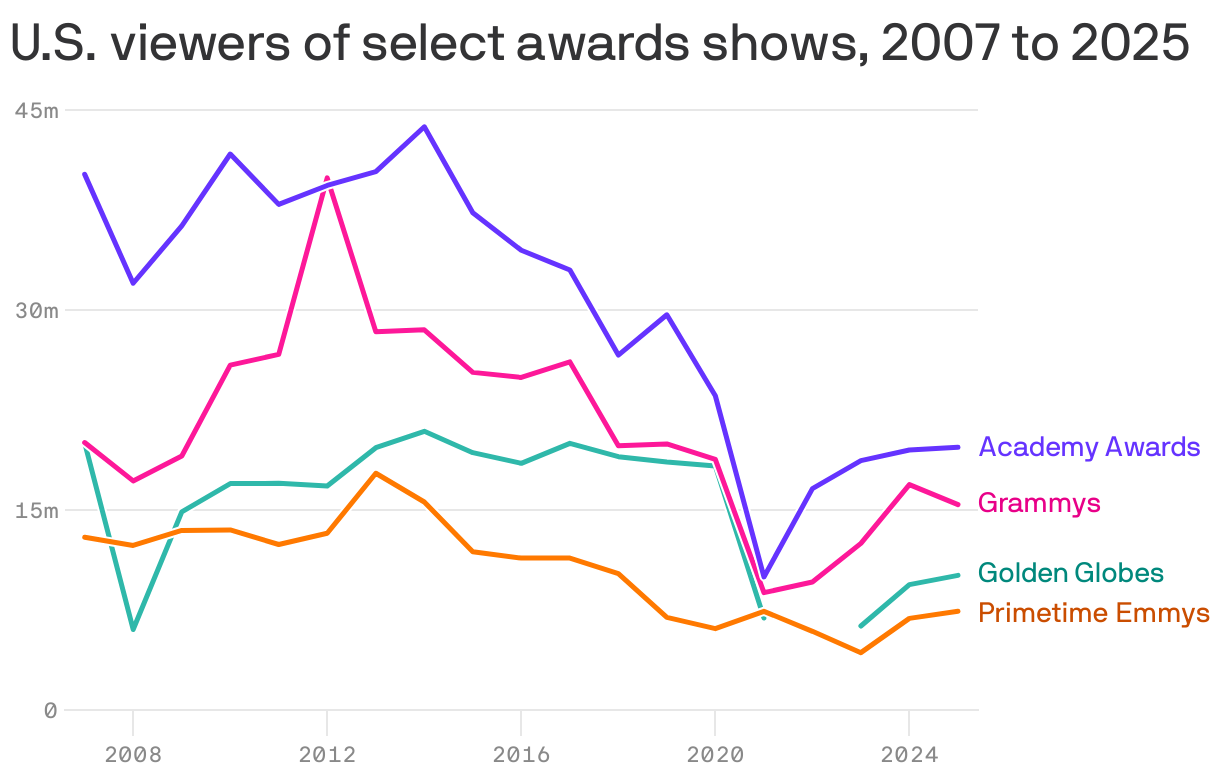
More than 7.4 million people watched the Primetime Emmy Awards on CBS, making it the most-watched Emmys since 2021.
Why it matters: Sunday's program, hosted by comedian and actor Nate Bargatze, saw an 8% increase in viewers over last year's broadcast on ABC.
🍿 What to watch: The Emmys currently rotates between the four major broadcasters — Fox, ABC, CBS and NBC — each year. The show's eight-year broadcast contract expires in 2026.
6. 👀 Hollywood's new power players
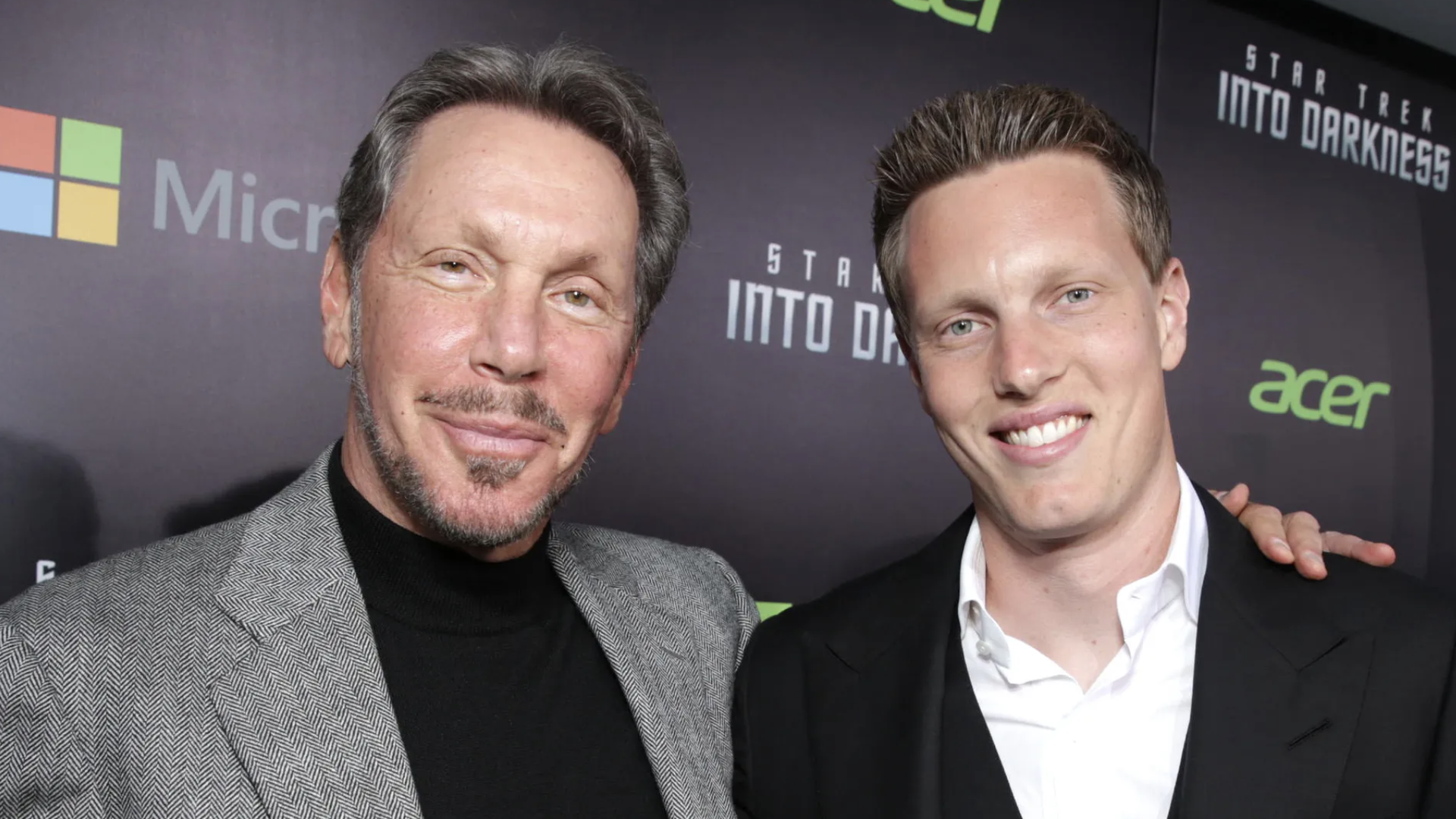
A series of swift deals in recent weeks suggest David Ellison and his father Oracle chairman Larry Ellison are looking to quickly buy their way to the top of Hollywood.
Why it matters: Few moguls have access to enough money to be able to acquire major companies, sports rights and film rights all at once. Fewer have the political capital to get away with a massive media deal blitz in the Trump administration.
- For David Ellison, 42, now is a ripe time to move in on distressed media assets that are struggling to survive in the streaming era.
- Now that his company Skydance Media has finally completed its merger with Paramount Global, he is looking ahead to bigger targets.
🏔️ State of play: Paramount Skydance is working on a cash bid to acquire Warner Bros. Discovery, a source familiar with the discussions confirmed to Axios.
- The deal would give the CBS parent access to another major news network, CNN, and a rival Hollywood studio, Warner Bros. Pictures.
- It would also breathe new life into Paramount Skydance's streamer Paramount+, which — combined with WBD's HBO Max — could better compete with Netflix and Disney for scale.
💸 By the numbers: A deal to buy WBD in cash wouldn't come cheap. WBD is currently valued at around $44 billion on the public market.
- It has $35 billion in debt remaining from the merger of Discovery and WarnerMedia, which formed the current company in 2022.
7. 🏫 Exclusive: The Atlantic to offer free access to all U.S. public schools

The Atlantic plans to offer every public high school in the United States free digital access to all of its digital journalism and 168-year archive, Axios has learned.
The big picture: It's part of a broader effort by news organizations to expand access to students.
- ☕️ The Economist last year made Espresso — its short-form, daily news app — free to over 400 million students worldwide at no cost.
- 📓 The New York Times gives U.S. public schools and students free access through a student sponsorship program.
🧑💻 Zoom in: Beginning this week, all public high schools and districts — including magnet, charter and specialized schools — can register for unlimited access to theatlantic.com, a spokesperson confirmed.
- Access will be authenticated through a user's IP address on campus. Schools can register through The Atlantic's website, but the request must be submitted by either an administrator, librarian or IT professional at the school.
- Students, teachers and administrators will be able to access all of the outlet's digital content, including all articles, full magazine issues, podcasts and audio articles, games, and The Atlantic's complete archive.
Zoom out: The Atlantic has been experimenting with more ways to get its journalism in the hands of educators and students. It's enrolled more than 200 schools, colleges and universities through its academic group subscription, which launched in July 2023.
- There currently aren't any public schools with that group subscription, a spokesperson confirmed.
By the numbers: The new effort will help The Atlantic expand its brand to a younger audience, but the company doesn't plan to include those new readers in its official subscriber count, which currently stands at over 1.3 million.
8. 🗞️ Alden Global raises bid for DallasNews, topping Hearst

Alden Global today increased its takeover offer for Dallas Morning News publisher DallasNews to $20 per share, topping a $16.50-per-share proposal from Hearst.
Why it matters: A bidding war for newspapers seems almost as antiquated as print editions (something Alden is pledging to maintain in Dallas).
📈 Catch up quick: Hearst in July announced an agreement to buy DallasNews for $14 per share. Alden subsequently submitted an unsolicited, nonbinding $16.50-per-share bid, via its MediaNews Group subsidiary.
- DallasNews stuck with Hearst, which yesterday increased its own bid to $16.50 per share.
- Alden now has come back over the top, with a 21% premium to Hearst's latest offer and a 356% premium to where DallasNews shares traded before Hearst's initial bid. It would value DallasNews at around $95 million.
Zoom out: Alden has tried a few times to expand its newspaper dominance through aggressive takeover measures and lofty bids, sometimes unsuccessfully.
- The company made a successful play for Tribune in 2021. It made an aggressive takeover bid for Lee Enterprises — one of the last remaining independent chains of local newspapers — in 2022, but struggled to gain control over the company amid legal blowback.
9. AOL on the block
Apollo Global Management is in talks to possibly sell AOL, a source familiar with the matter confirmed to Axios.
Why it matters: AOL still drives hundreds of millions of dollars of free cash flow, Axios reported in 2023.
Zoom in: Apollo was not actively looking to sell AOL, but the brand's strong performance prompted inbound interest, pushing the firm to more formally evaluate which other buyers could be interested in the asset.
- 💰 The Wall Street Journal first reported on the discussions, noting a deal could value AOL around $1.5 billion.
- 🤝 In 2021, the private investment firmed acquired AOL and Yahoo, which were combined under their previous owners at Verizon.
- 📧 Apollo has since invested in its products, which a source said has helped contribute to engagement growth across its web and mail portfolio.
The big picture: Yahoo and AOL were struggling to grow before they were sold to Apollo. Under their new owners, both companies, but especially Yahoo, have gotten the rare chance to reinvent themselves.
Sign up for Axios Media Trends