Axios Media Trends

October 20, 2026

Good morning. Today's Media Trends, edited by Christine Wang and copy edited by Sheryl Miller, is 2,162 words, an 8-minute read. Sign up.
Today in NYC: Media Trends Live returns for year two, with news-making interviews from...
- 📣 SNL's Kenan Thompson, WSJ's top editor and publisher Emma Tucker and Almar Latour, Trump Media & Technology Group CEO Kevin McGurn, iHeartMedia chair and CEO Bob Pittman, FCC commissioner Anna Gomez, Anonymous Content president and CEO Darren Walker, Versant CEO Mark Lazarus, Hearst CEO Steven Swartz, Range Media Partners CEO Peter Micelli, actress and producer Lena Waithe, and Phoenix Suns and Phoenix Mercury owner Mat Ishbia.
- 📊 Arrive early for a live presentation of our annual report at 2pm ET.
- 📧 Can't make it? Media Trends Executive members will receive a copy of the report by email.
Situational awareness: Joel Kaplan, Meta's chief global affairs officer, will leave Meta next year after 15+ years as Mark Zuckerberg's top Washington advisor, Axios' Mike Allen scoops. Go deeper.
1 big thing: 🫨 Netflix growth reckoning
All eyes are on Netflix as it reports earnings this afternoon following a sweeping leadership shake-up and layoffs.
Why it matters: Netflix has long dominated subscription streaming, but efforts to deepen engagement have come up short.
State of play: Netflix fired chief content officer Bela Bajaria last week and named former Disney and Fox executive Peter Rice as her replacement.
- Days later, it parted ways with film chair Dan Lin, who had been in the role for under three years. (Rice will oversee film while Netflix looks for a replacement.)
Between the lines: Bajaria was informed she was fired shortly after Netflix announced 1,000 cuts to its global workforce, per a memo obtained by Axios.
- While co-CEOs Ted Sarandos and Greg Peters said the company expects to meet investor expectations for its full-year financials, they acknowledged that the company needs a strategic reset to meet growth targets.
Zoom out: The ousting of Bajaria and Lin points to a creative reckoning within Netflix to prioritize its core content offering as it builds out its ads business and monetizes its intellectual property across more touch points.
- The company has invested significantly in new formats, such as live sports, video podcasts, creator content, video games and live events, but it's struggled to turn those investments into meaningful growth drivers.
- According to the Wall Street Journal, only 3.5% of Netflix's subscribers play games monthly, putting Netflix around 10% behind its 2026 reach and engagement goals.
- Netflix's head of live experiences Greg Lombardo announced two weeks ago that he was leaving the company after seven years.
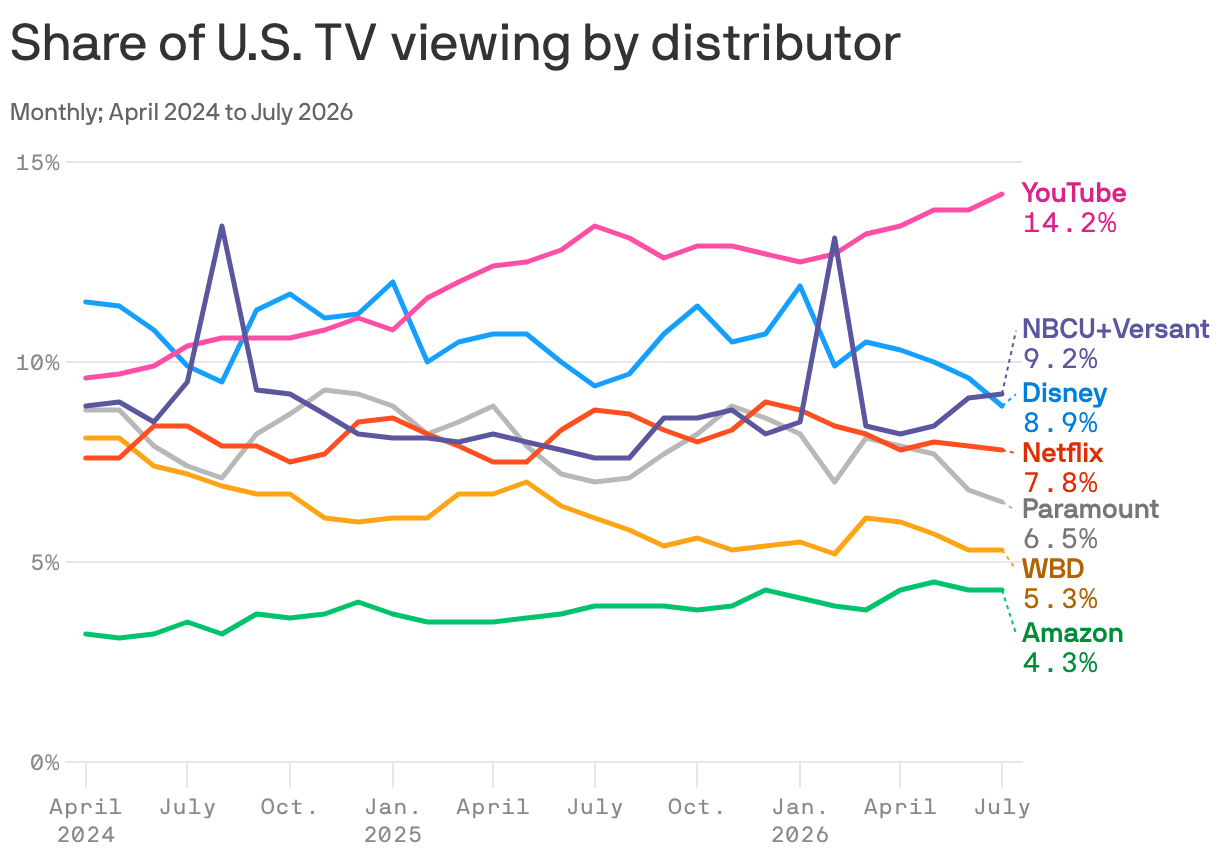
Reality check: Netflix has known it's needed to do something drastic for months, and it essentially conceded as much in its bid for Warner Bros. Discovery.
- Central to Netflix's antitrust defense in that deal was that despite having more than 325 million global subscribers, it still faced fierce competition for audience attention and ad dollars across a wide set of competitive platforms, most notably YouTube.
- Sarandos said last month in a Bloomberg interview that the company is not growing as fast as he would like.


The big picture: Netflix shares have fallen around 43% in the past year and 9% in the past two years, as investors lose confidence in the company's ability to translate its subscription dominance into a long-term growth story.
- While Netflix is still the most profitable streaming business among its competitive set, it's forecasting slower revenue growth this year (13%–14%) compared with the previous two years (15.7% in 2024 and 15.9% in 2025).
2. 🪜 Exclusive: Slate top editor becomes CEO
Slate, the digital news and culture magazine, has named editor-in-chief Hillary Frey as its new CEO, effective immediately, according to a memo obtained by Axios.
Why it matters: More top journalists are moving into executive positions as the news business demands greater collaboration between editorial and revenue operations to survive.
Zoom in: Frey, who was named editor-in-chief of Slate in 2022, will oversee the company's business while continuing to lead the newsroom, according to the memo sent to staffers by Tim O'Shaughnessy, CEO of Slate's parent company Graham Holdings.
- She succeeds Dan Check, who recently left Slate for a new role within Graham Holdings.
- Frey's primary focus will be elevating Slate's editorial products to boost subscriptions, which are the company's largest revenue stream.
Zoom out: Slate, which turned 30 this year, has undergone a digital transformation under Frey's leadership, leaning more heavily into paywalled and direct-to-consumer products.
State of play: Frey's promotion comes at a challenging time for the digital publishing industry, as AI threatens traffic and the subscription business becomes even more saturated.
- In a July regulatory filing, Graham Holdings said Slate reported lower revenue and operated at a loss in the first half of 2026, but it did not disclose the dollar amount of either. The digital magazine employed just over 100 employees as of the end of 2025, per Graham Holdings' annual report.
The big picture: Frey's appointment reflects a broader shift in digital media, where more top editors are moving into chief executive roles, either by appointment or through starting their own companies.
- Nick Thompson, former top editor for Wired, was named CEO of The Atlantic in 2020.
- Fast Company's top editor Stephanie Mehta became CEO and chief content officer of Mansueto Ventures, which owns Fast Company and Inc., in 2022.
- Time named longtime editor Edward Felsenthal CEO in September 2018, he retained his role as CEO and editor-in-chief for several years, until he became executive chair in 2022.
Context: Other former top editors now serve as CEOs of media companies they founded, including Janice Min of The Ankler, Jessica Lessin of The Information, Jim VandeHei of Axios and Anna Palmer of Punchbowl News.
3. 🍿 Instant Gen Z cult classic
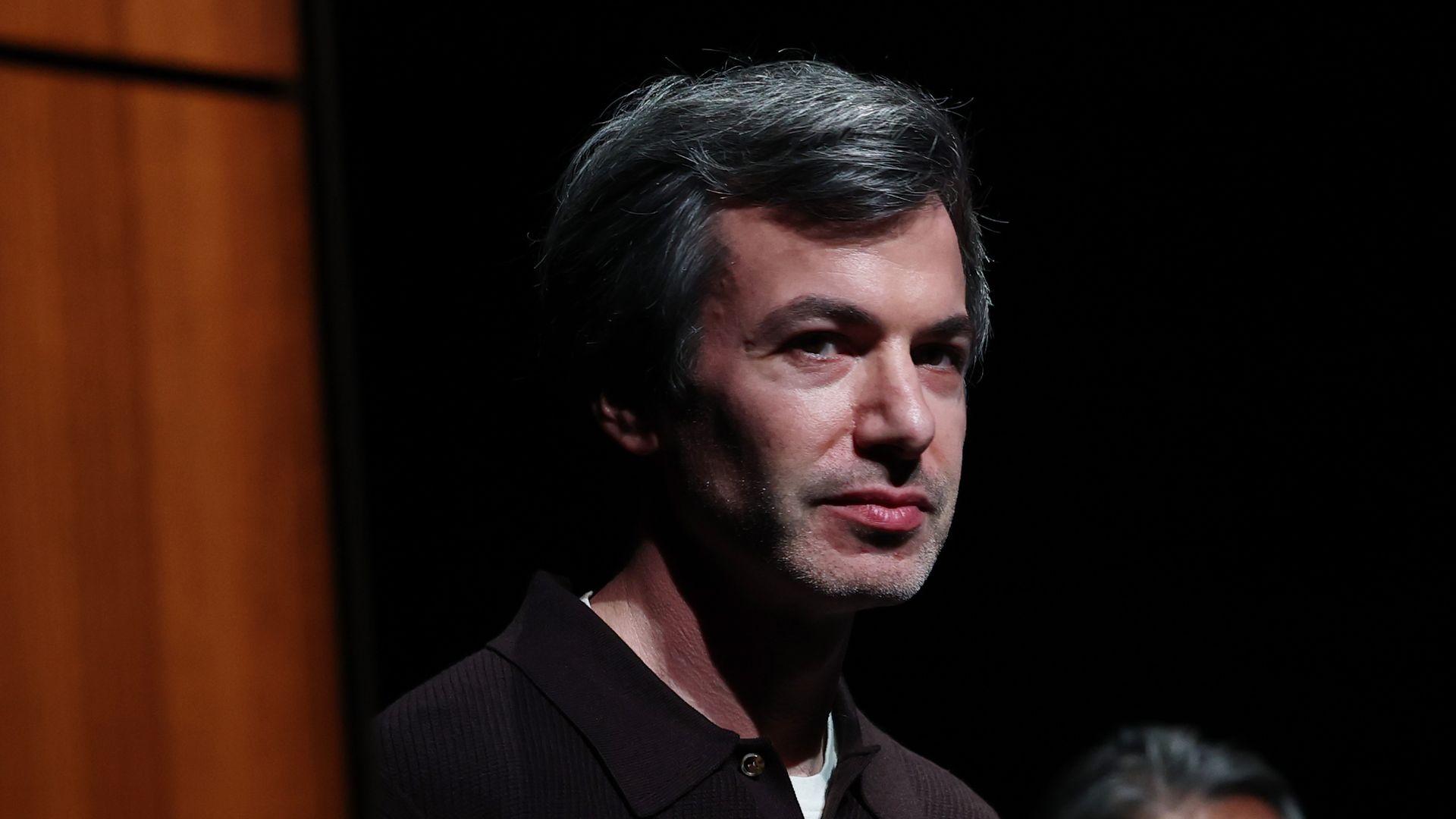
"You Can See Everything" has the early makings of a Gen Z cult classic.
Why it matters: The Nathan Fielder documentary, which debuted with an impressive $15 million at the box office, is already building the kind of obsessive fandom that could give it a long afterlife.
Zoom in: The film, which has had the highest-grossing non-music documentary theatrical debut in decades, took nearly four years to make and was only known by a handful of people involved with its production.
- The new documentary from A24, the indie studio behind films like "Everything Everywhere All at Once" and "Moonlight" was directed by comedian, actor and producer Fielder and documentary filmmaker Lance Oppenheim.
- It follows disgraced Theranos founder Elizabeth Holmes during the final 34 days before she began serving her prison sentence for fraud.
- Fielder spent a month living with Holmes and her family. Holmes hadn't spoken to the media for seven years.
By the numbers: Despite a limited theatrical release in just 855 theaters, the film grossed more than double the opening-weekend haul of Amazon MGM's recent "Melania" documentary, about $7.1 million across 1,778 theaters.
Between the lines: The film's surprising format, which blurs the lines between reality and performance, is part of its allure.
- In a Wired interview, Fielder said Holmes initially contacted A24 about a film and that he and Oppenheim didn't know if the project would even result in a movie.
- Amanda Seyfried, the actress who won an Emmy portraying Holmes in a limited series on Hulu called "The Dropout," makes an unexpected appearance in the movie to help Fielder examine Holmes in real life.
The big picture: The film's breakaway success speaks to its ability to create a must-see event through online buzz among younger audiences.
- In that sense, its success echoes that of the YouTube-born box office horror hits from earlier this year, such as "Backrooms" and "Obsession."
- 70% of the film's audience was under 35, per Deadline.
The bottom line: Fielder's audience is accustomed to his quirky and unconventional comedy style, which blends real-life situations with comedic stunts. But even this was a stunner.
- The endeavor left Fielder himself questioning whether even he understands Holmes, per his Wired interview.
4. 🚫 Exclusive: Nearly half of top publishers block Claude


46% of publishers completely block Anthropic's ClaudeBot, compared with 38% that block OpenAI's GPTBot, according to an Axios analysis.
Why it matters: While OpenAI has struck dozens of publisher licensing deals, Anthropic hasn't publicly announced any.
Zoom out: The finding is part of a broader study conducted for Axios Media Trends Executive subscribers that shows how much publishers are eager to have their content be discovered by generative AI search interfaces without giving it away to train the models powering them.
- Case in point: More than 40% of top U.S. publishers block AI training crawlers, compared with just 25% that bar AI search crawlers, per the study.
How it works: Publishers use robots.txt files to tell crawlers which parts of their websites they can access.
- Robots.txt files have long been used to manage search engine crawlers, but AI content scraping requires a much more nuanced playbook.
- An evaluation of what those files allow today shows which types of data publishers are most focused on restricting in the AI era.
By the numbers: According to an Axios analysis of robots.txt files across 102 top U.S. publisher domains, 31% apply partial restrictions to AI training crawlers, while 39% do so for AI search crawlers.
- Search crawlers face far fewer outright blocks than those used to train large language models.
- OpenAI's training crawler is more than 3 times as likely to be completely blocked as its AI search crawler. Anthropic's Claude training crawler is around 2.5 times more likely to be completely blocked compared with its search counterpart.
Yes, but: Setting restrictions doesn't guarantee that AI companies will respect them.
5. Internet loses human touch

The following report is part of a briefing sent to Axios Media Trends Executive subscribers over the weekend. Subscribe to access the full report and data.
The internet is undergoing a foundational shift as websites evolve from human destinations to information hubs for AI agents.
Why it matters: Human discretion, a critical safeguard for establishing trust online, is rapidly disappearing.
The big picture: Bad actors are using AI to create new information sources designed to manipulate LLMs.
- Ad requests tied to low-quality AI content surged 354% from January to September, topping 3.2 billion in the first nine months of 2026, per DoubleVerify.
🔮 State of play: Premium publishers and brands are looking to get ahead of this problem in the short term by becoming reliable information warehouses for bots while serving premium experiences for humans.
- At Time, human visitors encounter articles with imagery and storytelling while AI agents receive structured information, COO Mark Howard told Axios. Time's Agent Ads product extends that approach to advertising, providing machine-readable information about sponsors, including FAQs.
Reality check: AI crawlers are hitting websites at roughly 10 times the rate of traditional search crawlers, per data from Ceramic.ai.
- Smaller companies may struggle to handle an influx of bot traffic or build the infrastructure needed to serve both humans and machines.
- Few consumer websites will survive as direct destinations in the agentic era.
What to watch: As some tech giants pour billions into building AI models, others are betting that knowing what people like is a valuable business in itself.
- Mentions of "taste" on Pinterest, Spotify and Etsy earnings calls jumped from 2 in Q1 2024 to 22 in Q2 2026, per an Axios analysis.
The bottom line: Without a trust layer to vet information that machines retrieve and analyze, the internet risks becoming a breeding ground for content that's useless to humans.
Share this story ... Subscribe to Axios Media Trends Executive.
6. 🌙 1 TV thing: Late night lives on
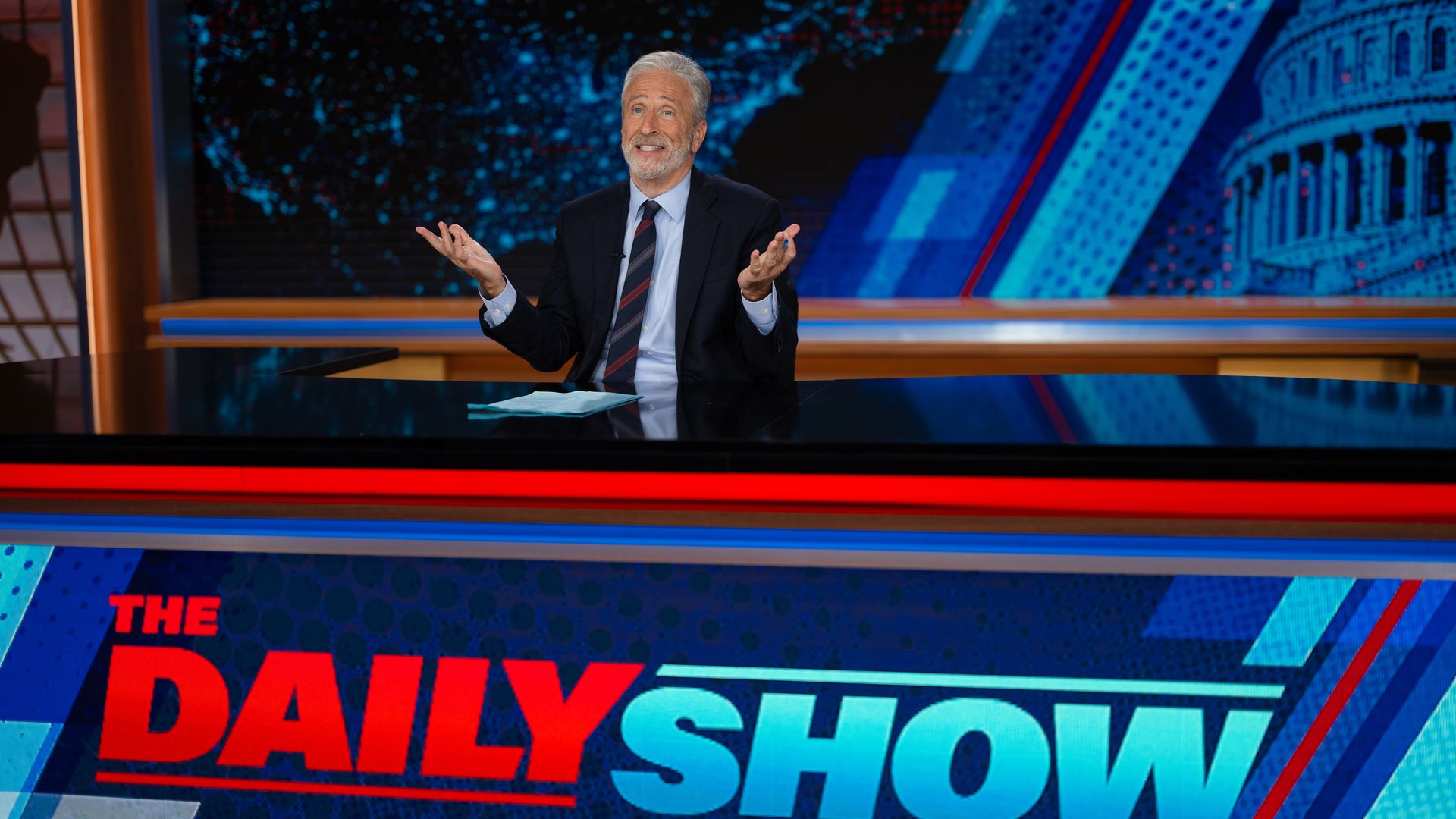
Comedy Central said yesterday it extended Jon Stewart's contract through December 2028, which means he will continue to host "The Daily Show" on Mondays and serve as its executive producer through the next presidential election.
Why it matters: Despite mounting political and financial pressure, most major late-night shows are slated to remain through the next presidential election.
- ABC extended Jimmy Kimmel's contract last year through May 2027, after temporarily suspending his show amid pressure from Trump's FCC. The network denied reports it planned to end the show after next season, and the two parties are reportedly in talks about another contract extension.
- Jimmy Fallon and Seth Meyers have both signed contracts to remain with NBC through at least 2028.
- Bill Maher's "Real Time" will remain with HBO, which is owned by Skydance, through 2028.
- John Oliver's "Last Week Tonight" was renewed by HBO this year through 2027.
The big picture: Stewart's renewal represents a critical vote of confidence by David Ellison's Skydance as late-night shows continue to face political scrutiny from President Trump and his administration.
Can't make it to Media Trends Live? We'll recap the event in a special send of Media Trends tomorrow.
Sign up for Axios Media Trends