Axios Media Trends

March 10, 2026

Good afternoon. Today's Media Trends, edited by Christine Wang and copy edited by Sheryl Miller, is 1,669 words, a 6ยฝ-minute read. Sign up.
๐ฃ Tomorrow: Axios' Kerry Flynn, Christine Wang and I will walk through the data and trends from our latest ad economics report in a members-exclusive webinar. Sign up to join.
๐ค Heading to SXSW? I'll be interviewing Serena Williams this Friday at Axios House. We'll also host Texas Rep. Greg Casar (D) and Republican Party of Texas chair Abraham George at Axios House. RSVP.
Situational awareness: Jamie Stockwell, Axios' former executive editor for local news, has been named the top editor for USA Today. She's the company's third top editor in three years.
1 big thing: Scoop... Nielsen's Gracenote sues OpenAI

Gracenote, a metadata and identification services company owned by media measurement giant Nielsen, has sued OpenAI for copyright infringement, Axios has learned.
Why it matters: Gracenote is suing OpenAI not just for using its metadata without authorization or compensation, but also for copying the relational framework it uses to connect its metadata, which is in part what makes the data valuable to its enterprise clients and useful for consumers.
- To date, there hasn't been a major media copyright lawsuit that focuses on the theft of a proprietary sequence or structure behind a dataset.
- This lawsuit could set a new precedent for how data providers, in the media industry and outside of it, protect their intellectual property.
๐ค Zoom in: The complaint, filed by Susman Godfrey lawyers on behalf of Nielsen's Gracenote in the Southern District of New York, alleges OpenAI copied and used Gracenote's data for its large language models that support lucrative products like ChatGPT.
- The plaintiffs argue outputs from OpenAI's products contain and generate exact copies of Gracenote's data and relational framework, which includes human-curated and analyzed sets of entertainment metadata across music, video and sports.
- The complaint alleges the unauthorized use of that data and the relational framework that connects it โ both of which are copyright protected โ threaten Gracenote's core business with media content distributors, such as smart TV providers.
- Those providers could use the data and framework scraped by OpenAI to build their own "substitutive, competing media metadata products and platforms, all without permission or compensation to Gracenote," it reads.
How it works: Gracenote employs hundreds of editors who use human insight and judgment to create millions of narrative descriptions, original video descriptors, unique identifiers and other program identifiers that TV providers and other clients can use to help customers discover content.
- In the lawsuit, Gracenote alleges OpenAI scraped and used a near-exact copies of show descriptors when prompted by a ChatGPT.
๐๏ธ Between the lines: Gracenote's entire Programs Database, which includes its metadata and the proprietary relational map its editors use to connect that data, is registered with the U.S. Copyright Office.
- Because of those protections, the company is suing OpenAI for statutory damages, in addition to actual damages.
๐ค Zoom out: Gracenote's complaint is notable given the fact that the company has expressed willingness to work with AI companies, and has struck AI licensing deals with firms like Samsung and Google.
2. ๐ฎ States become media antitrust cops

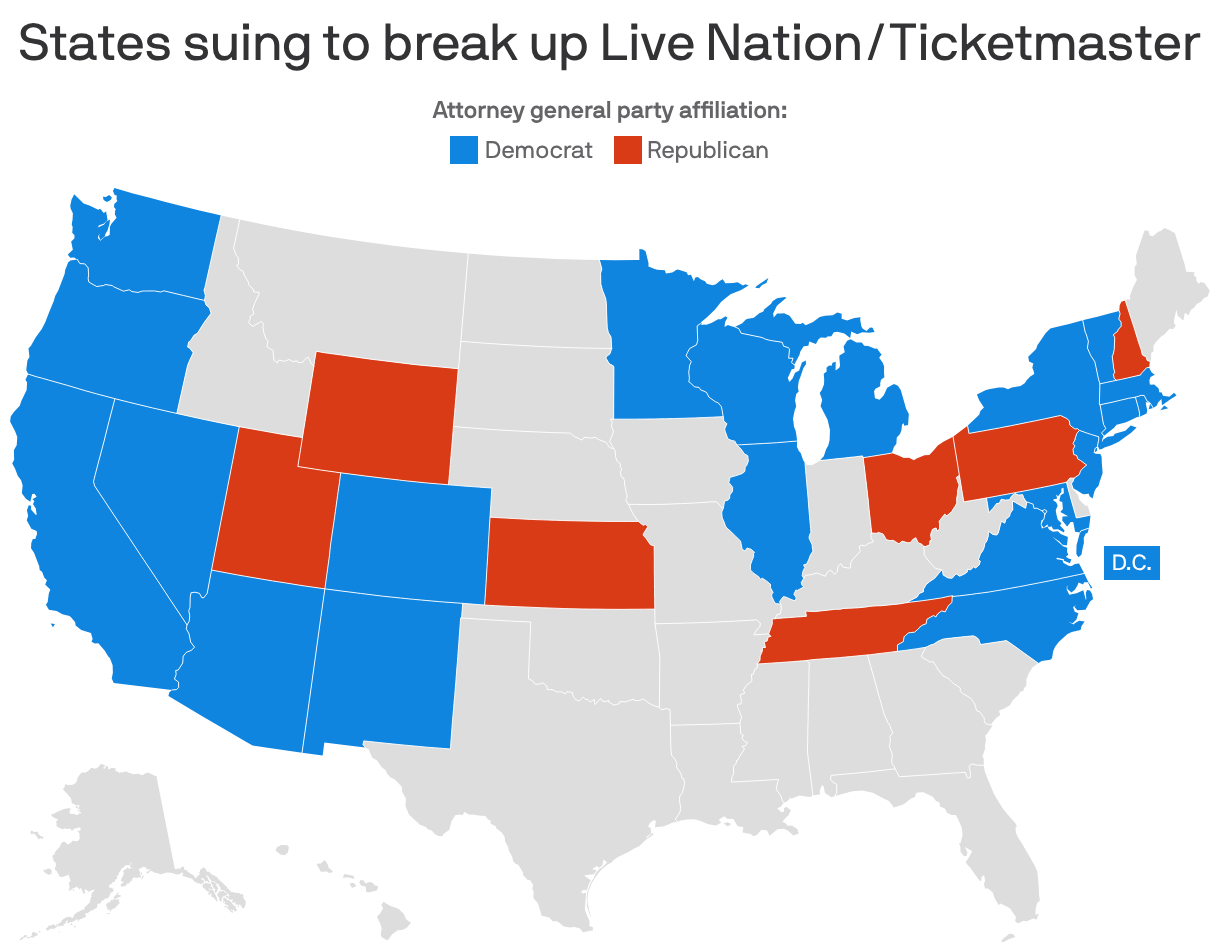
State attorneys general are moving aggressively to sue corporate giants in an attempt to fill a void they argue is being left by federal antitrust regulators.
Why it matters: Recent examples show states can be effective in blocking big mergers, especially when they band together.
๐ซ Driving the news: More than two dozen Republican and Democratic state attorneys general on Monday filed a motion for a mistrial in the federal antitrust lawsuit that sought to break up Live Nation/Ticketmaster.
- They are looking to continue their lawsuit after the Justice Department on Monday said it settled the case for $280 million.
- The settlement quickly drew outrage from consumer groups and activists, who argue the Trump administration let the firm off the hook.
- While the motion for a mistrial has mostly been signed by Democrats, it still has bipartisan support.
State of play: Earlier today, a judge ordered those states to negotiate a possible settlement with Live Nation, as it declined to rule on a request for a mistrial following the Justice Department's settlement, per Bloomberg.
The big picture: States are playing a greater role in trying to block deals and break up companies amid what they perceive as a regulatory pullback from the Justice Department, FTC and FCC.
- ๐บ Local news: A coalition of states, including California, Colorado and New York, is preparing to sue Nexstar and Tegna for antitrust should the FCC approve their $6 billion megamerger, per the Wall Street Journal.
- States that are home to overlapping broadcast stations would likely make the case that the merger would give one company too much power in certain markets.
- ๐ฌ Hollywood: California's Attorney General Rob Bonta has already said that the state's Department of Justice has an open investigation into the deal between Paramount and Warner Bros. Discovery.
- The most viable state antitrust argument would likely be that the combination of two major studios would result in fewer bidders for services, which could impact production jobs and theatrical distribution.
Zoom out: State attorneys general have played critical roles over the past few years in joining federal regulators to sue to break up social media behemoths, like Google and Meta.
3. ๐ Newsroom strike surge


๐ Below is an excerpt from Axios Media Trends Executive's latest monthly report โ this month focusing on media workers and labor. Sign up to get full access to the data and report.
Labor organizing in the media industry has entered a new era as digital-native workers embrace unions as platforms to shape workplace norms.
Why it matters: The evolution marks a generational power shift as more media workers bring new expectations around transparency and social responsibility to the bargaining table.
The latest: Those issues are coming to a head as several big contracts are up for renewal.
- ๐ฐ The New York Times editorial union is currently trying to negotiate a contract renewal with management, after its latest three-year deal lapsed Feb. 28.
- Management tried to bring its proposals to the table earlier this time around, following a brutal public spat over their last contract renewal in 2022.
- ๐ญ SAG-AFTRA, the union representing roughly 160,000 actors, broadcast journalists and media professionals, is currently negotiating a contract renewal with major Hollywood studios ahead of their current deal lapsing in June.
- Its negotiations could foreshadow upcoming contract battles between the studios and other unions, such as the Writers Guilds of America East and West, and the Directors Guild.
By the numbers: Newsroom union activity has reached historic levels.
- More than 23 media unions have formed per year on average since 2020, compared to roughly eight annually for the decade prior, according to an Axios analysis of NewsGuild and Writers Guild of America East data.
- Media union drives peaked at 34 in 2020 โ more than four times the number in 2016 โ before settling into a lower but still historically elevated rate. Per NewsGuild, 39 of its 286 media unions are bargaining for a first contract.
โ๏ธBetween the lines: Strikes have become a key tactic for journalists to compel companies to act on stalled union recognition or contract negotiations.
- An estimated 40 U.S. media unions organized by the NewsGuild have gone on or authorized a strike since 2019, after none did so in the previous 18 years.
What to watch: Roughly 30% of the more than 17,000 media job cuts last year were attributed to acquisitions and mergers, according to data from Challenger, Gray & Christmas.
4. ๐ก Historic victory for government broadcasters
A federal judge on Saturday ruled that efforts to delegate control of the U.S. Agency for Global Media to Trump ally Kari Lake were unlawful, therefore voiding Lake's actions as the acting head of the agency over the past year.
โ Why it matters: The ruling notably invalidates Lake's directive to lay off hundreds of employees across USAGM and the government-funded broadcasters it governs, such as Voice of America.
- It also voids other actions Lake took to reduce spending, including the cancellation of USAGM's lease on new office space and a significant reduction of broadcasting capabilities across USAGM-supported broadcasters.
๐ The big picture: An increase in U.S. military action abroad in places like Venezuela and Iran is calling attention to the lack of soft power resources being used to combat foreign propaganda.
- Republicans, in addition to Democrats, have expressed concern about the dismantling of the VOA as the Iran conflict has ramped up.
Between the lines: U.S. government-funded broadcasters for decades have relied on bipartisan support to combat foreign propaganda with authoritative and truthful storytelling.
- While the Trump administration has sought to gut USAGM, Congress, which authorizes the body's funding, has continued to fund the agency.
๐ What's next: Lake told Axios in a statement she plans to appeal the ruling.
5. ๐ฌ Hollywood power shift
The commercial and critical success of "Sinners" signals a decisive power shift in Hollywood โ from distributor back to creator.
๐ State of play: "Sinners" director Ryan Coogler, who secured a rare agreement with Warner Bros. that grants him ownership of the film in 2050, could become the first Black person to win Best Director at the Academy Awards, which airs March 15.
- He made history last Sunday as the first director to win two Actor Awards for best ensemble, for "Sinners" and "Black Panther."
- The vampire thriller secured 16 Oscar nominations, breaking a long-standing record for the most-nominated film of all time and made almost $370 million worldwide, more than four times its $90 million budget.
๐ธ How it works: Coogler will directly receive royalties from streaming, broadcasts, licensing and merchandising that would normally go to the studio.
The big picture: Major studio executives are seeing other directors demand the same terms, making talent relationships difficult to manage, Vulture reports.
The other side: On a recent episode of "The Town With Matthew Belloni," Sony Film CEO Tom Rothman explained that he turned the film down because he didn't want to "institutionalize" the type of deal Coogler wanted.
๐๏ธ The bottom line: "Sinners" isn't just a commercial success, it's the latest disruptor to a film industry that covets intellectual property.
Sign up for Axios Media Trends