
Axios Media Trends

October 29, 2024

Today's Media Trends, copy edited by Sheryl Miller, is 1,935 words, a 7½-minute read. Sign up.
⚡️ Situational awareness: Microsoft and Google are officially at war.
- Microsoft has accused Google of running "shadow campaigns" to discredit the tech giant with regulators in Europe and the U.S. Last month, Google filed an EU antitrust complaint against Microsoft over its cloud licensing practices.
- The tension comes as Google faces serious regulatory pressure around its dominance in the U.S., something Microsoft understands all too well.
1 big thing: Fox's decision desk shift
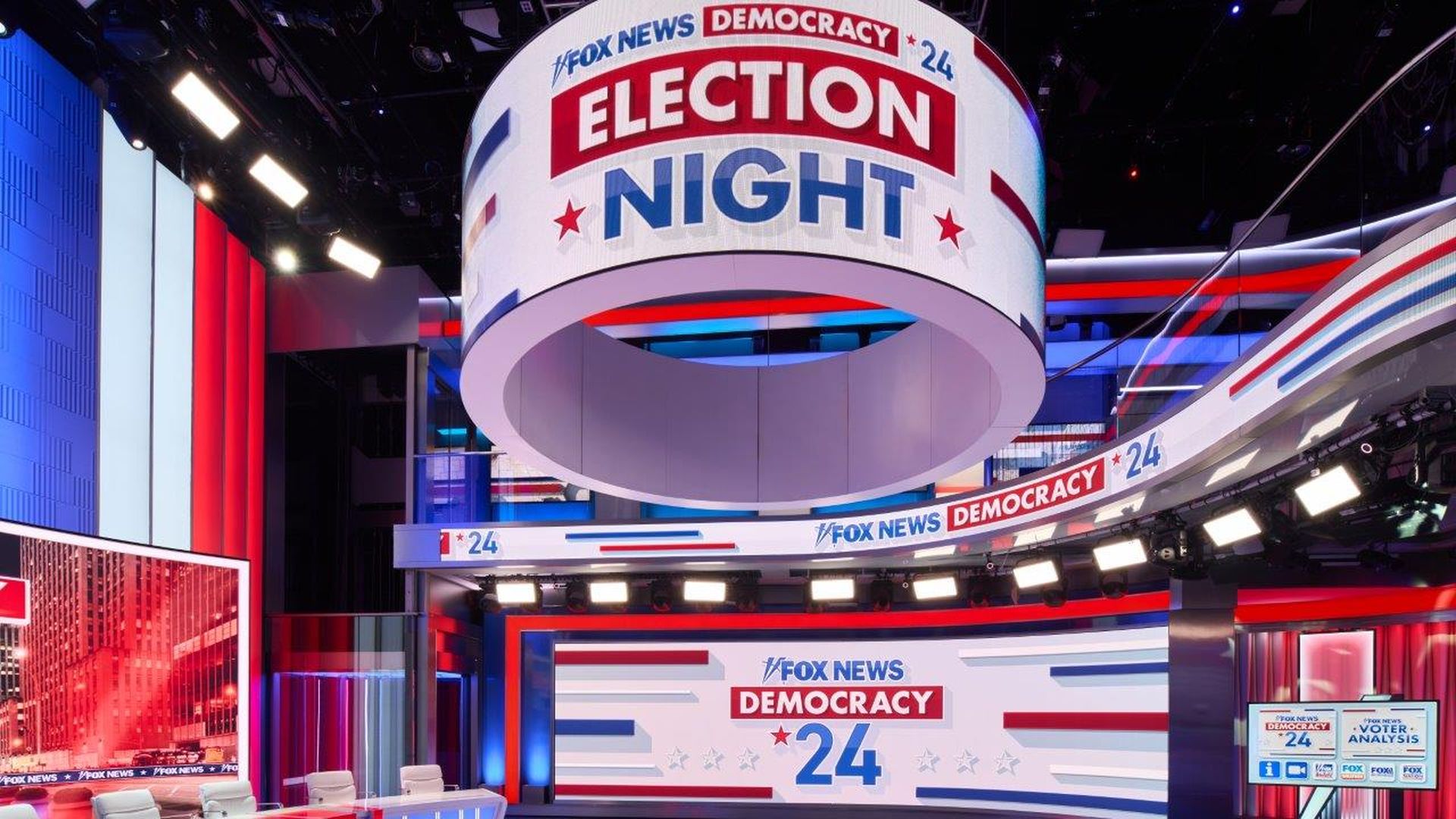
Fox News' historic Arizona election call in 2020 wasn't premature, the network's longtime decision desk head Arnon Mishkin told Axios. But heading into this year's election, Fox News is doing more to ensure the public understands how, why and when it calls certain races.
Why it matters: Fox News isn't responsible for distributing results to thousands of newsrooms globally like the Associated Press, Edison Research or Decision Desk HQ do, but its coverage is expected to be the most watched of any major network on election night.
- In 2020, Fox News' prime-time coverage set a record for the most-watched election night coverage in cable news history with 13.7 million total viewers. It's been the most-watched cable news network by far this election cycle.
Zoom in: In being the first to call Arizona for Joe Biden in 2020, Fox News established itself as an authoritative voice on election night coverage, even if pollsters disagree on how the call was made.
- Mishkin said this year, Fox News' decision desk has adjusted its models to take into account votes by type, such as mail-in votes versus in-person votes, in the states that provide such data.
- The network will also do more to explain its process in real time to viewers so that they aren't caught off guard if Fox is the first to call a race for a candidate they weren't expecting.
- "I think that there's going to be a much greater focus on making sure that when we make a call, that call is made by the right anchor," Mishkin said. "We've adjusted some of our communication systems to make sure that happens."
Flashback: In 2020, the network showed the Arizona race call on a map on the screen before an anchor was prepared to fully explain it, Mishkin recalled.
- "There were a couple of surprises [in 2020] in terms of everyone being on the same page with the understanding that a call was about to come," said Martha MacCallum, who will co-anchor Fox News' election night coverage.
- "I think that we will have a much clearer way of demonstrating why they were able to make that call this time around," she said, referencing the Arizona decision.
Between the lines: Part of Fox News' new election night strategy includes giving viewers more real-time data and better graphics to help visualize how close certain vote tallies will be.
- The graphics, MacCallum said, will help viewers understand "why there might be a delay in one place and a faster number in another place."
2. 🪓 Chaos as papers axe endorsements
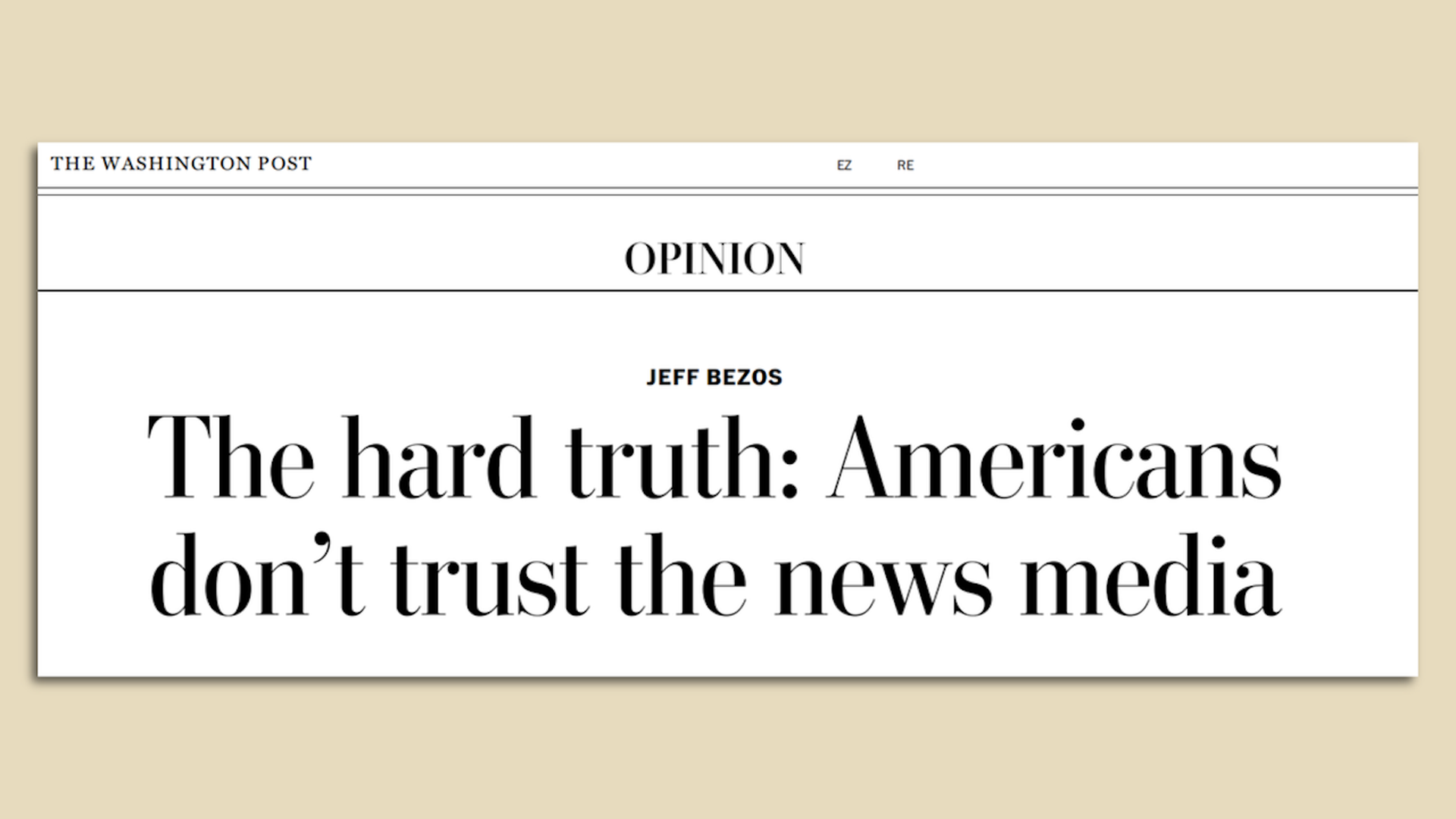
Washington Post owner Jeff Bezos tried to put out a media firestorm Monday night by publishing an op-ed defending the eleventh-hour decision to kill the paper's endorsement of Vice President Kamala Harris — but the damage was already done.
Why it matters: More than 200,000 people have canceled their subscriptions to the Post, NPR reported.
- Three members of the 10-person editorial board — David Hoffman, Molly Roberts and Mili Mitra — left the board but are staying at the paper in other roles.
Between the lines: The Post's situation is especially chaotic, given Bezos' role as a billionaire business leader whose companies rely on billions of dollars' worth of government contracts.
- Bezos aggressively defended his position Monday, writing, "I challenge you to find one instance in those 11 years where I have prevailed upon anyone at the Post in favor of my own interests. It hasn't happened."
- Across the country, the Los Angeles Times is also facing resignations and subscription cancellations for pulling a Harris endorsement ahead of the election.
Zoom out: A growing number of newspapers across the country are choosing to back away from political endorsements, with many citing an increasingly polarized political environment.
- USA Today, one of the largest daily newspapers by circulation in the country, on Monday said it would also forgo a presidential endorsement, although local editors at the roughly 200 publications across USA Today's network "have the discretion to endorse at a state or local level," a Gannett spokesperson said.
- The Minnesota Star Tribune said in August it will not endorse candidates or causes in the 2024 elections, with an editor citing the polarizing nature of today's political environment.
- More than 200 publications owned by hedge fund Alden Global Capital, including the Chicago Tribune and Denver Post, declared in 2022 that they would no longer endorse national political candidates in their opinion pages, arguing the public discourse "has become increasingly acrimonious."
What to watch: Several major newspapers have decided to proceed with endorsements, bucking the new trend.
- The New York Times, Las Vegas Sun, Philadelphia Inquirer, Boston Globe and others have endorsed Harris, while the New York Post, Las Vegas Review-Journal and the Washington Times have endorsed Trump.
3. Local broadcast surges on political spend
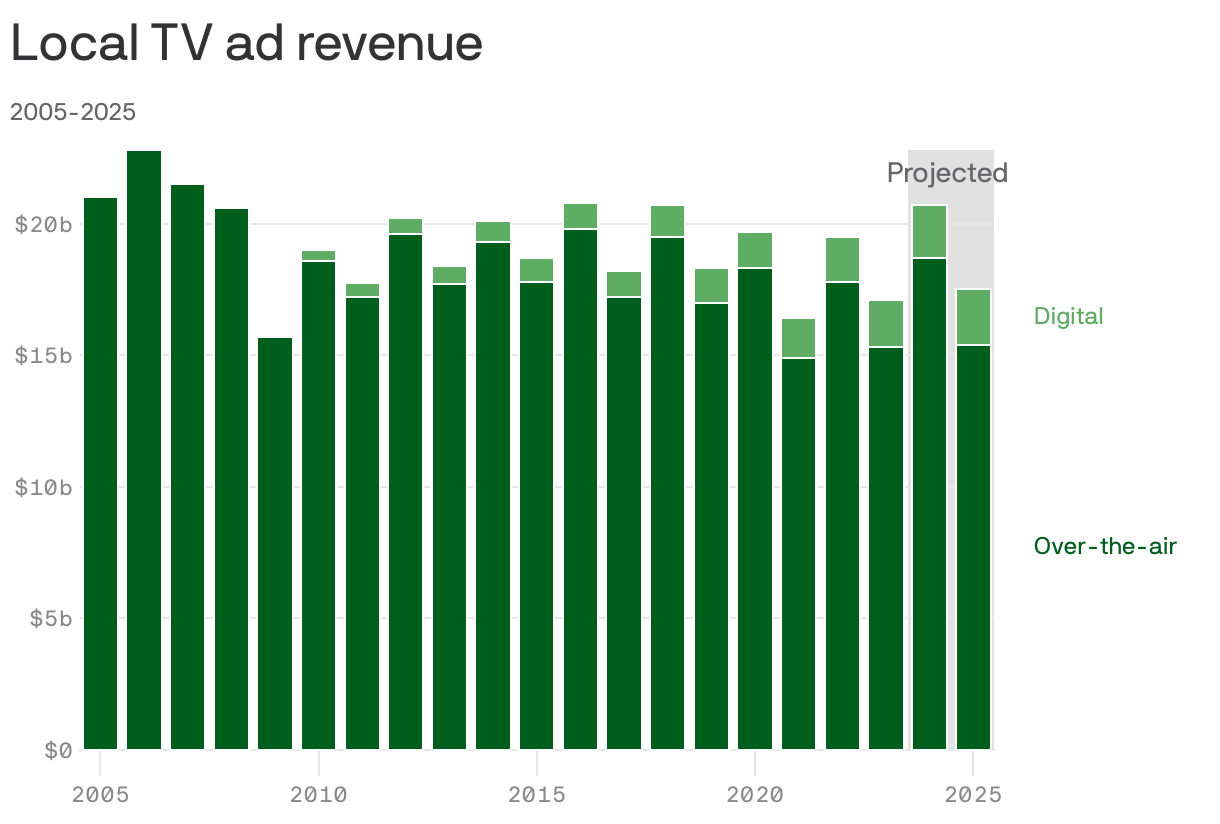
Local TV stations are experiencing an advertising windfall this election cycle, thanks to a record amount of U.S. political ad spend.
Why it matters: Despite an influx of new ways to reach voters online, local broadcast is still the top place campaigns spend their ad dollars, due to its effectiveness for voter persuasion and buying efficiency.
- While streaming ads make it easier for campaigns to target niche voting demographics, they often lack the scale necessary to persuade large amounts of voters in a particular region.
- Regulations around local broadcast ads allow campaigns to unlock cheaper rates and protect their ads from being blocked because of misinformation.
State of play: Local TV broadcast stations have historically benefited in even-numbered years from huge upticks in ad spending around congressional elections. Every four years, that number balloons even higher with the presidential election.
- For example, a whopping $2 billion was spent on local political ads in 2020, followed by just $208 million in 2021 and then $1.9 billion in 2022.
- This year, several highly competitive congressional races, combined with new fundraising energy around a close presidential election and a surge in state ballot measures, have driven huge ad opportunities for local broadcasters.
By the numbers: Around $11.7 billion in political ad dollars are expected to be spent locally in 2024, according to BIA Advisory Services, up 21.3% from 2020. Political ads will make up roughly 6.7% of the total local ad market ($173.7 billion).
- Local broadcast stations are also expected to bring in a record amount ($2.2 billion) in "TV digital" political advertising this year, or advertising sold by local broadcast stations on their digital properties, like their websites or owned and operated streaming apps.
What to watch: While more video ad dollars are still flowing to local broadcast than any other medium, connected TV (CTV) ads on streaming are by far the fastest-growing medium for local campaign dollars.
- BIA estimates more than $2.6 billion will be spent on CTV ads this cycle.
4. Scoop: Meta's first news deal in AI era
Meta has struck a multiyear deal with Reuters to use its news content to provide real-time answers to user queries about news and current events in its Meta AI chatbot, sources familiar with the agreement told Axios.
Why it matters: Meta backed away from news content in its platforms' main feeds amid regulatory scrutiny, but news content may prove harder to avoid with AI products that respond to users' requests.
Zoom in: Users of Meta's AI chatbot feature in the U.S. will have access to real-time news and information from Reuters when they ask questions about news or current events.
- Meta's AI chatbot is integrated into the search and messaging features on Facebook, Instagram, WhatsApp and Messenger.
- Answers to user queries about news will cite Reuters' stories and link out to its coverage.
- Reuters will be compensated for access to its journalism, a source said.
Between the lines: It's unclear whether the partnership includes a licensing component that would allow Meta to use Reuters' journalism to train Meta's large language model, Llama.
- But it makes sense that Meta would partner with a global wire service for its first AI news partner, given Reuters' nonpartisan reputation and its commitment to accurate, real-time news.
- Reuters has been a fact-checking partner of Meta's since 2020, but it was never part of Meta's News Tab efforts.
5. Most U.S. counties have little to no local news sources
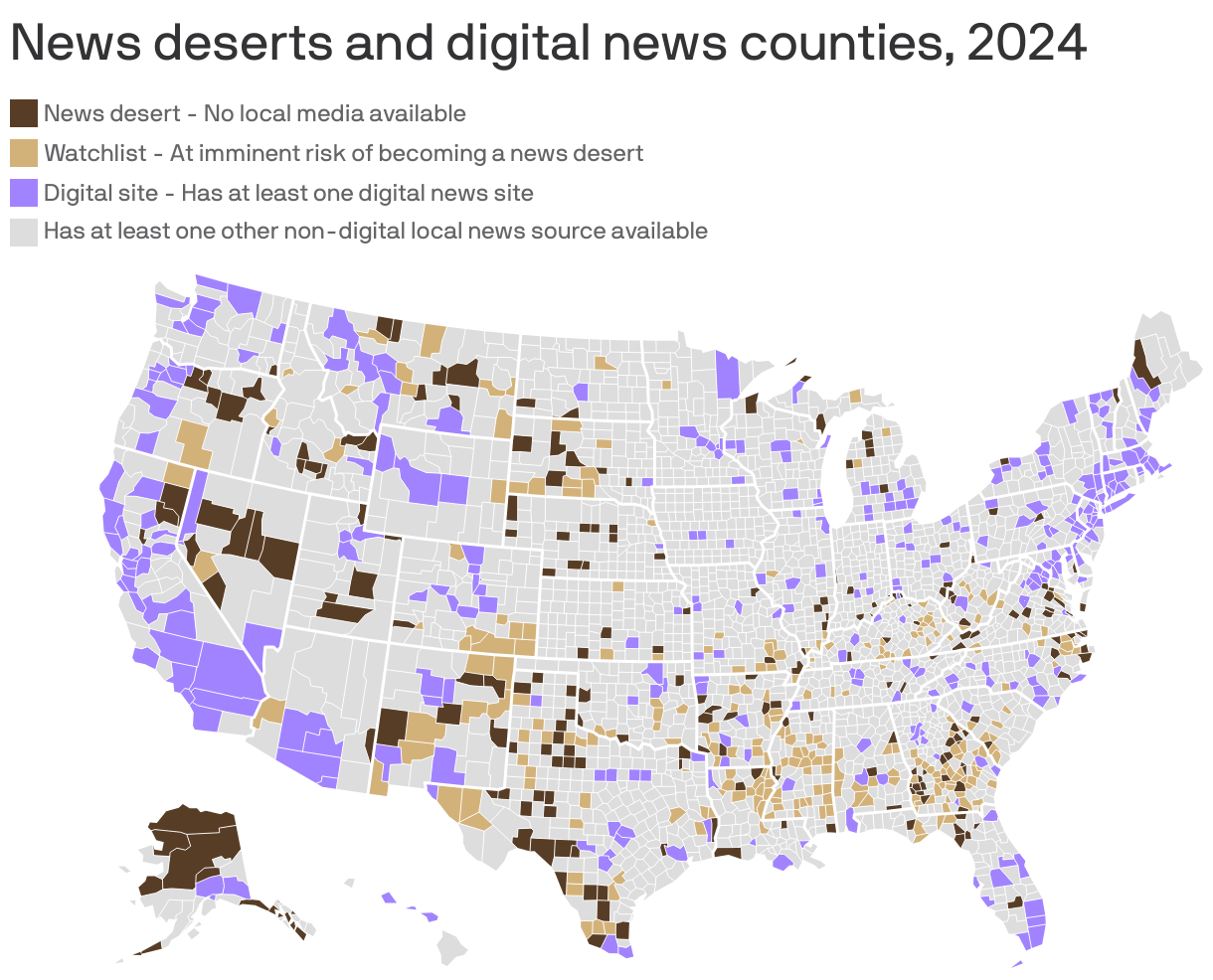
An uptick in newspaper closures this year has left more than half of the nation's 3,143 counties — or 55 million people — with just one or no local news sources where they live.
Why it matters: The rapid rise of digital local news sites isn't enough to offset the dramatic rate of newspaper closures.
- Digital news outlets also tend to serve urban and coastal communities, which are less likely to become news deserts.
By the numbers: The U.S. saw 127 newspapers close in the last year at a rate of roughly two and a half per week, according to a new report from Northwestern's Medill School of Journalism.
- As of this year, the U.S. has lost more than one-third of its newspapers (3,300) compared to 2005 — a statistic Medill projected last year.
- There's been a 73% decline in newspaper jobs during that time, representing one of the most significant declines in employment across any sector over the past two decades.
- U.S. newspaper circulation is down to roughly 40 million, compared to more than 115 million in 2005, a 65% decline.
Zoom out: A significant increase in philanthropic funding for local news over the last year has given rise to more digital local news sites than ever, offering researchers a glimmer of hope for the future.
- Last year, the number of new stand-alone local news websites increased by 81 to more than 630, a year-over-year record.
- The rise of local digital news sites that are part of larger networks also continues to grow. Medill tracked over 700 local news sites belonging to 22 broader local networks such as Patch, Axios Local and TAPinto.
Reality check: Most counties that lose a newspaper are unlikely to see a replacement, even though there are more new digital local news sites than ever.
- News deserts tend to have populations that are poorer, older and less educated and mostly rural.
- Nearly 90% of all new stand-alone local news sites are in metro areas.
What to watch: A significant number of newspapers (258) changed hands over the past year, compared to 2023 (180).
- While large chains mostly owned by hedge funds or private equity groups continue to dominate the industry, more newspapers this year were sold out of corporate control and returned to local ownership groups that are typically more committed to on-the-ground coverage.
6. 🏈 1 fun thing: NFL x Simpsons collab

Disney and ESPN will livestream an animated version of an NFL game this winter set in the cartoon world of The Simpsons.
Zoom in: The animated game between the Cincinnati Bengals and the Dallas Cowboys will stream live on ESPN+ and Disney+ on Dec. 9, alongside ESPN and ABC's presentation of the actual Monday Night Football game, per the Hollywood Reporter.
- Classic Simpsons characters will make appearances throughout the program with unique bits and skits co-developed by the NFL, ESPN and The Simpsons' production team. The game will feature voice actors from the show.
Why it matters: Animated alternate telecasts (dubbed "alt casts") are part of a broader effort by the NFL to lure younger viewers.
- Last year, Disney+ aired an animated NFL game on a Sunday morning, set in the fictional world of Toy Story.
- The league has partnered with Paramount on Nickelodeon-themed NFL alt-casts since 2021. Earlier this year, it debuted its first Super Bowl alt-cast with Nickelodeon, averaging more than 1.2 million viewers.
Sign up for Axios Media Trends