Axios Media Trends

March 11, 2025

Good afternoon. Today's Media Trends is 1,785 words, a 7-minute read. Sign up.
🗞️ Situational awareness: Puck has hired entertainment strategist and analyst Julia Alexander to write full time for Puck's premium subscription tier, The Inner Circle.
Like what you're reading?
- Join Axios Media Trends Executive, a new membership for media professionals, to unlock access to breaking news, exclusive analysis, data, events and more. (Use code SARAFRIEND for a special Media Trends reader discount.)
- Sign up here.
1 big thing: WaPo's big shift
The Washington Post is writing too much commodity news, executive editor Matt Murray told me in an interview yesterday.
- Over time, he said, "We should seek to write less in total, but more in impact."
Why it matters: While other newspapers, such as the New York Times and the Wall Street Journal, have found ways to be distinctive to a national audience, the Post has not.
- That challenge has become clear in recent years as the Post has struggled to become profitable again while its competitors grow.
State of play: Murray announced a slew of changes to the Post's newsroom structure Monday that are meant to help the Post regain competitive ground.
- "I think the larger ambition for the Post is to be more national in scope, and potentially one day, more international," Murray said. The Post's newsroom will focus more on appealing to average readers, not just the elite, he noted.
- To do that, the Post will need to broaden its scope and become less dependent on political news, which can be cyclical in nature, Murray added.
- It will focus more coverage on business, science and tech transformation. The Post will also integrate more data and digital products across its news departments.
Zoom out: The changes follow months of high-profile staff departures and blowback to recent opinion coverage changes by owner Jeff Bezos.
- Murray acknowledged those issues, saying "change is a challenge," but he noted that "morale has been hurting around here for a long time," even before he arrived last year.
💬 My thought bubble: While Murray and CEO Will Lewis entered the Post at a challenging time, the sweeping changes made across the business, news and editorial departments over the past year have contributed to an identity crisis as employees and readers struggle to understand the Post's strategy and mission.
- Murray offered the clearest distillation yet of the Post's news ambitions on Monday, but his announcements didn't go far enough to offset confusion around the Post's business strategy.
- Murray said he's committed to producing more off-platform content to attract a broader range of readers, but most publishers have historically struggled to monetize off-platform distribution.
- The Post has introduced new subscription tiers to attract more paid users, but recent changes to its opinion section have alienated some readers.
What to watch: Critics have slammed Bezos' Opinion section changes as part of a broader effort to cozy up to the Trump administration.
- Amazon announced yesterday that "The Apprentice" is beginning to stream on Amazon's Prime Video this week.
- In January, the company said it would release a new documentary about first lady Melania Trump as part of a $40 million licensing deal,
2. Trump's mainstream reliance

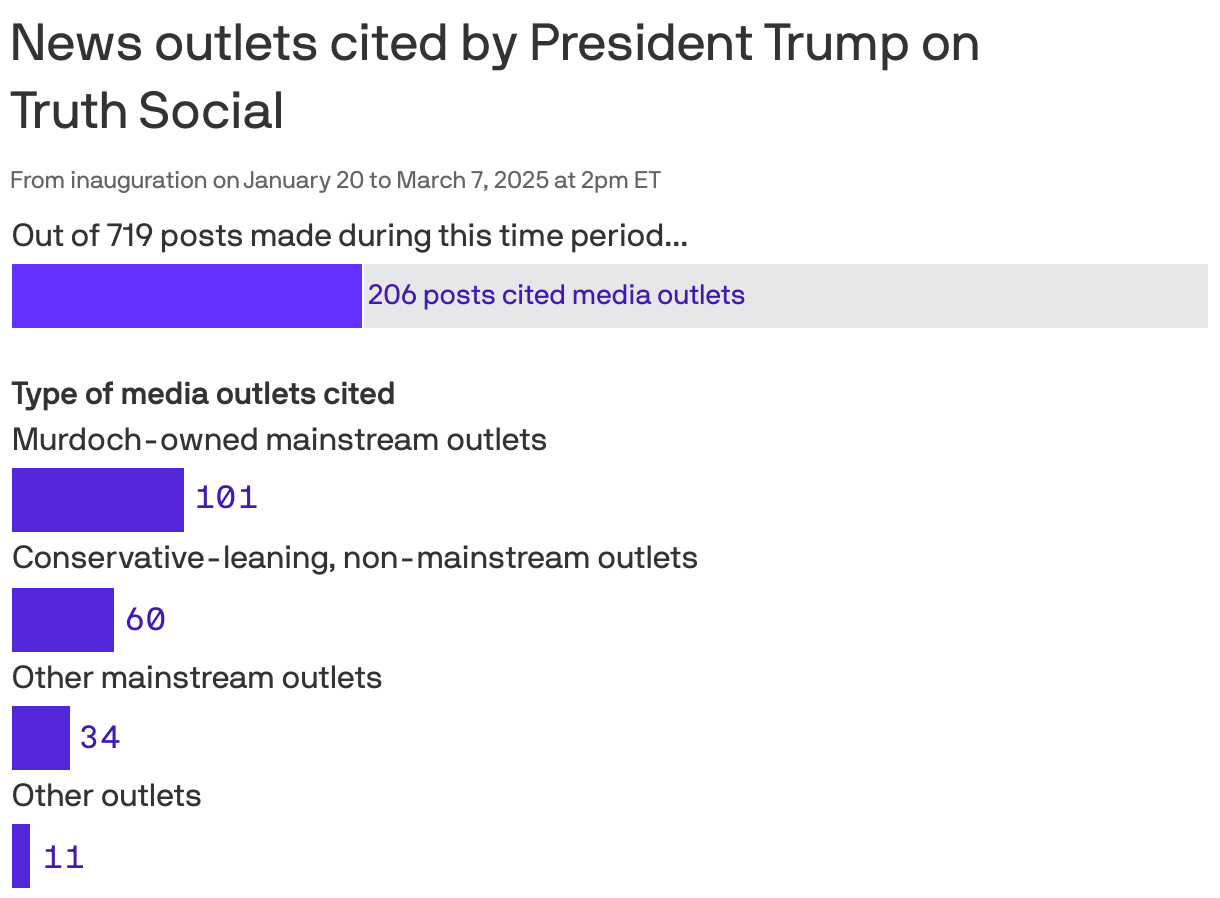
Nearly half (49%) of the media companies cited by President Trump in his Truth Social posts since his inauguration are Murdoch-owned, according to an Axios analysis. Around 17% are mainstream outlets, including ones he's suing or has banned.
Why it matters: While Trump relies heavily on MAGA-affiliated influencers and media to reach his base, his Truth Social activity shows how much he still cites mainstream outlets for credibility and reach.
Case in point: Less than two weeks after AP sued three Trump administration officials for stripping its access to presidential events, Trump cited an AP story about comments made by Ukrainian President Volodymyr Zelensky in a press conference.
- He cited a positive CBS News/YouGov poll about his address to a joint session of Congress last week, despite doubling the damages in his lawsuit against the network.
- Trump has cited USA Today three times since January, despite filing a lawsuit against its parent company Gannett and the Des Moines Register.
Between the lines: Trump's social media strategy relies heavily on the visual authority of TV network content, most notably from Fox News.
- Trump has cited Fox News 62 times, more than every other non-Murdoch owned conservative-leaning outlet combined.
- About one-third of those posts include embedded videos, often clips from Mark Levin's show "Life, Liberty and Levin."
- Trump's other posts include his commentary, reposts of content featuring him on Truth Social and official White House content.
The other side: He has never cited NBC News or MSNBC during the period analyzed by Axios. He has bashed MSNBC, its parent Comcast and its CEO Brian Roberts several times, although he's cited CNBC stories twice about tariffs.
The intrigue: Despite Trump's close relationship with Elon Musk, he doesn't link out to posts on Truth Social rival X. Instead, he shares screenshots of X posts, without a link to the original post.
- He will, however, link out to Rumble, the video platform that hosts Truth Social and serves its advertising.
- Trump is generally obligated to shareholders of his public company, Trump Media & Technology Group, and to post on Truth Social before other social media sites.
3. Disney enters its robot era
Disney's $1.5 billion investment in Epic Games last year is part of a broader push to amplify its franchise flywheel with new tech, Disney Experiences chair Josh D'Amaro and Disney Entertainment co-chair Alan Bergman told Axios in an interview from SXSW.
Why it matters: "From an investor point of view, the combination of strong IP and ambitious investment leads to returns," D'Amaro said.
- "If you look at the return on invested capital over the period of time when we started leaning in [to tech innovation], it goes up by 3x," D'Amaro said.
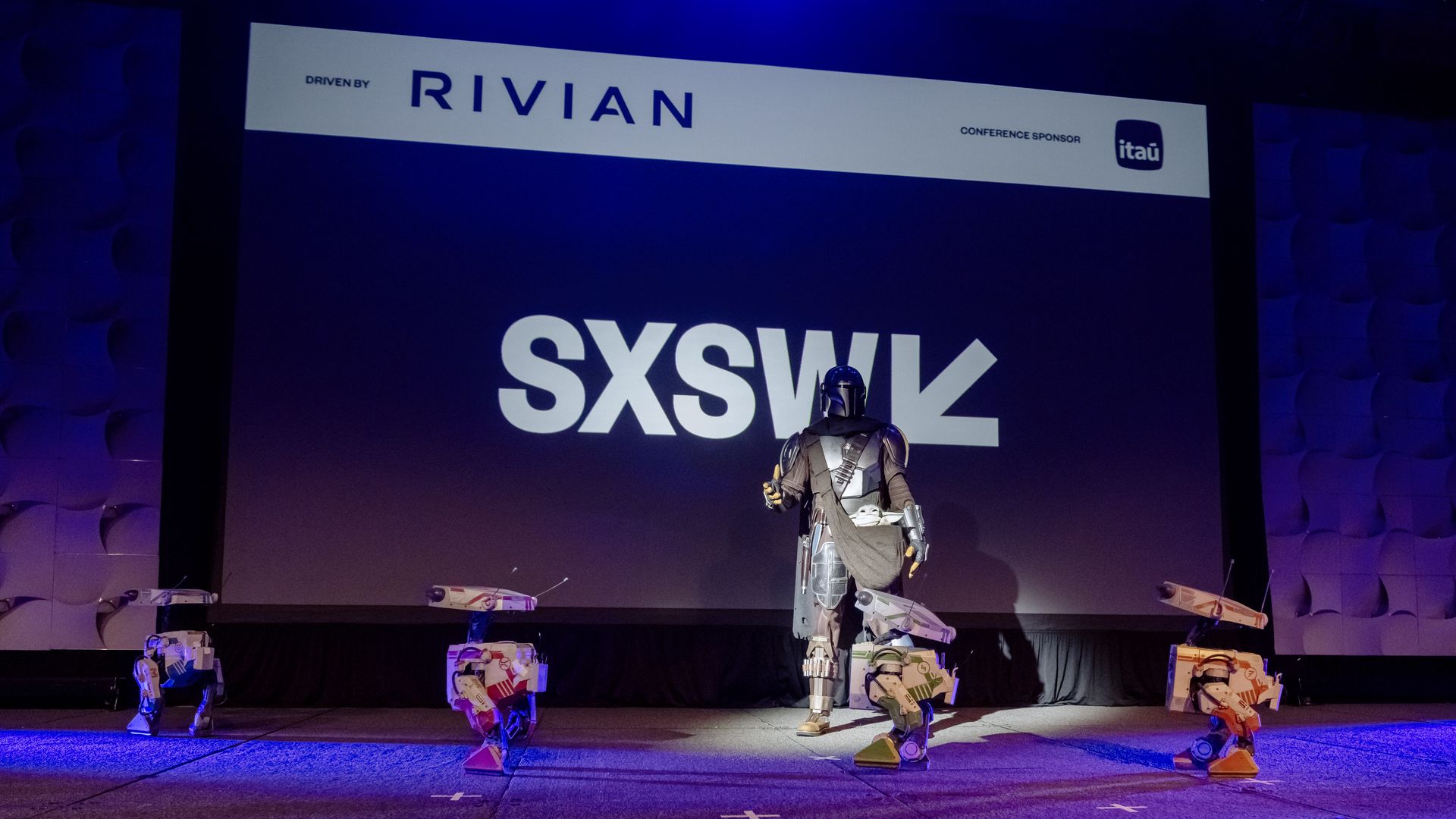
State of play: D'Amaro and Bergman appeared on stage at the annual SXSW conference in Texas on Saturday to unveil a slew of tech-enabled additions to their franchises.
- They were joined by director Jon Favreau who showed off new BDX droid robots built by Disney's Imagineering team for his upcoming film "The Mandalorian & Grogu."
Zoom out: Disney has long invested in technology, but as the media landscape shifts away from traditional television and movie theaters, it's had to rely more on innovation and collaboration among its studios and parks to push its IP forward.
- Over the past few years, Disney has brought more of its franchises into its parks as part of that effort.
- A new Monsters, Inc.-themed land is coming to Hollywood Studios. New Encanto and Indiana Jones attractions are in the works at Disney's Animal Kingdom. An Avatar-themed destination coming to Disney California Adventure.
- Great park experiences are often what inspire new film sequels, Bergman said, pointing to examples such as Zootopia land, which opened in Shanghai in 2023, ahead of a planned sequel.
What to watch: The integration of Epic Games' tech across Disney's franchises will hopefully result in more consumer experiences that resonate with younger generations, per D'Amaro.
4. AI chatbots struggle to cite news
AI search engines provide incorrect citations of news articles in response to a majority of user queries, according to a new study from Columbia's Tow Center for Digital Journalism.
Why it matters: The hope that AI chatbots will meaningfully deliver traffic to news companies as traditional search withers seems unlikely for the foreseeable future.
Zoom in: The Center studied eight of the biggest consumer AI search companies in the market today, including ChatGPT, Perplexity, Perplexity Pro, Copilot, Gemini, DeepSeek, Grok 2 and Grok 3.
- More than half of the user query responses from Gemini and Grok 3 "cited fabricated or broken URLs that led to error pages," per the report.
- Grok 3 would often link to a fabricated URL, even when it correctly identified an article as the source of its answer.
The big picture: Formal licensing deals don't necessarily translate to more accurate attributions or citations of publisher content, the study found.
- "Such deals might raise the expectation that user queries related to content produced by partner publishers would yield more accurate results. However, this was not what we observed during tests conducted in February 2025. At least not yet," the authors note.
5. Substack spikes

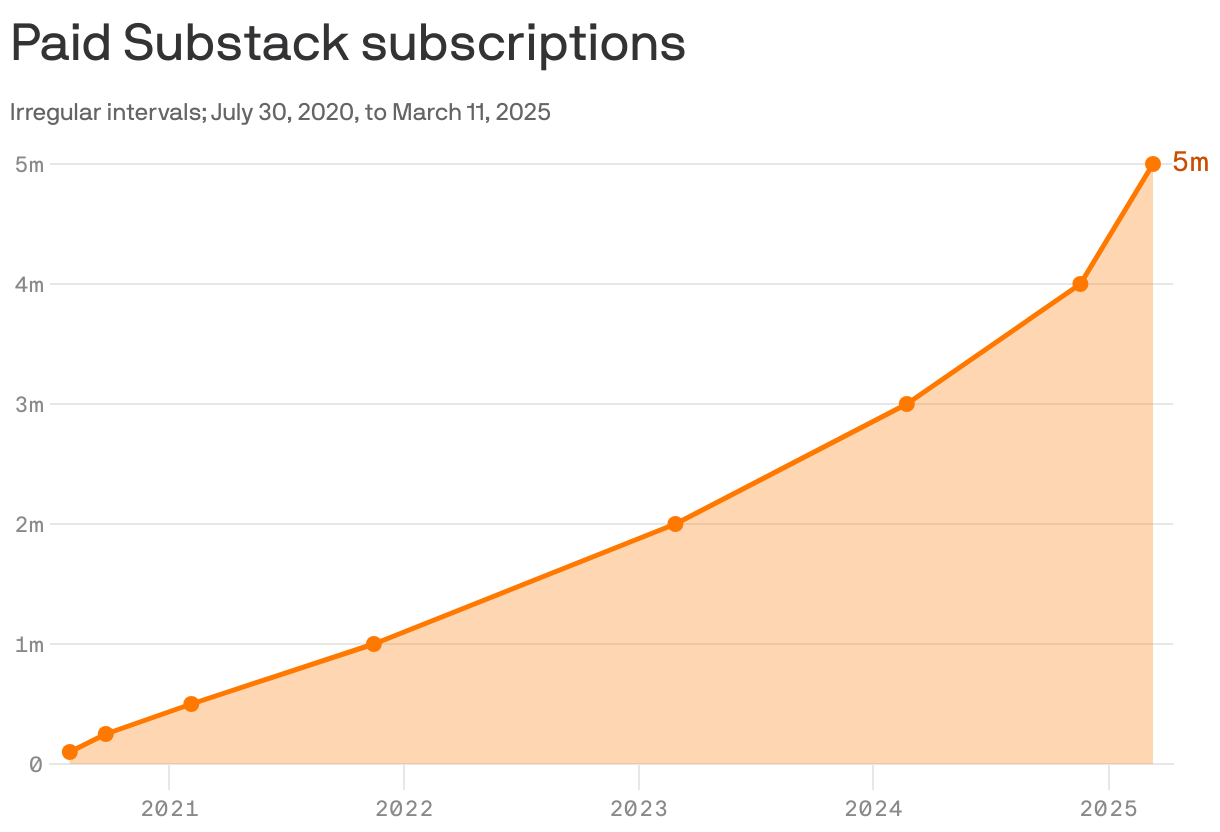
Substack has over 5 million paid subscribers, it said today, a major jump from the 4 million milestone it announced in November.
Why it matters: Investments in new video and podcasting tools over the past few months have not only boosted engagement, but have helped lure new types of creators to the platform, like ex-TV broadcasters.
By the numbers: Over 40% of Substack subscribers pay for publications that publish video, the company said.
- The vast majority (82%) of Substack's 250 highest-revenue creators use audio and video.
6. CBS goes on offense
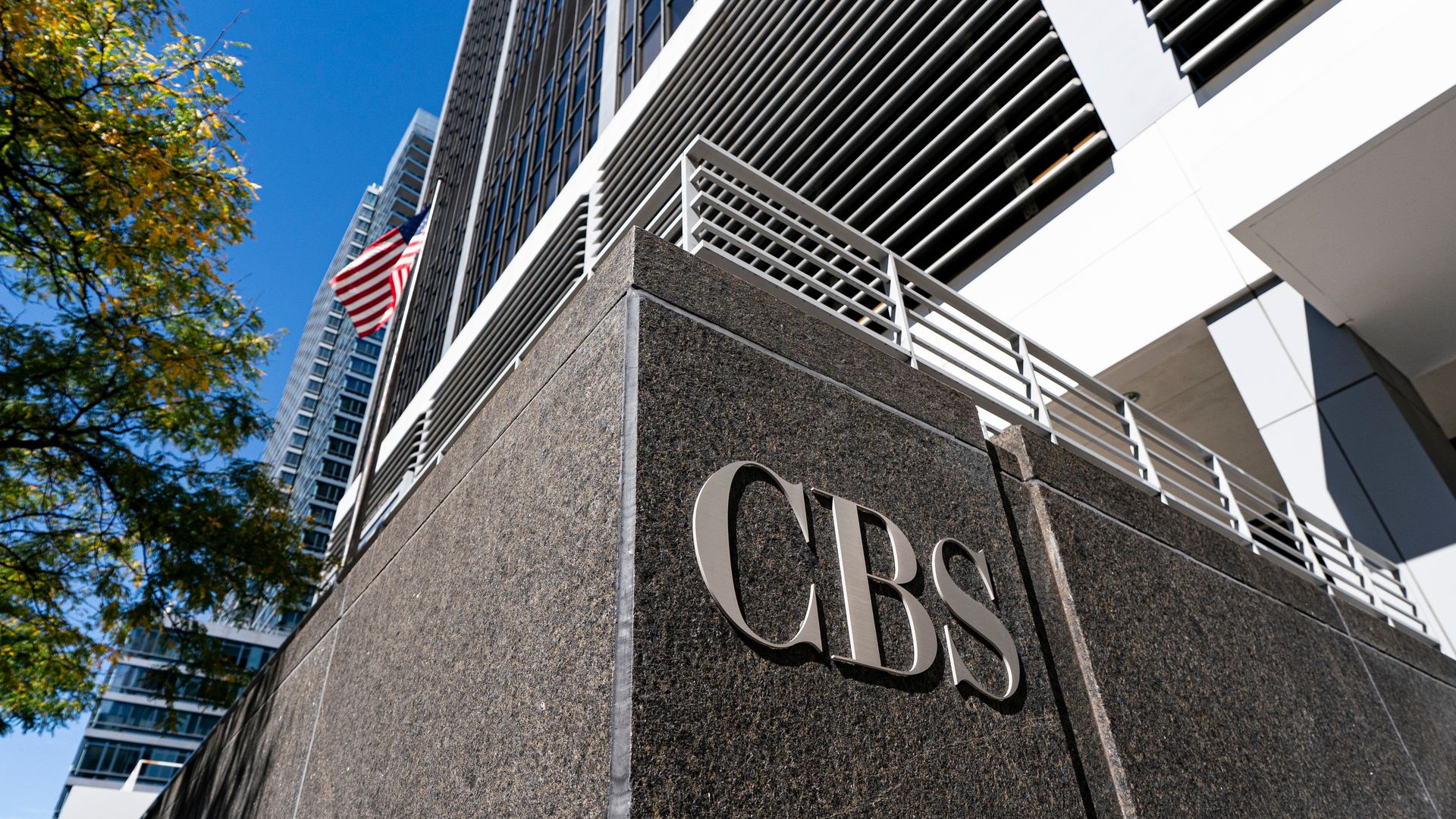
CBS urged the FCC yesterday to toss a complaint over the network's "60 Minutes" interview with Vice President Kamala Harris during the election.
Why it matters: The move comes days after the company filed two motions to dismiss an amended complaint to the lawsuit filed against it by Trump last year.
The big picture: CBS is under extraordinary pressure to resolve its legal battle with the president as it awaits the FCC's regulatory approval for a merger between its parent company Paramount and Skydance Media.
- The FCC inquiry adds pressure on CBS, as it considers whether to settle.
State of play: FCC chair Brendan Carr launched the inquiry into CBS to investigate whether the network violated the FCC's "news distortion" rules in how it edited its interview with Harris for two different programs.
- CBS on Monday said the agency's inquiry "completely disregards both the letter and the spirit of the Commission's news distortion policy," per Reuters.
Go deeper: Media deals market chills under Trump
7. 😮 1 surprising thing: Adam Neumann's latest pivot

Adam Neumann's media company The Flow Trip is profitable with 13,000 paid subscribers, the billionaire businessman and WeWork founder told Axios in an interview.
Why it matters: It's part of Neumann's residential real estate startup, Flow, which was valued at over $1 billion after a16z invested $350 million in the company in 2022.
- Media is an essential part of Flow's vertically integrated real estate model, Neumann said.
State of play: Flow, which rents and manages six residential properties across Florida and Saudi Arabia, aims to differentiate itself by focusing on community benefits and residential culture.
- The media assets serve as a focal point for the entire company to align on topical themes and events that matter to its community, Neumann said.
Catch up quick: Flow acquired Whalebone Magazine, a popular Montauk, New York-based lifestyle publication, in early 2024. That spring, The Flow Trip magazine was launched with Whalebone's creative team and paid subscriptions.
By the numbers: The Flow Trip's main media assets are a bimonthly magazine and a free multiday newsletter.
- The media brand has accrued 13,000 paid members who pay between $72 and $108 annually, Neumann said.
- Those figures don't include the 4,000 residential subscribers who get one year free as a part of their living experience with Flow.
- The magazine is also available for retail purchase in major airports, grocery chains, book stores and newsstands in Europe.
What's next: Neumann hopes to reach 20,000 total paid subscribers by the end of 2025.
This newsletter was edited by Christine Wang and copy edited by Sheryl Miller.
Sign up for Axios Media Trends