Axios Media Trends

June 02, 2026

Hello! Today's Media Trends, edited by Christine Wang and copy edited by Sheryl Miller, is 1,927 words, a 7½-minute read. Sign up.
🇫🇷 June 22–25: Axios is returning to Cannes Lions this summer for a week of exclusive programming and events.
- New confirmed speakers include SNL's Colin Jost, tennis champion Maria Sharapova, Spotify co-CEO Gustav Söderström, TikTok star Josh Richards, Snap CEO Evan Spiegel, and many more.
- Request an invitation here.
👀 Situational awareness: The White House Correspondents' Association has rescheduled its annual dinner for July 24. President Trump says he'll attend the event at the Waldorf Astoria.
1 big thing: 🕺 Long live LIVE


Live event companies are delighting Wall Street as the trend toward in-person entertainment continues to accelerate in the AI era.
Why it matters: The decline of appointment viewing has created a higher premium for events that can bring groups together for shared experiences.
- The scarcity tied to physical experiences, which are harder to mass-produce, has given venues more pricing power.
🎞️ Driving the news: For the first time since the COVID-19 pandemic, the movie production pipeline has remained consistent and strong, leading to a wide array of genres attracting bigger audiences.
- Cinemark on Monday said it delivered its highest-ever domestic box office performance for May. "Backrooms" delivered its biggest horror opening day of all time last week, for example.
- AMC said last month was its highest-attended month of May since 2019, both domestically and globally.
- IMAX, which is reportedly eyeing a sale, posted a record global box office in 2025.
🥤Between the lines: Premium experiences, like higher-quality seats, screens and snacks, are also helping to drive theatrical recoveries.
- Last month not only topped in ticket sales, but also represented Cinemark's highest-ever food and beverage per cap spend, the company said.
State of play: A focus on scarcity has helped venue companies with competitive pricing.
- 🎸 Sphere, for example, saw revenue grow 69% year over year in the first quarter of 2026, thanks in part to concert residencies. Those numbers are helping fuel investor optimism around expansions planned in Abu Dhabi and National Harbor in D.C.
Reality check: As mobile screen time continues to rise, brands are increasingly focused on live formats where attention is undivided.
- National CineMedia, the largest cinema ad seller in the U.S., can thank a stronger cinema ad market for helping it recover from its balance-sheet crisis that sent it into bankruptcy in 2023.
The bottom line: Investors are becoming more bullish on live events as in-home entertainment across streaming and gaming reach saturation points.
- Even Live Nation, which was found guilty of violating federal antitrust laws in April, has seen its stock increase 16% year to date.
2. 🎨 Exclusive: Congress backs creators
A bipartisan group of members of Congress introduced a bill that would give visual artists legal protections against commercial AI imitation of their work without permission.
Why it matters: There currently isn't a legal framework that protects a creator's style. Copyright laws protect registered works, but not someone's likeness.
State of play: The CREATOR Act (Creative Rights for Artists' Technique and Originality Are Reserved Act) was introduced Tuesday by Reps. Beth Van Duyne (R-Texas), Yvette D. Clarke (D-N.Y.), Burgess Owens (R-Utah) and Valerie P. Foushee (D-N.C.).
- The proposed legislation would create a federal standard for protecting a visual artist's distinctive style.
- It gives all creators the ability to sue a platform or individual for intentionally copying their style with AI for commercial gain.
- The bill is being championed by Adobe, whose customers include corporate teams and individual creators, many of whom have worked for years to develop a signature artistic style.
How it works: The bill provides a legal framework for creators to stop bad actors who knowingly use AI to copy their visual style for commercial gain and seek damages for that illegal use.
- It includes liability and safe harbor provisions that protect AI platforms from being liable for infringement by their users, as long as those platforms comply with the act, which includes several notice and take-down requirements.
Context: The bill establishes a legal framework for creators, but it does not mandate infrastructure for creators to register their likeness or visual style in a database that can be referred to when suing for damages.
- When asked if something like that should be introduced, Clarke said there should be an independent arbitrator that can evaluate the veracity of creators' legal claims so that the policing isn't left to platforms, but this bill doesn't outline what that could look like.
Zoom out: There have been a number of state and federal bills introduced around AI impersonation, deepfakes and data protection, but those measures don't typically cover visual artists.
- The bipartisan NO FAKES Act, for example, protects creators from unauthorized AI-generated replicas of their voice, face, likeness or performance, but it doesn't explicitly address their visual style.
3. 🧟♀️ Hollywood horror heist

The unprecedented success of "Obsession" and "Backrooms" — both produced by YouTubers in their 20s — represents Gen Z's power in driving what could be a historic shift for Hollywood.
🤳 Why it matters: Major movie studios have spent years trying to crack the code on organic social media marketing.
- Gen Z has turned free platforms like YouTube into powerful testing grounds for new ideas, using them to reach massive, highly engaged audiences.
👀 By the numbers: What made the box office debuts of both "Obsession" and "Backrooms" so surprising is how well they fared against major studio releases last month.
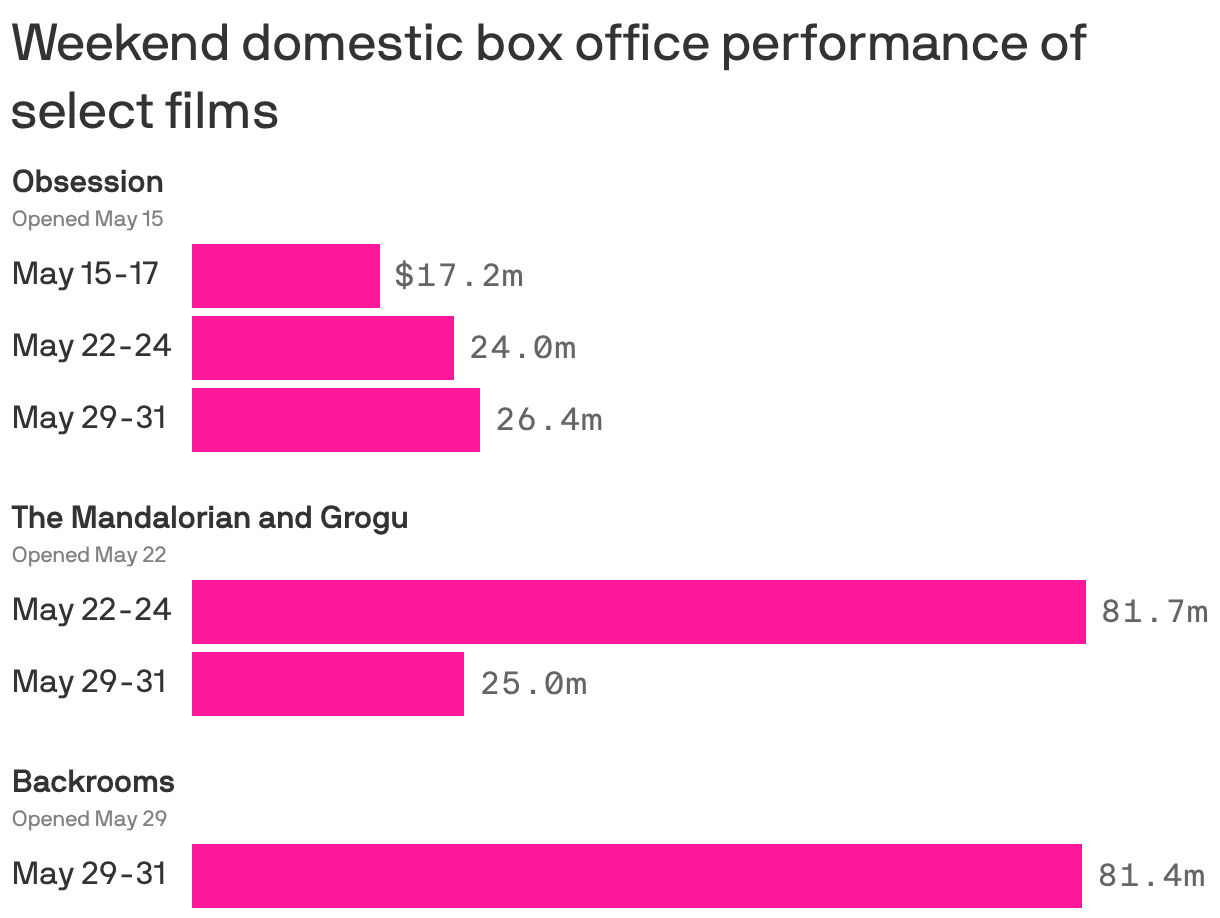
- "Backrooms," which cost roughly $10 million to produce, brought in roughly the same amount of theatrical revenue in its three-day opening as the debut for "Star Wars: The Mandalorian and Grogu" — which cost around $300 million in production and marketing.
- "Obsession," which cost roughly $750,000, brought in more at the box office in its third week than the latest Star Wars film did in its second week.
- The film actually increased its earnings in its second week in theaters, a rare feat for any film, let alone a creator-led YouTube horror film.
😱 Zoom out: Horror, a genre that has historically lagged behind action and adventure sequels at the box office, is proving to be an effective genre in jump-starting Gen Z's theatrical ambitions.
- It also underscores Hollywood's preference toward existing franchises over novel, internet-first stories going viral online.
Case in point: "Iron Lung," a film adapted from a horror video game by YouTube creator Markiplier, has grossed more than $50 million since its debut in January.
- Ironically, the full film debuted on YouTube last week, after its theatrical run.
4. 🕣 Chaos at "60 Minutes"
Nick Bilton, the newly installed executive producer of "60 Minutes," faces a crisis of confidence as senior CBS News staffers openly rebuke his appointment amid broader backlash to changes at the show and network.
Why it matters: "60 Minutes" has spent more than 50 consecutive seasons as the top-rated news program in the country. Its insular culture within CBS News is what insiders credit for preserving its editorial sanctity.
😬 State of play: Longtime "60 Minutes" correspondent Scott Pelley told Bilton Monday that he was hardly qualified for his role and that CBS News editor-in-chief Bari Weiss was "murdering" the program, the New York Times reported. A source familiar with the encounter confirmed the exchange to Axios.
- The testy exchange occurred during Bilton's first meeting with members of the "60 Minutes" team in New York City.
- Pelley argued Weiss' efforts to overhaul CBS Evening News have been "catastrophic," and said she too was not qualified for her role.
Later on Monday, Bill Owens, the show's former executive producer, said at a press event that the recent upheaval is a "pity because CBS News and '60 Minutes' are institutions, not places where partisans and ideologues should be employed."
- "My colleagues at '60 Minutes' were told to their faces that they would be able to do their jobs as they always had. That has not happened," he said.
- Owens resigned from the show in April 2025, citing concerns about journalistic independence.
🗃️ Between the lines: The tense meeting occurred days after CBS News confirmed the show parted ways with longtime producer turned interim executive producer Tanya Simon, as well as correspondents Sharyn Alfonsi and Cecilia Vega.
- Alfonsi, who clashed with Weiss over the delayed airing of one of her reports, railed against Weiss in her exit memo.
The intrigue: A source familiar with the network's inner workings said Bilton reached out to Pelley directly before the meeting, but his outreach went unanswered.
Zoom out: Bilton, a CBS outsider, told Axios last week he plans to expand the show's reach to more days and across more platforms.
- He has, to staff and to reporters publicly, stated his commitment to the show's reputation for resource-intensive investigative journalism.
🤔 Yes, but: Journalists inside and outside CBS News aren't buying it.
- On Monday, The Guardian reported that dozens of former CBS News staffers wrote a letter to Paramount chair David Ellison urging him to "uphold editorial independence" at "60 Minutes."
5. 💰 Buyout barrage
Lax regulatory oversight of deals at the federal level, combined with competitive pressure in the AI era, has ushered in a slew of new takeover opportunities across media, music and movies.
Yes, but: The era of cheap money is over. Many of these deals are struggling to get over the finish line as companies and investors struggle to align on terms.
- 🎙️iHeartMedia's deal talks with SiriusXM have stalled as the two sides fail to come to agreement on deal terms, per NYT.
- 🎵 Universal Music Group on Monday formally rejected a $65 billion buyout offer from Bill Ackman's Pershing Square Capital, following shareholder concerns that it undervalued the company.
- 📺 Sinclair's hostile takeover bid was rejected by Scripps' board over the winter. No new deal has been proposed.
- 🎰 People Inc., the publicly traded company formerly called IAC, on Monday offered to buy out the remaining stake in MGM Resorts International that it doesn't already own (roughly 74%) for $48.30 per share, valuing MGM at $18 billion.
- 🍿 Paramount is reportedly eyeing July as a closing date for its takeover of Warner Bros. Discovery, following a drawn out bidding process that saw it submitting several hostile bids.
6. 💸 Paying for protection
New York Times publisher A.G. Sulzberger on Monday said the company has spent $20 million in legal fees related to AI over two and a half years.
📰 Why it matters: Few news organizations have the resources to wage lawsuits against AI giants. The industry is mostly relying on bigger companies, like the Times and Wall Street Journal parent News Corp., to foot the bill on precedent-setting cases.
✍️ Yes, but: While larger publishers are spending big money to fight AI firms, they are also earning millions signing licensing deals with others.
- The Times has an AI licensing deal with Amazon reportedly worth over $20 million a year. It is also suing Perplexity, OpenAI and Microsoft.
- News Corp. has deals with OpenAI and Meta, while subsidiary Dow Jones sues Perplexity.
🤖 Reality check: The dollars spent on legal fees or earned through licensing deals pale in comparison to the billions spent elsewhere in the AI race.
- Anthropic and OpenAI are racing to the public markets and expected to be among the three mega IPOs this year set to debut with valuations over $1 trillion.
- "Though publisher licensing deals are not public, given the small size of deals that have been reported, it appears that less than half of 1 percent of that investment is going to compensate the people and companies creating the data that powers AI," Sulzberger said.
What to watch: The outcome of NYT's lawsuit against OpenAI and Microsoft is expected to set a historic precedent around what content is considered "fair use" in the age of AI.
Sign up for Axios Media Trends