Axios Media Trends

June 03, 2025

Good afternoon. Today's Media Trends is 1,742 words, a 6½-minute read. Sign up.
🇫🇷 Axios is returning to Cannes Lions this year (June 16–20), and our main stage lineup is bigger and better than ever.
- Speakers include Paris Hilton, Bethenny Frankel, will.i.am, Twitch CEO Dan Clancy, Pinterest CEO Bill Ready, Yahoo CEO Jim Lanzone, Business Insider CEO Barbara Peng, Wall Street Journal editor-in-chief Emma Tucker, and more.
- See more info & RSVP here.
🗞️ Situational awareness: Puck is expanding into tech and AI coverage with the hiring of AI reporter Ian Krietzberg, executives told Axios. He will publish a twice-weekly newsletter called The Hidden Layer.
1 big thing: 🗳️ Scoop... Dems' one platform push

The group responsible for overseeing Democratic Party state efforts is strongly encouraging all of its state campaigns to use a single digital ad tech platform from a company called TargetSmart.
Why it matters: The move aims to help Democrats streamline their ad buys and save money, but critics say the one-vendor mandate is anticompetitive and limits innovation.
- "It's questionable when a party organization endorses a specific media platform without evaluating the leading technology providers in the space," said Grace Briscoe, EVP of client development at Basis, a large ad tech firm that manages campaigns across the political spectrum.
Zoom in: After a meeting last week in Little Rock, Arkansas, the Association of State Democratic Committees (ASDC) passed a resolution to allow TargetSmart to become what it says is "the first and only Media Buying Platform built for the Democratic Party," according to a copy of the resolution obtained by Axios.
- TargetSmart has been one of the leading voter data sources for Democratic political parties and progressive organizations since it launched in 2006. The company provides services to the Democratic National Committee to enhance its voter file.
- TargetSmart also operates a demand-side platform that allows its users to buy and place digital ads on behalf of customers in a programmatic, or automated, fashion. Its ad-buying platform sits on top of its proprietary voter file.
- The firm is still privately owned by its co-founders, Drew Brighton and Jeff Ferguson.
Between the lines: The ASDC argues that campaigns should use TargetSmart's tech for its digital ad buys because it's more transparent and efficient.
- TargetSmart, which it refers to as the "Democratic Party Media Buying Platform," has voter file data that is "sourced by Members of the Association," the resolution reads. It "supports significant data royalty payments to the Voter File Coop and its Members."
- The resolution, which was unanimously endorsed by all state parties within the ASDC, asks that campaigns "limit any and all exports of State Party Voter File data for digital onboarding purposes to only be accessed via secure API connection to the Democratic Party Media Buying Platform."
The other side: The move is being met with skepticism by some within the party and the ad tech community, who argue that selecting one platform weakens the party's ability to stay competitive against the GOP.
- "You don't see the Republicans mandating one janky tech for their campaigns — they want to leverage the best of the tech industry," one political ad tech veteran told Axios.
The big picture: The Democrats have a history of selecting one vendor to streamline tech initiatives for down-ballot races. But with an industry as large as advertising, giving one vendor control is notable.
- For years, the party has relied nearly exclusively on NGP VAN, a privately owned campaign software tool, for field and digital organizing.
2. Scoop: WaPo remodel rattles newsroom
The Washington Post has removed historic headlines from some of its conference rooms and has started adding its new mission statement, "Riveting Storytelling for All of America," to more conference rooms and walls throughout the newsroom, employees familiar with the changes told Axios.
Why it matters: The refresh is meant to encourage Post employees to focus on the future of the Post, a source said, but some journalists feel it's part of a larger effort by the Post to weed out employees who are not excited about leadership's vision for the future.
Between the lines: The changes were particularly noticeable to employees who were returning to the office full time on Monday. While managers have been required to be in five days per week since February, that policy was only extended to all employees at the beginning of this week.
- A notice that cosmetic changes were coming was communicated to the newsroom via an email from HR on May 6. Another newsroom note was sent on May 21 detailing some of the changes, per a source who received both notes.
Zoom in: Some of the headlines removed from Post conference rooms are about historic election wins. Others highlight grimmer events, like the Titanic sinking and Joseph Stalin dying of a stroke.
Flashback: After the Post moved from its historic headquarters on L Street to brand-new digs on K Street in 2015, the outlet sought to add touches of historical reminders to its new office.
- Huge quotes from the late Pentagon Papers editor Ben Bradlee and the late Watergate investigation publisher Katherine Graham, for example, were displayed proudly in some of the newsroom's most prominent areas.
State of play: Those quotes, including others from more recent Post veterans like Marty Baron, are still displayed prominently around the newsroom.
- The Post's new mission statement, "Riveting Storytelling for All of America," is now displayed in the main news conference room.
- As of now, the titles of conference rooms, which are named after historic Post figures such as Ben Bradlee, Meg Greenfield and Fred Hyatt, remain.
Reality check: Small remodels are not uncommon in any corporate sense, especially when there's a leadership change. But the Post's newsroom is particularly sensitive to any shifts, even minor ones, as they tend to represent a larger tension between the outlet's newsroom and new leadership team.
3. 📺 Local TV consolidation blitz begins
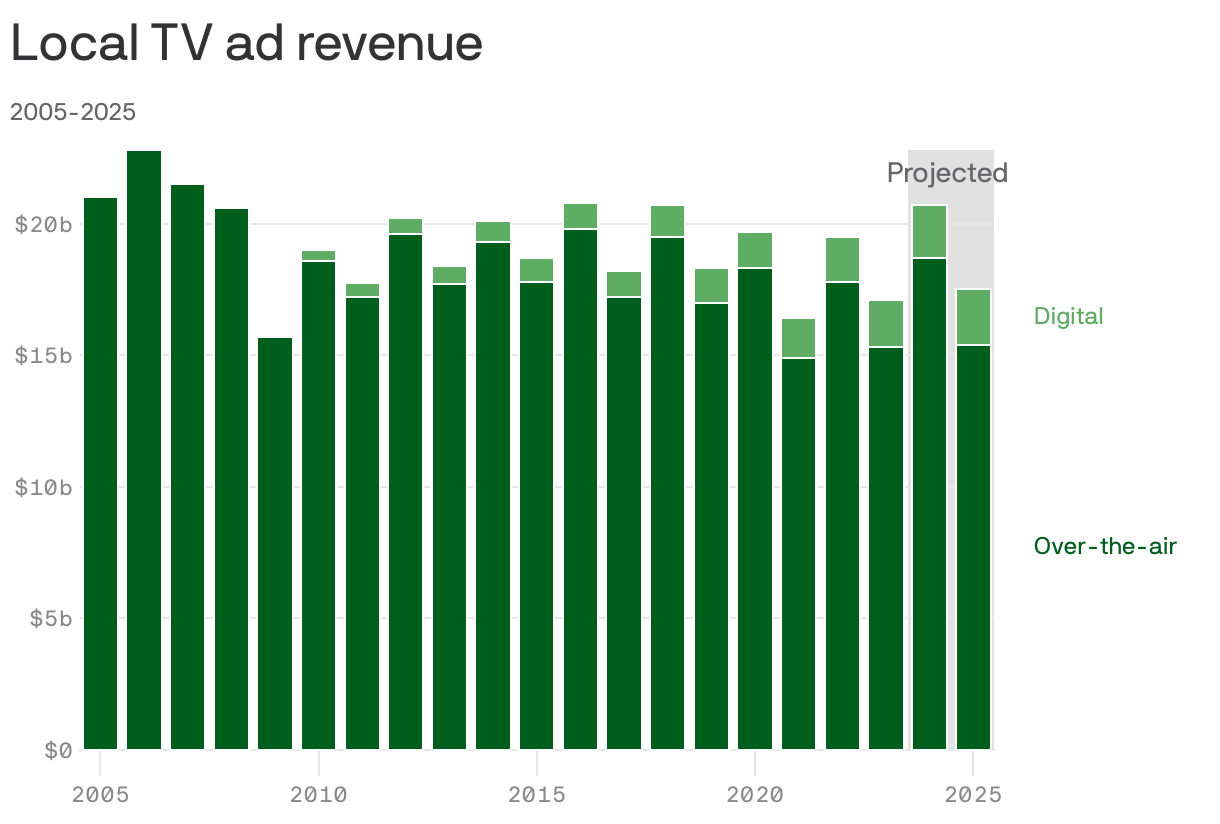
Local broadcast station owners, eager to take advantage of what they expect to be a more relaxed regulatory environment in the Trump administration, are racing to divest their assets.
Why it matters: FCC Chair Brendan Carr has long been an advocate for relaxed local broadcast merger rules.
- Although, the FCC is now threatening to block media mergers based on corporate DEI policies, which could impact some of that consolidation.
State of play: Allen Media Group, founded and owned by media mogul Byron Allen, on Monday confirmed it's looking to sell off 28 local broadcast stations across 21 markets in an effort to reduce its debt load.
- In a statement, Allen said the company has received numerous inquiries and written offers for most of its television stations.
- The company said it has invested over $1 billion in acquiring television stations over the last six years.
Zoom out: More station owners are exploring deals to offload their local stations amid a more relaxed regulatory environment.
- Sinclair was reportedly exploring the sale of more than 30% of its stations last year, per CNBC.
- Apollo Global Management is reportedly eyeing a sale of its Cox Media Group TV and radio stations portfolio for $4 billion, per Bloomberg.
Flashback: Under the first Trump administration, the FCC significantly rolled back local broadcast merger regulations, ushering in a new era of consolidation for local broadcasters.
- Nexstar acquired Tribune for $4.1 billion in 2019.
- Gray Television acquired Raycom for $3.6 billion.
- Cox sold a majority stake in its stations group to Apollo.
Yes, but: There were a few deals that were blocked by the first Trump administration.
- Prior to Tribune's Nexstar deal, Sinclair abandoned its $3.9 billion acquisition of Tribune after facing regulatory hurdles.
- Local broadcast deal momentum hit a snag during the Biden administration as well.
- Tegna scrapped its $8.6 billion merger deal with hedge fund Standard General after facing significant several regulatory hurdles.
The bottom line: Local broadcast stations still mint money, but with their business in terminal decline, consolidation is considered necessary by station owners to survive.
4. Scoop: FTC takes over House Omnicom/IPG probe
The FTC has fully taken over the congressional antitrust probe into the Omnicom/IPG merger, sources told Axios.
- House Judiciary Chair Jim Jordan (R-Ohio) had initially sent letters to the CEOs of both agencies as part of an antitrust investigation into whether ad agencies had colluded with advertisers to organize boycotts of conservative media brands and voices.
Why it matters: Sources interviewed by the FTC about the deal say the questioning so far lacks any sort of political undertones.
- But industry leaders don't rule out external political pressure, given the Trump administration's track record, Axios' Kerry Flynn and I report as part of our latest members-only deep dive out last Saturday.
- On Monday, the New York Times reported that the FTC was probing whether roughly a dozen groups violated antitrust law by coordinating ad boycotts.
Zoom out: A major shift is underway as legacy agency holding companies consolidate their brands and invest in services and tech businesses that don't directly rely on a fickle ad market.
- Services and tools-based businesses are less dependent on expensive labor costs, but they put more pressure on agencies — which have historically relied on retainer fees — to become more outcome- and performance-driven.
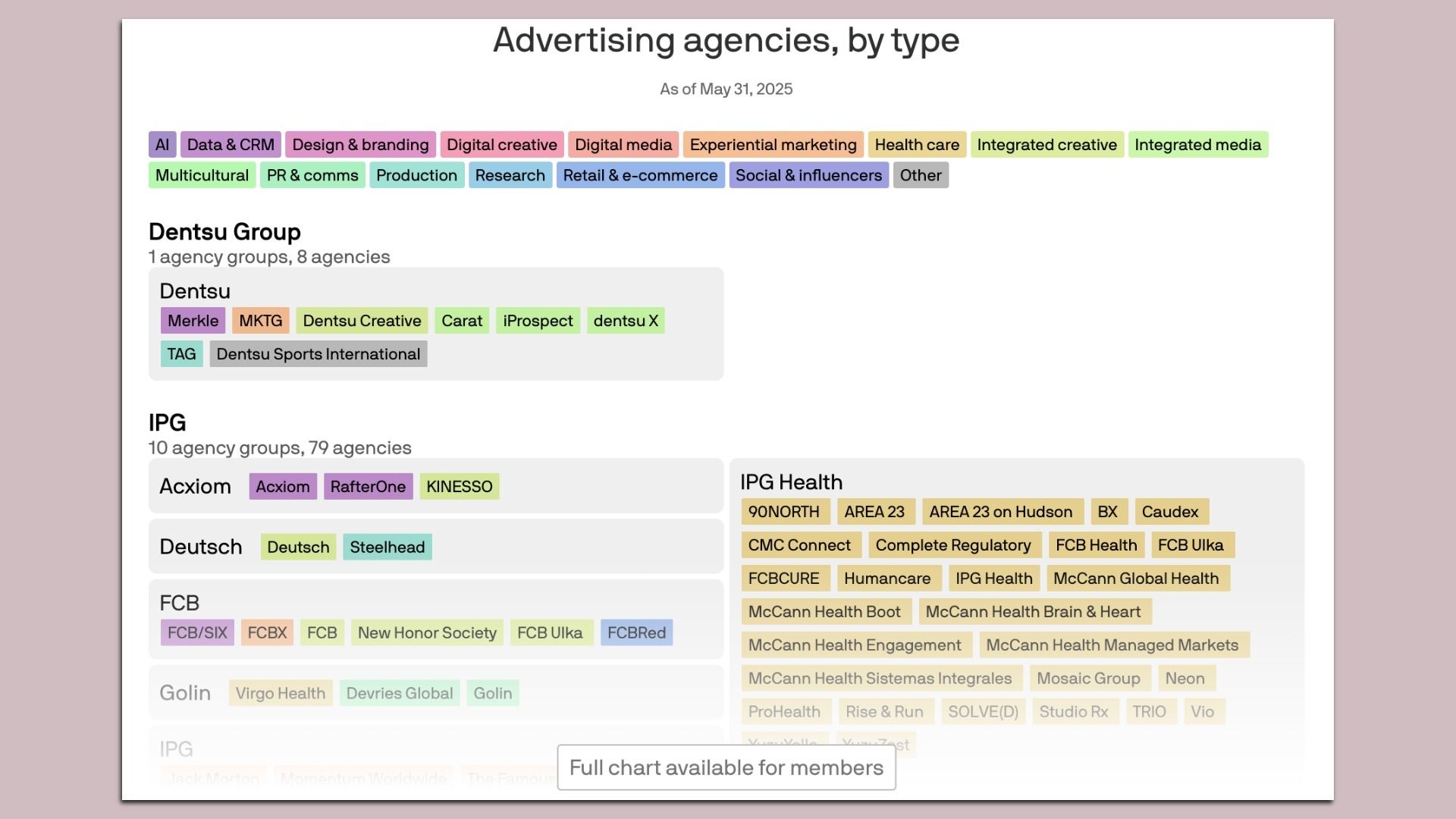
By the numbers: While agency giants still make the majority of their revenue from media buying, many have since expanded into specialized services.
Of 417 agencies that sit across six of the major ad holding companies (Stagwell, Dentsu, Omnicom, Publicis, WPP and IPG):
- 🖼️ 83 are dedicated to integrated creative services.
- ⚕️60 are health care groups.
- 📣 50 are dedicated to PR and communications.
The big picture: Many of the big holding groups are still too bloated.
- WPP currently has 141 agency brands under its umbrella that it's now looking to consolidate.
- IPG and Omnicom, which have announced a merger, each have 81 agencies. Consolidation is expected after that deal is done.
Yes, but: Analysts are still recommending agency stocks to investors as defensive positioning in the event of an ad market downturn.
What to watch: Sweeping consolidation is expected to significantly cut headcount at the world's biggest holding groups.
- By 2030, U.S. ad agencies are expected to lose 32,000 jobs to automation, or 7.5% of the industry's workforce, according to Forrester.
For full access to our agency chart above and more exclusive reporting, subscribe to Axios Media Trends Executive.
5. Hollywood braces for cuts
Disney on Monday informed employees that it plans to lay off several hundred staff members globally as part of an effort to become more efficient.
The big picture: The cuts come as traditional media giants face growing pressure from Wall Street to focus on efficiency and streaming profitability amid gloomy ad forecasts.
- The Wall Street Journal reports that layoffs at Warner Bros. Discovery and Paramount are also expected soon.
Zoom in: While no full teams at Disney are being eliminated, the cuts will impact an array of functions, including marketing for both film and television as well as TV publicity, casting and development, and corporate financial operations.
Zoom out: Disney has already taken big steps to cut its workforce in the past few years.
- CEO Bob Iger announced in 2023 that roughly 7,000 workers would be cut to save around $5.5 billion.
Sign up for Axios Media Trends