Axios Media Trends

June 24, 2025

1 big thing: 🔨 Major crawler crackdown
Cloudflare, the giant cloud service company, is working on a new tool that will stop content scraping on a macro scale, its CEO Matthew Prince told me at an Axios X Human Ventures event at Cannes Lions on Thursday.
📰 Why it matters: According to Prince, "every publisher you have ever heard of is on board" with Cloudflare's new solution.
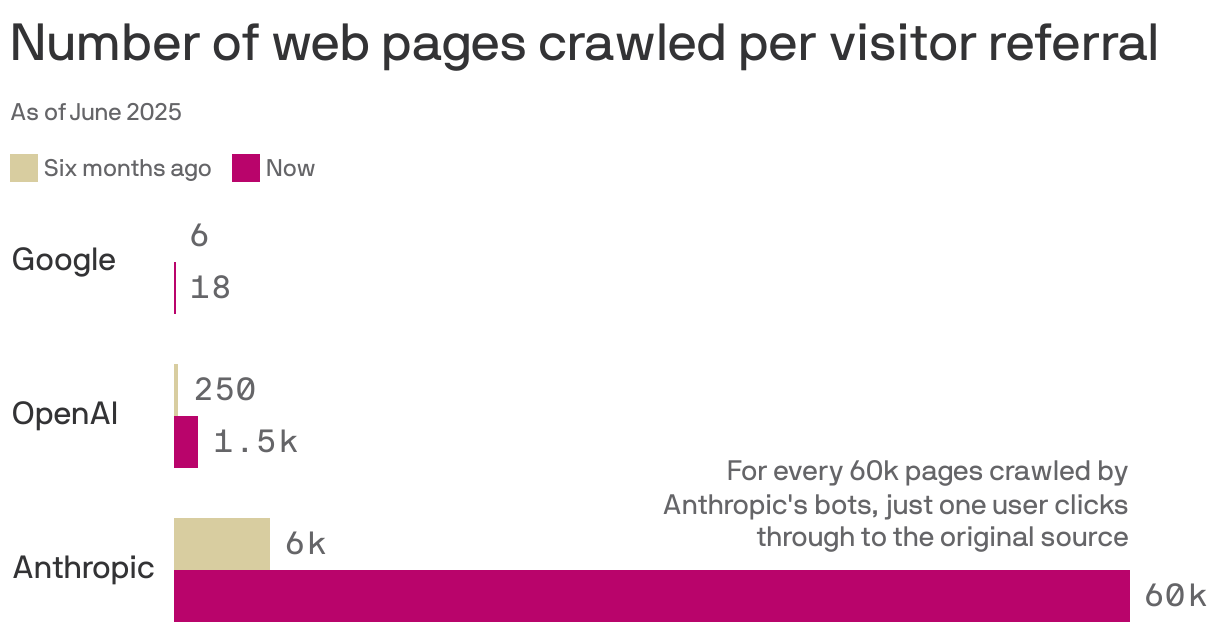
🕸️ Startling stat: Ten years ago, Google crawled two pages for every visitor it sent a publisher, per Prince. Now, it's 18:1.
- For Anthropic, that margin is even wider. Today, for every 60,000 pages crawled by an Anthropic bot, just one visit is sent to a publisher.
- For OpenAI, it's 1,500:1.
Flashback: Cloudflare has been hinting at a possible solution for months.
- It recently launched a feature that obstructs bots that ignore "no crawl" directives. Its new solution aims to target crawlers on an even bigger scale.
Between the lines: While search engines and AI chatbots include links to original sources, publishers can only derive advertising revenue if readers click through, and that's happening less with AI summaries.
- AI search engines, particularly Grok, often link to fabricated URLs, even when it correctly identified an article as the source of its answer, according to a study from Columbia's Tow Center for Digital Journalism.
- ❌ They also provide incorrect citations of news articles in response to a majority of user queries.
The bottom line: "People trust the AI more over the last six months, which means they're not reading original content," Prince said.
- "The future of the web is going to be more and more like AI, and that means that people are going to be reading the summaries of your content, not the original content."
🎧 Go deeper: Dotdash Meredith CEO Neil Vogel, "The Rebooting's" Brian Morrissey and I recorded a podcast about the future of AI and publishing at Cannes Lions.
2. 🇮🇷 VOA's Iran mess
3. Scoop: TikTok's news push

4. Meanwhile, TikTok sale talks stall

5. FTC approves Omnicom, IPG merger with an unusual condition


The Federal Trade Commission yesterday said it will approve Omnicom Group's $13.5 billion acquisition of rival Interpublic Group, but only if the agencies agree they won't bar ads based on politics.
Why it matters: A consent order that addresses the possibility of political collusion is rare, and it speaks to the hyper-political climate facing the business community.
- The merger between Omnicom and IPG will create the largest global ad agency holding group by revenue. The deal is still pending approval from regulators in the U.K.
❌ Zoom in: The proposed consent order imposes restrictions "that prevent Omnicom from engaging in collusion or coordination to direct advertising away from media publishers based on the publishers' political or ideological viewpoints," per the FTC.
- It also prohibits agencies from accepting requests to direct advertising spend to a certain media publisher "based on political or ideological viewpoints or political content."
- Agencies are also prohibited from declining to do business with an advertiser based on their political or ideological viewpoints.
Between the lines: Advertisers are still allowed to dictate where their ads appear. The agency will need to act with caution to avoid accusations of collusion or bias when considering an advertiser's targeting requests.
Yes, but: The consent order also contains fairly standard provisions barring anticompetitive coordination over conditions such as pricing, ad placement and sponsorships, as well as helping execute advertisers' ad campaigns.
- Axios previously reported that despite concerns around politics, most of the FTC's inquiries into the merger with ad professionals were apolitical.
Reality check: Regulators rarely put in place merger provisions that specifically bar this type of coordination, but political pressure around allegations of ad groups penalizing conservatives has gained steam.
- Last year, X sued the liberal watchdog group Media Matters for defamation, claiming one of its research reports contributed to an advertiser exodus.
- The FTC is now investigating the group over the same issue. Media Matters countersued the FTC yesterday, arguing its investigation was "retribution."
6. 🎬 Pixar's worst debut ever

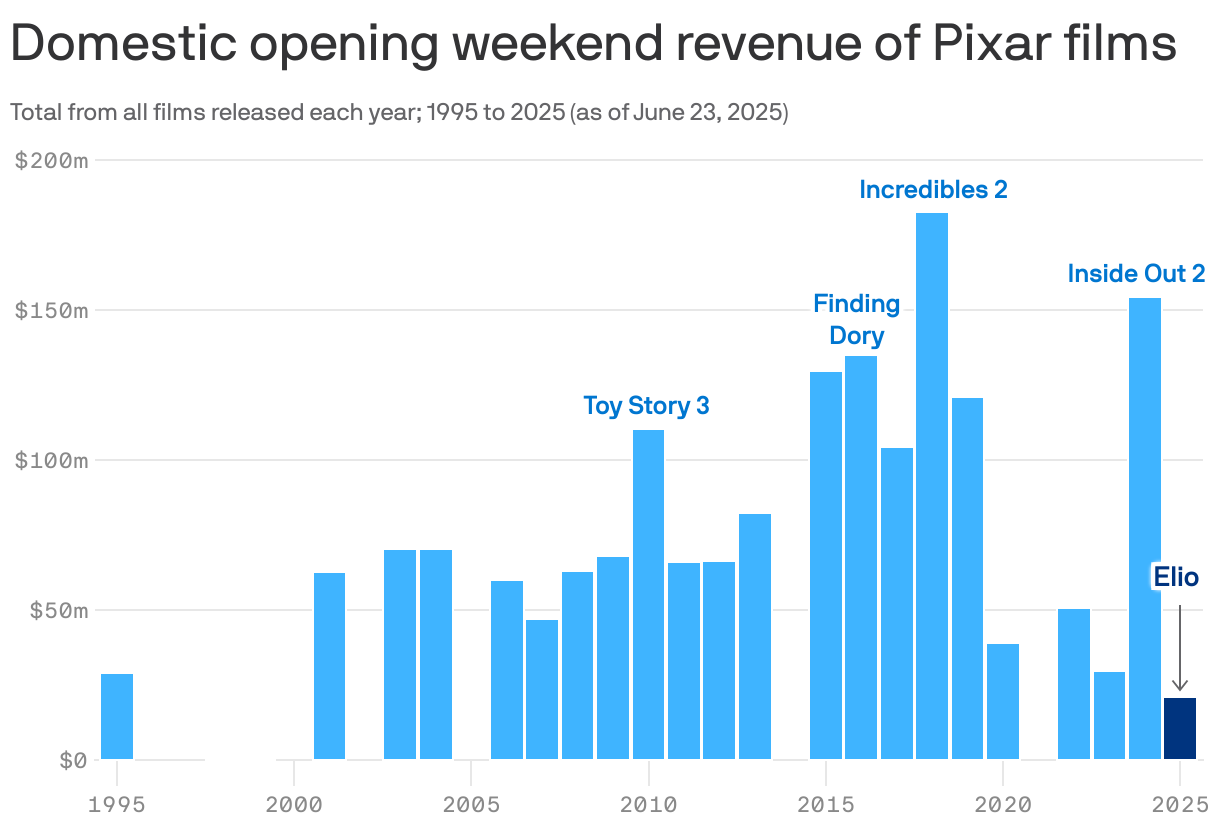
Disney's Pixar saw its worst-ever box office debut over the weekend with its sci-fi adventure film "Elio" earning just $21 million domestically after reportedly spending at least $250 million on production and marketing.
🍿 Why it matters: The animated movie is a costly outlier to other family-friendly films that have packed cinemas and helped theaters toward a post-pandemic rebound.
The big picture: With the exception of "Inside Out 2" last summer, Pixar has struggled to regain the box office momentum of its dominance in the 2000s and 2010s.
- "Luca" and "Turning Red" released straight to Disney+ in 2021 and 2022, respectively. "Lightyear" underwhelmed at the box office in summer 2022.
- Pixar's previous opening weekend low was "Elemental" in summer 2023 at $29.5 million, though it ended up becoming a sleeper hit and brought in nearly $500 million globally.
- "Elio" is Pixar's only theatrical release slated for 2025.
🍅 Yes, but: "Elio" has garnered positive early reviews with an 83% critics score and 91% audience score on Rotten Tomatoes.
Flashback: Activist investor Nelson Peltz took aim at Disney's studio struggles during his failed proxy fight, telling the FT that the company had "lost first place in animation." Though he lost that battle for board seats, his critique of Disney's creative outputs still resonates.
Zoom out: The box office has otherwise seen a strong summer. Analysts have projected this season could be near a post-COVID record.
- Disney's "Lilo & Stitch" live-action remake secured the biggest four-day Memorial Day weekend opening ever domestically and is on track to top $1 billion worldwide.
What to watch: Other major releases coming this summer include "F1," "Superman," "Jurassic World Rebirth" and "The Fantastic Four: First Steps."
7. Aggregators own the lock screen



Half of the top eight news alert vendors in the U.S. are aggregators, not publishers, according to a new analysis from the 2025 Reuters Institute Digital News Report.
Why it matters: The battle for the lock screen is heating up as more media companies turn to push alerts to offset search traffic declines.
- Platforms like Google News, Apple News, Yahoo News and Newsbreak were among the top senders alongside publishers CNN, Fox News, BBC News and the New York Times.
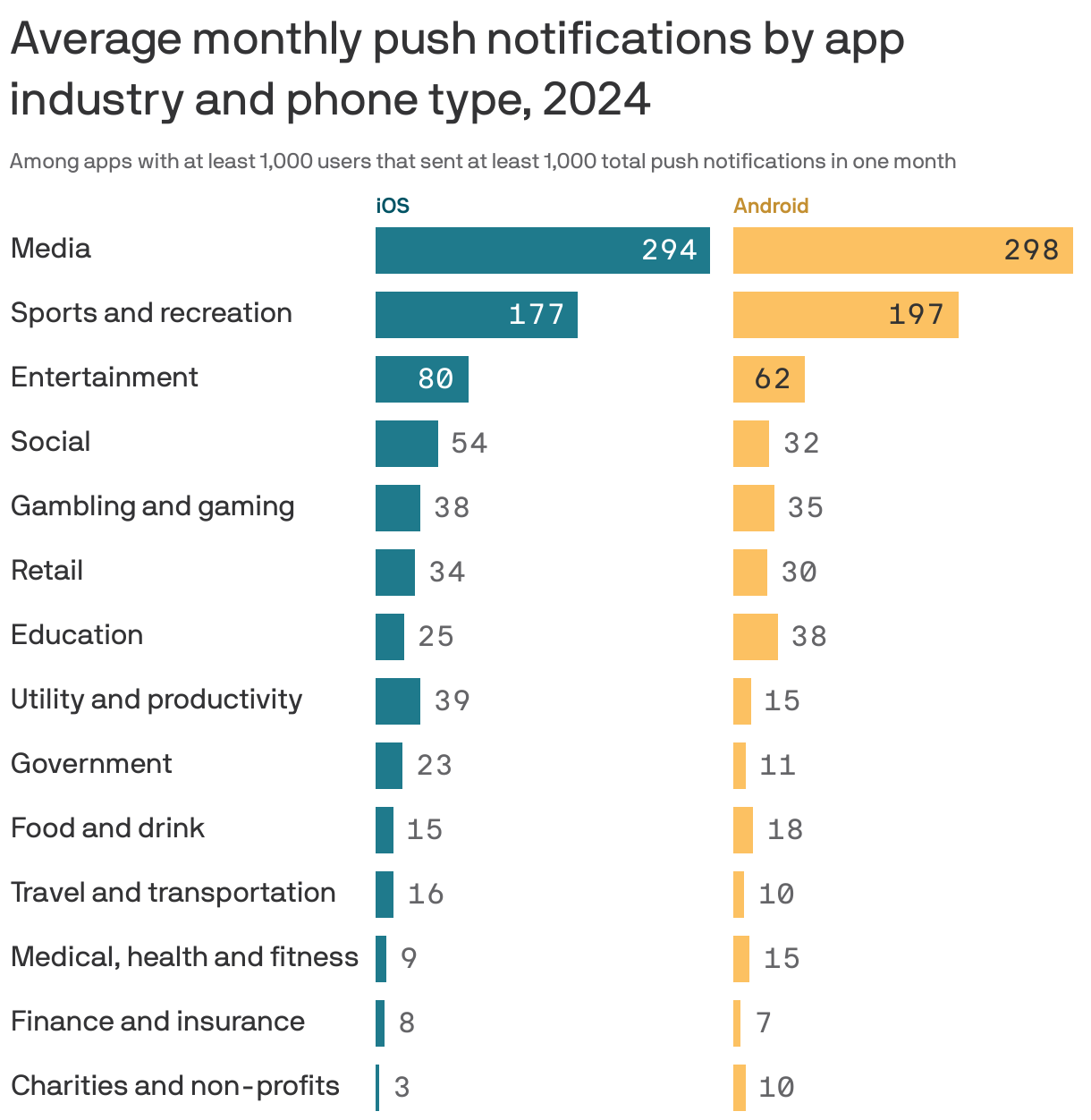
- Axios previously reported that media companies overall, both aggregators and publishers, are by far and away the most prolific push alert senders.
- While social media and search referrals remain important for traffic, the report said those platforms drive shallow engagement compared to alerts and newsletters.
Yes, but: There's a fine line between maximizing reach and overloading consumers.
- 🚨 The vast majority (79%) of respondents to Reuters' survey said they don't get any news alerts during an average week. 43% of those said they actively disabled notifications, saying there were too many or not useful.
- 📈 That comes as the share of respondents reporting receiving a news alert in the past week has ballooned from just 6% in 2014 to 23% now.
The big picture: Media companies need to use news alerts strategically to build their audiences and cannot solely rely on them to offset search traffic declines.
- About one-fifth said they used news alerts weekly as a starting point, with just 9% saying notifications were their main gateway.
8. Too many ad networks
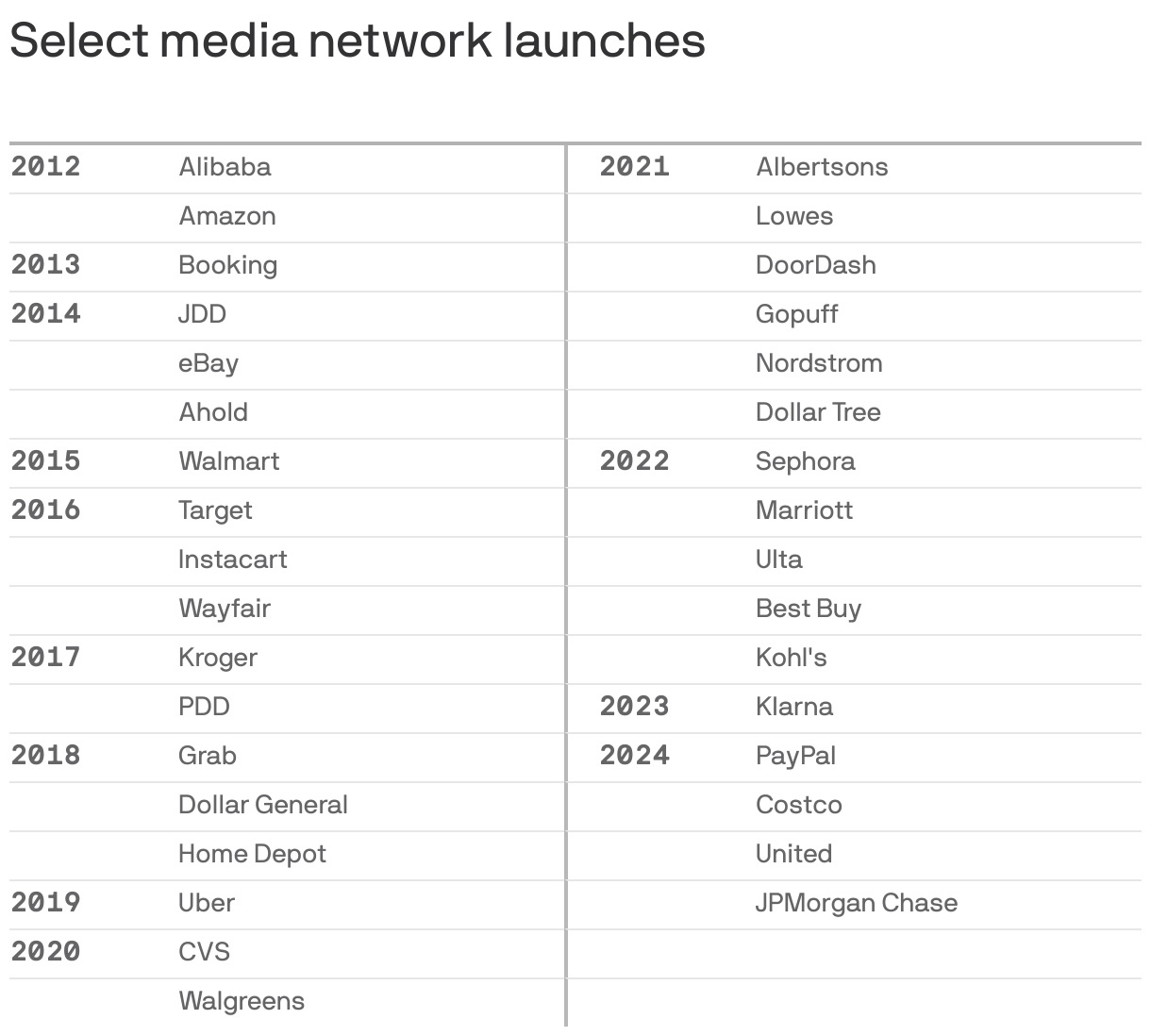
The doubling of global ad revenue to $1 trillion over the past decade has ushered in a new wave of companies eager to sell consumer attention.
Why it matters: Publishers aren't just competing with Big Tech to sell advertising, they're now also competing with some of their biggest brand clients.
- 🥂 On my way to Cannes, France, last week, United Airlines handed out drinks to customers boarding its flights from Newark to Nice, celebrating the one-year anniversary of its new ad network, Kinective Media.
- ✈️ "You've got to have scale," United MileagePlus CEO Richard Nunn told Axios in an interview. "We flew 174 million people in 2024, so we've certainly got scale. The quality of audience is obviously there. By definition, they're not bots. They're real people."
- 🖥️ Nunn also noted that the plethora of screens that a customer interacts with throughout their flying journey — from the apps on their mobile devices to the screens in the lounge, at the gate and on the plane — provides the company with a "multi-channel" digital platform to reach people with marketing and advertising.
How we got here: The massive growth in advertising over the past 10 years can mostly be attributed to the launch of the smartphone, which allowed social media and search companies to start selling a lot more inventory across their mobile apps.
- Over the past few years, other types of companies with scaled audiences, such as grocers, retailers and travel firms, have similarly built out advertising businesses as a way to make more money and upsell their existing customers.
- That trend has transformed the ad industry, shifting sales power from traditional publishers to technology firms.
Case in point: In 2011, the top five advertisers globally were mostly U.S. publishers: Google, Viacom and CBS, News Corp and Fox, Comcast, and Disney, per WPP Media.
- Today, the top five advertisers globally are all tech firms and two are Chinese: Google, Meta, ByteDance, Amazon and Alibaba.
Axios Media Trends