
Axios Markets

October 22, 2026

🌅 Good morning! We're waking up to oil prices up more than 2.5% and back near five-month highs after a report that the U.S. and Israel are planning renewed strikes after the midterms. And the AI trade once again looks under pressure after a sell-off in Asia overnight.
- Futures on the tech-heavy Nasdaq 100 are down 1.6%, as of 6:55am ET; S&P 500 futures are also pointing to a negative open.
- Treasury Secretary Scott Bessent is still bullish, telling investors at a private charity event yesterday that he does not see "a systemic problem" with the AI boom, per the Financial Times.
🗓️ Today, Matt tackles one of the thornier issues of the moment — the rapidly falling price of compute. Kalshi, meanwhile, wants to list its own market for compute, Axios colleague Nathan Bomey reports.
- Plus, a sad stat about the job market: 6 in 10 Americans are working bad jobs.
Let's get to it! 1,223 words, a 4.5-minute read.
1 big thing: The AI boom has a new complication
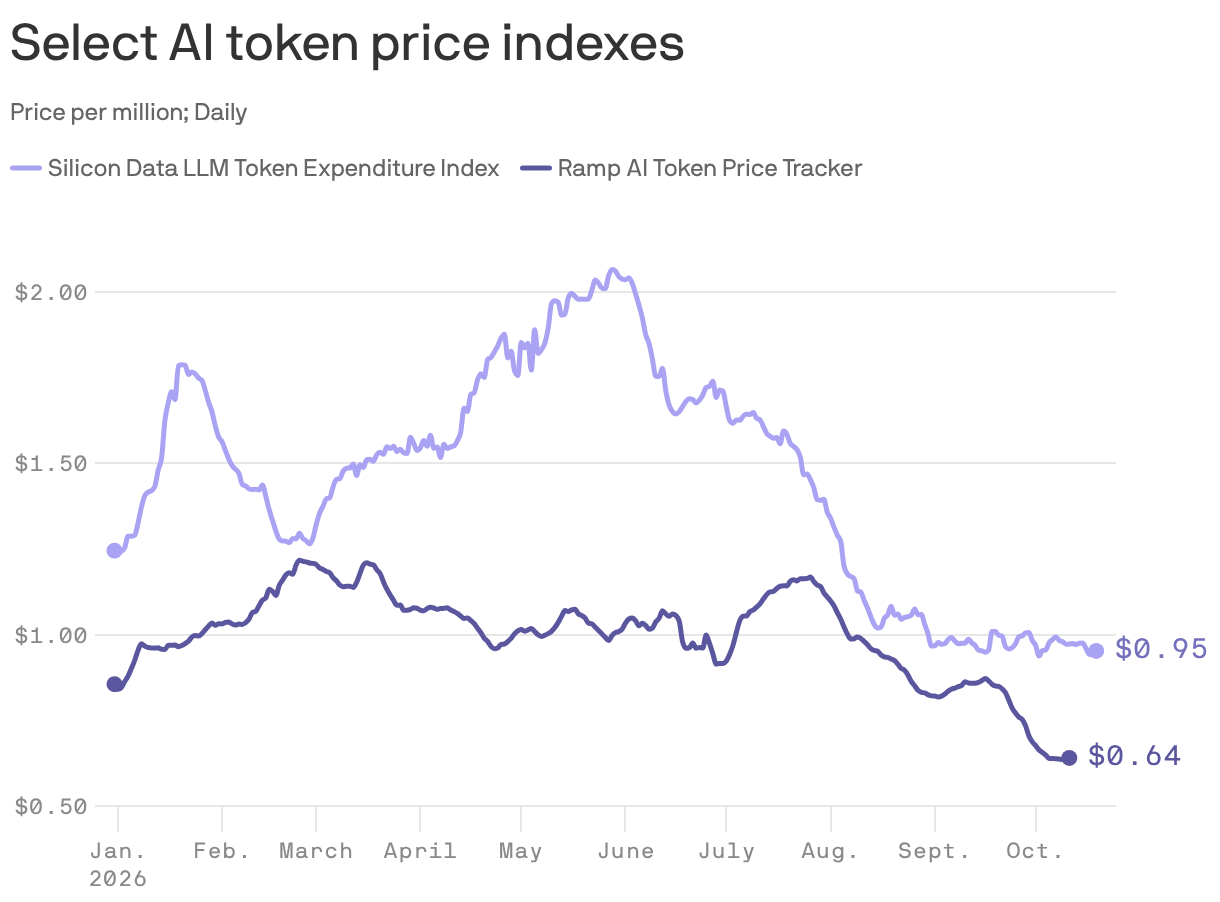
Prices for tokens — a measure of AI usage — have tumbled in recent months.
Why it matters: The price drop raises questions about the strength of an AI boom fueled by supposedly bottomless demand for computing power.
The latest: There's no token price that captures all activity, but several available public indexes show similar declines.
- Silicon Data's LLM Token Expenditure Index — a volume-weighted benchmark of AI token prices that captures a shifting mix toward lower-priced models — has broken the buck in recent days, falling below $1 per million tokens.
- It's down 54% from its peak of $2.07 per million tokens in late May.
- The token price index produced by corporate spending management company Ramp — based on spending by actual businesses on OpenAI and Anthropic — is down 48% from its late February peak of $1.22 per million tokens.
What they're saying: The collapse in token prices reflects both the impact of corporate customers switching to cheaper, open-weight models and the price cuts that OpenAI and Anthropic have made.
- "It's also a market in which the spend is not particularly sticky," Ara Kharazian, lead economist at Ramp, tells Axios. "And so, month over month, with the introduction of a new model, you can see billions of dollars of business spend shift from one provider to another."
- "It partly is because of a smart routing away from frontier models toward open models — that's the so-called end of cloud maxing or token maxing," says Steve Hou, head of research at Silicon Data.
- The decline also reflects that AI giants "have been cutting prices themselves, with each new generation being released with more capability, more powerful intelligence, but also at the lower price," Hou adds.
Increasing use of agents for longer AI interactions is also contributing to the decline in prices, says Chris Clark, co-founder and chief operating officer of OpenRouter, a software platform that lets developers use a range of AI models.
- That's because large chunks of these longer interactions are saved, or cached, rather than being rerun through the models. Tokens representing cached inputs are typically much cheaper than other tokens, Clark says.
The big picture: Whatever the reason, declining prices could prompt a recalculation of one of the largest investment booms in U.S. history.
Yes, but: The price drop has been largely shrugged off with frequent references to the so-called Jevons Paradox, an economic phenomenon in which technological improvement causes prices to drop, stimulating more economic activity at those lower prices.
- And that has been true, as far as it goes: AI usage, as measured in tokens, continues to rise incredibly quickly.
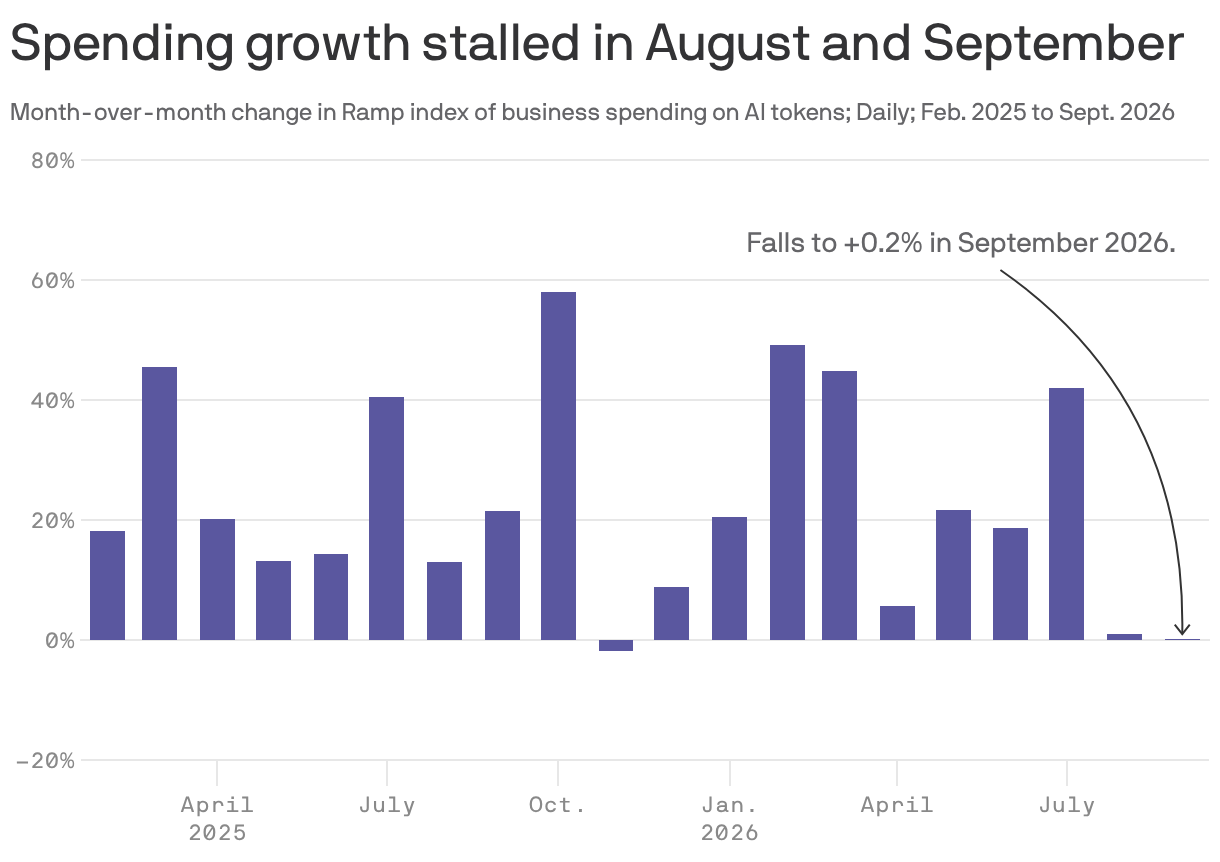
Friction point: By Ramp's accounting, however, token spending by businesses — as opposed to token usage — has been strangely flat for two consecutive months, even as businesses continue to burn compute.
- "For the first time, we're seeing token usage go up and token spend hold flat," Kharazian says. "And it's now occurred for two months straight."
The bottom line: Token spending by businesses is closely related to revenue for AI model makers.
- If spending is in fact beginning to flatline, that would be a big problem for the expected IPOs of AI companies like Anthropic — and for the AI trade that continues to be the engine driving the markets and economy.

2. Kalshi wants permission to list compute markets
Kalshi is asking federal regulators for permission to re-list compute derivatives, which would allow users to trade on the future cost of renting GPUs, the powerful chips used to run AI.
Why it matters: The prediction market was reportedly ordered by the Commerce Department to take down compute markets earlier this year over national security concerns. (Commerce denied that it did so.)
Driving the news: Sudhir Jain, Kalshi's chief compliance officer, said yesterday on LinkedIn that Kalshi had submitted comments to the Commodity Futures Trading Commission asking it to allow the markets.
- That would ensure that "price discovery" on GPUs happens in the U.S., not offshore, he argued.
- "Compute already fits the definition of a commodity" and "both sides have a reason to hedge" on compute pricing, Jain wrote. "Buyers like AI labs can lock in costs. Providers like data center operators can protect the revenue behind their GPU investments."
What they're saying: The CFTC declined to comment.
3. A majority of Americans have low-quality jobs
Only about 4 in 10 American workers say that they have a decent job, finds a new survey on job quality from Gallup out today.
Why it matters: Bad jobs aren't just a misery for employees — for companies, they're linked to costly turnover and higher health care expenses.
Zoom in: Gallup defines a quality job as one that meets minimum standards across a few dimensions: fair pay and benefits, a safe and respectful workplace free from harassment and discrimination, and a predictable schedule.
- Gallup surveyed 17,874 employed adults ages 18 to 75 from Jan. 26 to March 24.
By the numbers: This year, 41% of workers meet Gallup's standards for a quality job, unchanged from 2025.
- Older workers and those with advanced degrees are more likely to have a good job.
- Those with low-quality jobs were nearly twice as likely to work for a different employer after one year.
- And 51% of those with higher-quality jobs report better health, compared with 35% in non-quality jobs.
The big picture: This is the second year Gallup has released its American Job Quality study and it comes at a turbulent time for workers.
- While at a high level, the labor market looks good — with low unemployment and few layoffs — hiring rates are down. If you don't have a job, it's hard to land one, a particularly vexing problem for new grads.
Between the lines: This is partly an AI issue.
- Some employers are looking to see if they can do more with fewer workers, as they incorporate AI into their workflows, HR executives and workplace experts said at an event hosted by Charter this week.
- The twist: AI use is more common in the better jobs typically held by college grads, per Gallup. Those are the workers stressed that AI will replace them.
The bottom line: Most Americans are working in low-quality jobs — and those with a good job worry about AI taking it away.
Thanks for reading! Send us your thoughts, questions and suggestions for coverage or just say hello at [email protected] and [email protected] or reply to this email.
Thanks to Jeffrey Cane for editing and Carlin Becker for copy editing this edition.
Tell your friends to sign up here.
Sign up for Axios Markets

Stay on top of the latest market trends and economic insights