Axios Markets

March 15, 2024
Happy Friday! If this 32-hour workweek bill happens — probably not, but let's dream — many of you could be off today. Maybe us.
- Instead, we bring you news of steel deals, imploding numbers, and, of course, a chart for a treat. All in 977 words, 4 minutes.
1 big thing: Steelworkers' long game
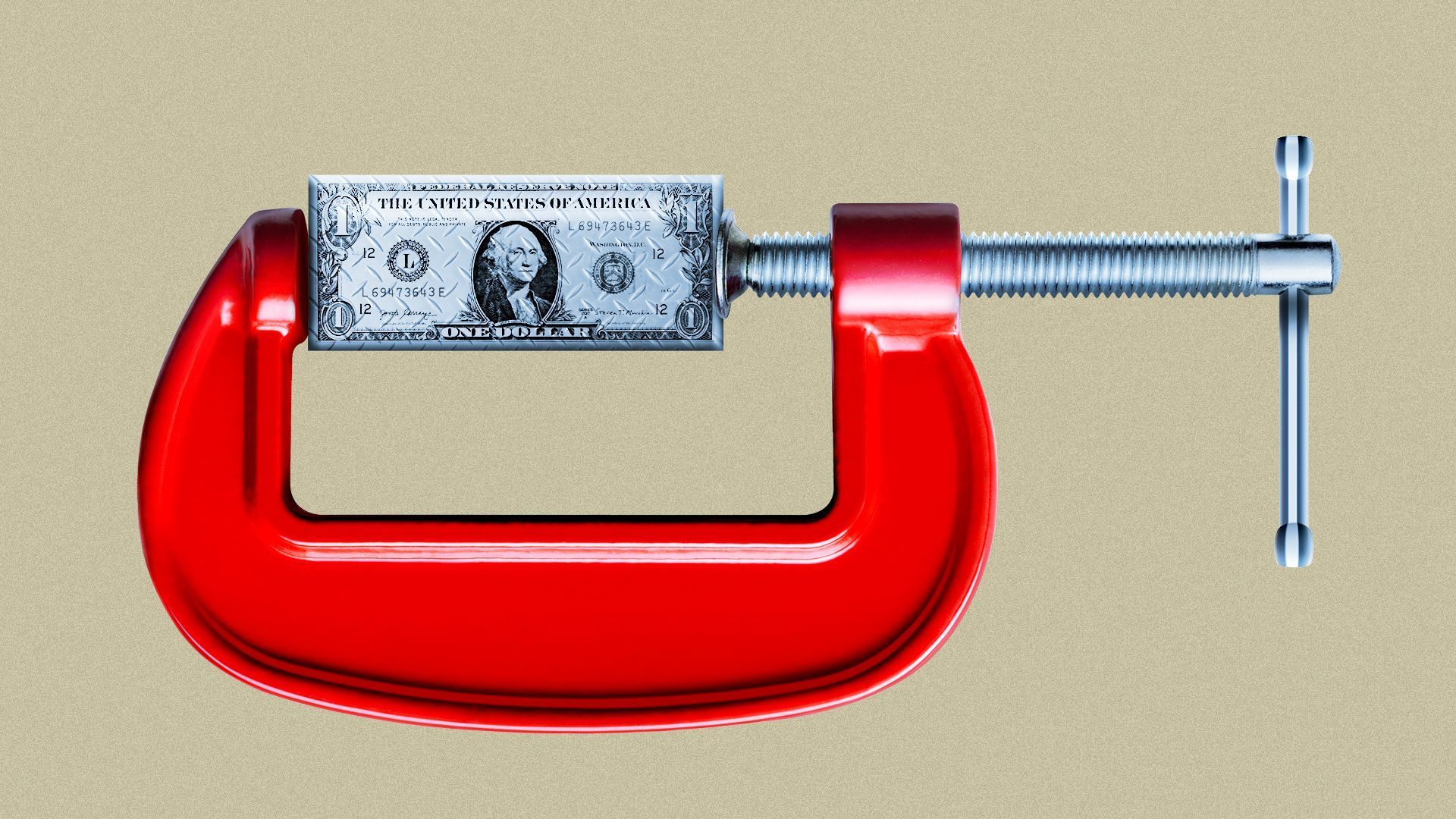
Illustration: Sarah Grillo/Axios
When President Biden spoke yesterday against Japan-based Nippon Steel's planned $14.9 billion acquisition of U.S. Steel, it was a win for the United Steelworkers — it's been blasting the deal for months, Emily writes.
Why it matters: The union's political influence stems from labor's heightened leverage in an election year — but a less understood factor involves the Steelworkers themselves.
- The union has a long history of influencing corporate M&A dating back to the 1980s when the steel industry was first upended by foreign competition.
Catch up quick: "[I]t is vital for it to remain an American steel company that is domestically owned and operated," Biden said.
- He called union president David McCall to "reiterate that he has the steelworkers' back," the White House said.
- The president could block this deal if CFIUS, the Committee on Foreign Investment in the U.S., recommends he do so.
- U.S. Steel shares dropped about 6% yesterday — they're trading at a 30% discount to Nippon's offer.
Zoom in: Biden's opposition to this deal comes after months of lobbying from both the union and Ohio-based steel company Cleveland-Cliffs, the WSJ reported.
- Cleveland-Cliffs tried to buy U.S. Steel last year, in a deal the union supported.
- One of Cleveland-Cliffs' board members, Ron Bloom, is a former adviser to United Steelworkers. He was a "key player" in 2007 when the union blocked the acquisition of steelmaker Wheeling-Pittsburgh by Brazil's CSN, notes a company press release from January.
The big picture: Decades ago, the steelworkers union started playing an active role in M&A after the industry began shrinking.
- "Instead of confronting management with traditional demands, the steel union decided its best hope for preserving jobs and benefits was to back good companies that could make money," reported the WSJ in 2007.
- "It began trying to pick winners and losers, often diving into restructuring battles."
They often played a role in shaping the deals themselves. In 2001, the union agreed to back Wilbur Ross' acquisition of LTV Steel, out of bankruptcy, if he put aside some profits from the new entity into a trust for steelworker retirees. Ross agreed.
- The union blocked the Wheeling-Pittsburgh deal by wielding a clause in their labor contract that gave them veto power. The union then sided with another buyer, Esmark — which agreed not to lay off workers. That deal went through.
Fun fact: Last year, Esmark said it wouldn't make a bid for U.S. Steel out of respect for the union.
- "The USW was our partner in the successful acquisition of Wheeling Pittsburgh Steel, and we remain close with them," said Esmark CEO Jim Bouchard.
One way the union wields influence is through detailed successorship clauses explaining what happens if a company is sold.
- In U.S. Steel's case, the union has previously said its contract requires any prospective buyer to agree to a new labor deal before a sale can be finalized.
Reality check: A president has only blocked a foreign transaction seven times since 1990.
The bottom line: The union has said that neither Nippon nor U.S. Steel talked to them before the deal was announced. That may have been a big mistake, says John Logan, a labor historian at San Francisco State University.
2. NYCB's imploding earnings


New York Community Bancorp's stock rose last week on the news that it was getting rescued by a private equity consortium led by Steve Mnuchin. But its expected earnings plunged, Felix writes.
Why it matters: In early February, after NYCB took an extraordinary charge of $552 million for credit losses on its commercial real estate portfolio, the message from the bank's leadership was that it was still solidly profitable.
- That has now changed: Wall Street's earnings estimates for both the first quarter and the full year of 2024 turned sharply negative over the last week.
Between the lines: Before Mnuchin's $1 billion cash infusion, NYCB desperately needed the confidence of Wall Street, and had a very strong incentive to report positive earnings every quarter.
- Now that the bank's solvency has been assured, the new management team can afford to front-load bad news.
- Bank earnings are as much art as science, in terms of whether and when provisions should be taken against a loan portfolio.
- By taking another big provision in the first quarter, NYCB's new management would create a runway for future profits, while lumping their predecessors with implicit blame for current losses.
The bottom line: There wasn't any formal earnings guidance on NYCB's most recent call with analysts, on March 7. But since then, every single analyst covering the stock has slashed their first-quarter earnings forecast to a negative number.
3. Four-year anniversary


Office occupancy levels on the busiest day of the week are just 62% of their February 2020 average, according to Kastle Systems' office swipe data for 10 major metros, Emily writes.
Why it matters: It's been four years since COVID first shut down offices in the U.S., and the decline in office use has touched nearly all aspects of our lives — from where people live to how they structure their work-family balance to the way companies operate.
- The shift is, of course, roiling the commercial real estate market, as we wrote about earlier this week.
Zoom in: Peak office days, typically Tuesdays or Wednesdays, are a useful measure for employers that need to have space available for everyone who wants to come to work in person.
- And they give a better sense of the return to office momentum than Kastle's previous system of just publishing the five-day average, says Kastle CEO Haniel Lynn.
- While occupancy is at 61.7% on those high-attendance days, it falls to around 35% on Fridays.
- Those Fridays drag down the weekly average — it was only 52.5% for the week ending March 6.
The bottom line: The number on peak occupancy days has been creeping up, though isn't likely to go back to 100% anytime soon, says Lynn.
Was this email forwarded to you? Subscribe here.
Axios Markets is edited by Kate Marino, and copy edited by Mickey Meece.
Sign up for Axios Markets

Stay on top of the latest market trends and economic insights