
Axios Markets

January 22, 2025

👋 Good morning! Today we're tackling one of the strongest vibe shifts of the new Trump era: The return to office, and what happens when your best people don't want to come back full-time.
- Plus: America's population problem, and President Trump's revealing remark about TikTok.
- All in 935 words, a 3.5-minute read.
🚨 Situational awareness: Trump last night said he's looking at a 10% tariff on China to kick in Feb. 1. It's unclear how it could happen that fast.
1 big thing: Trump's looming talent exodus
The federal government will have a tougher time attracting and retaining talented employees now that President Trump has ordered workers back to the office full time, experts tell Axios.
Why it matters: That's likely the point. Trump's return-to-office executive order is part of a broader DOGE effort to cut the size of the bureaucracy.
- Finding new people to work for the federal government is clearly not a priority.
The big picture: It's been years now, but employers are still banging the drum on return to office. Now as the labor market slows — and businesses care less about hanging on to employees — they're starting to notch wins.
- 75% of workers with jobs that could be done remotely said their employer has put in-person mandates in place, according to a Pew Research survey conducted last fall and released last week. That's up from 63% in 2023.
Zoom out: Trump and DOGE head Elon Musk have telegraphed the return-to-office push for months, said Rob Sadow, CEO of Flex Index.
- The real momentum started with Amazon calling folks back to the office last fall, he said. He expects more companies to issue RTO announcements in the coming months.
- Some big employers like JPMorgan already have such programs underway.
Between the lines: Return-to-office pushes can often be a way for companies (and governments) to do layoffs without technically having to fire anyone.
- For the Trump executive order, that appears to be the plan.
- "Requiring federal employees to come to the office five days a week would result in a wave of voluntary terminations that we welcome," Musk and Vivek Ramaswamy, who is stepping down from DOGE, wrote last year in a Wall Street Journal opinion piece.
Republicans have been pushing for federal workers to return to the office for some time.
- In a 60-page report out last year, Sen. Joni Ernst (R-Iowa) said, essentially, that those claiming to work remotely were "phoning it in."
Yes. but: The government has long been at a recruiting disadvantage to the private sector because the jobs pay less, and in the case of certain sectors, like technology, it's hard to lure people away from the West Coast to Washington.
- Remote work or, better yet, policies that let people work from anywhere, gave the government a hiring edge, Prithwiraj Choudhury, a professor at Harvard Business School, told Axios.
- A work-from-anywhere policy at the U.S. Patent and Trademark Office led to a 4.4% increase in productivity, per research he conducted. It also led to lower rates of attrition and helped the patent office attract and retain women.
- Remote work opportunities tend to attract more diverse talent, according to research on startup jobs released in 2023. That's also not a priority for the Trump administration.
What they're saying: "Without the flexibility option, it's going to be extremely hard for federal agencies to attract and retain talent," Choudhury said.
- The executive order "will lead to high quit rates, particularly amongst hot skill areas like IT," Stanford University economist Nicholas Bloom wrote on LinkedIn.
What's next: Trump's order does leave some wiggle room, mandating the change to happen "as soon as practicable" and allowing for "exemptions" as department and agency heads deem necessary.
- Meanwhile, some unions representing public-sector employees negotiated telework arrangements in their contracts, as NPR has pointed out. Those agreements would be hard to break.
2. Charted: The last U.S. population surge
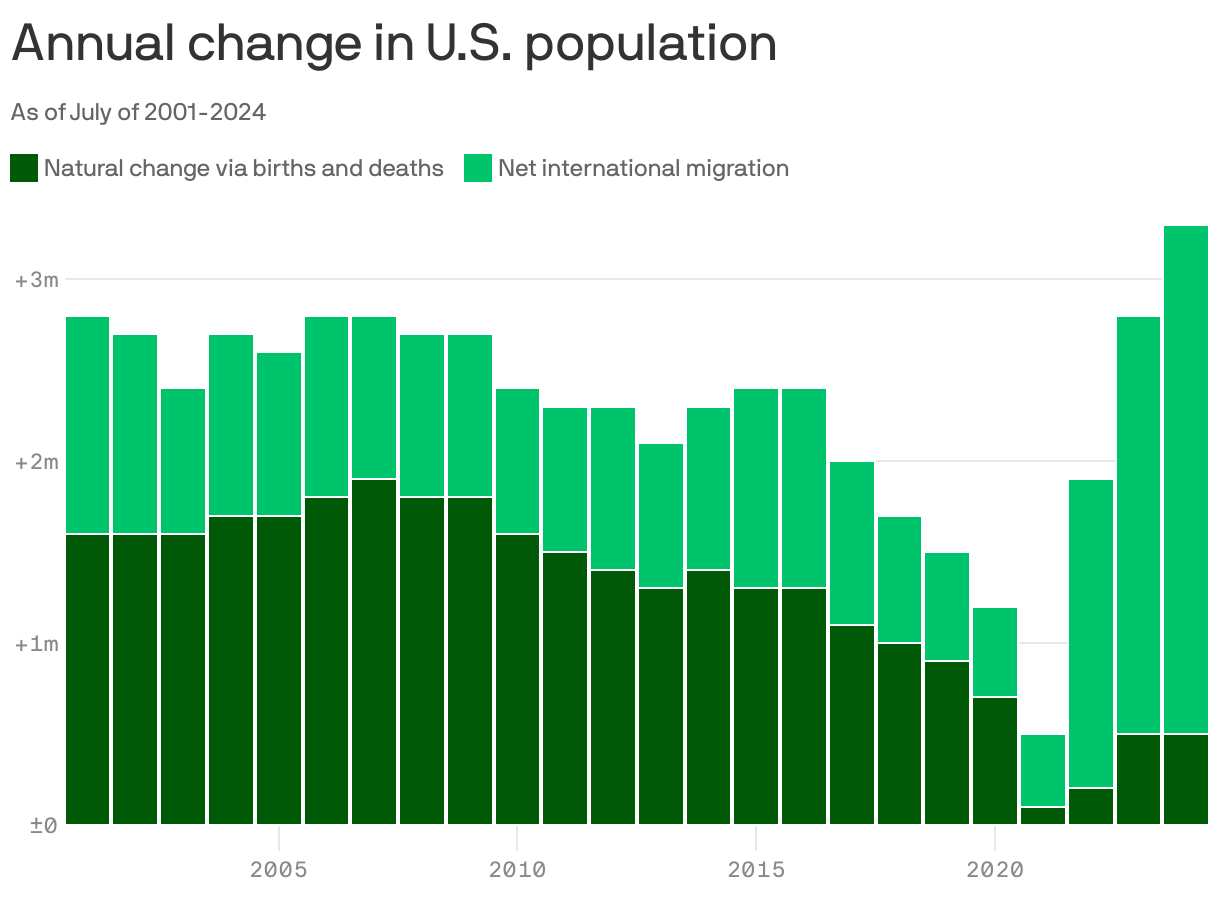
The U.S. population grew by more than 3 million people last year, the fastest growth of the century so far.
Why it matters: That economic tailwind is certain to diminish greatly as Trump's anti-immigrant agenda kicks in.
The big picture: The U.S. is heading into an era of population growth of around 0.4% over the next few years, down sharply from 1% last year, per a new paper from S&P Global.
- That marks its slowest growth since the early 1950s, outside the pandemic year of 2021.
- "It is unlikely," wrote S&P U.S. chief economist Satyam Panday, that any increase in the employment-to-population ratio will be enough to "offset the drag from slower immigration."
The bottom line: Any increase in GDP is, mathematically, just the increase in the number of workers multiplied by any increase in their productivity.
- The Trump administration has a target of 3% GDP growth.
- But if Biden couldn't hit that level with record-high immigration, it's hard to see how Trump will achieve it with immigration rates plunging.
3. Quoted: Why Trump flip-flopped on TikTok
"I went on TikTok and I won young people by 36%."— President Trump
Trump was asked Monday night why he's now opposing a ban on TikTok. His answer: "Because I got to use it."
- "I went on TikTok and I won young people by 36%," he said.
- "And Republicans typically don't do too well with young people but it's a different Republican Party," he said while chatting with reporters in the Oval Office and signing executive orders.
Reality check: Trump got the narrative right but the number looks off.
- The president's share of support among voters ages 18 to 29 jumped 10 points in 2024 from 2020, per an analysis conducted at Tufts University.
- Still, a majority of young voters favored Kamala Harris (51%) over Trump (47%), according to AP VoteCast.
The big picture: The remarks neatly encapsulate Trump's transactional approach to politics — deliver for him, and he'll deliver for your company.
Catch up fast: In his first term, Trump threatened to close down TikTok because of the threat his administration said it posed to national security. On Monday night, Trump played that threat down.
- "TikTok is largely about kids, young kids. If China's gonna get information about young kids...I think we have bigger problems than that," he said.
Thanks to Ben Berkowitz for editing and Anjelica Tan for copy editing.
👋 We'd love to hear from you! What are you hoping to read about in the new Trump era? What's the big issue on your mind? Or send us some good jokes and reading recommendations.
- Just reply to this email or click here.
Sign up for Axios Markets