Axios Markets

May 06, 2026

πͺ Hi! This morning, stock futures are surging, government bond yields are falling, and oil prices are tumbling after Axios reported that the White House believes it is getting close to a deal with Iran. Meanwhile, I'm flying back to the East Coast this morning from the Milken conference, kind of like a sunnier Davos (with palm trees!).
- Today, I'm sharing a smidge of what I've learned βΒ mainly that the sunniness extends to the vibes about the overall investing picture. Despite (waves hands) everything βΒ the Milken crowd is very optimistic.
Plus, Wall Street is cutting deals with Anthropic and OpenAI, and why borrowing in the U.K. keeps getting more expensive.
All in 1,293 words, a 5-minute read.
1 big thing: π΄ CEOs at Milken: Don't worry
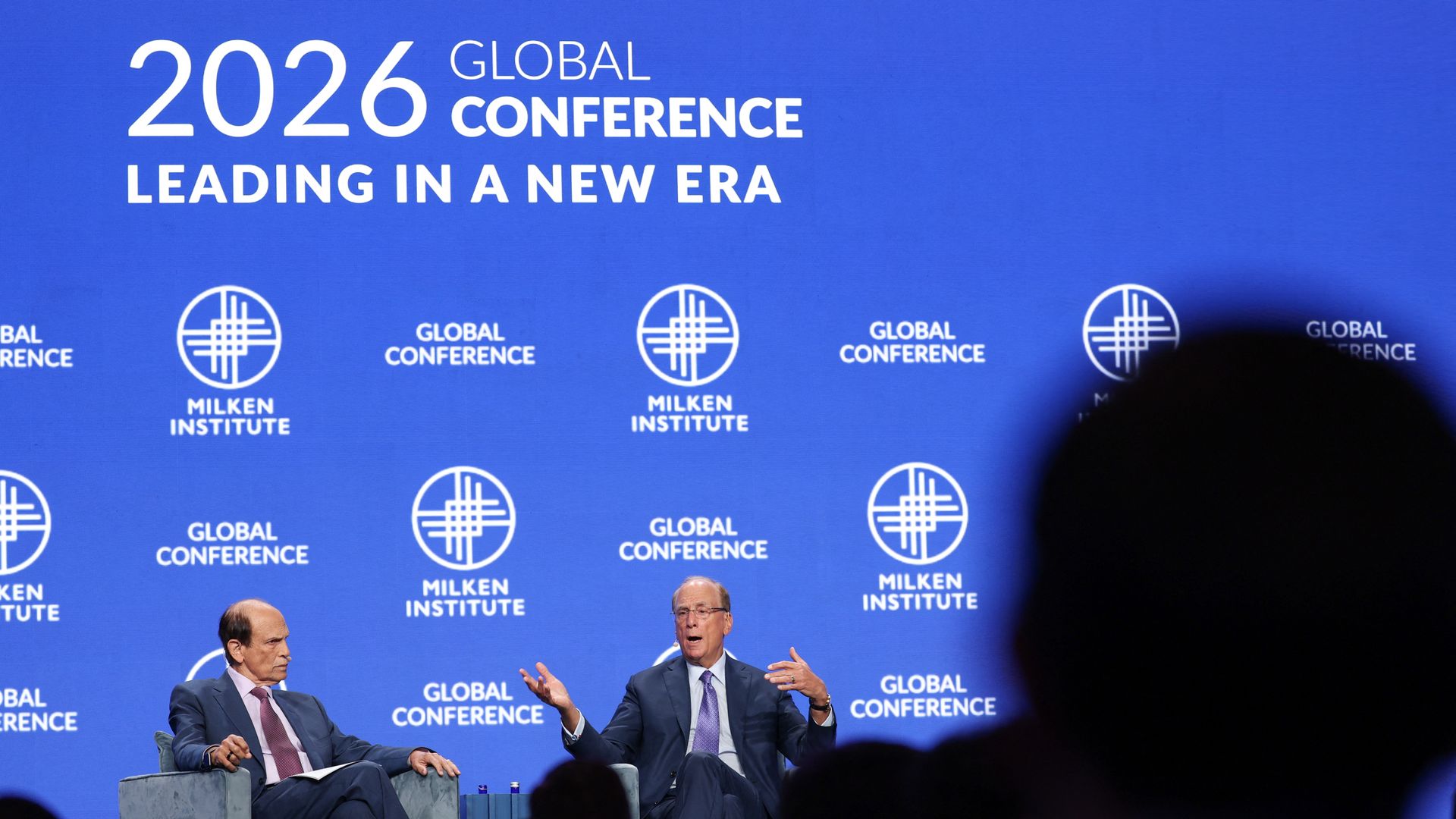
The movers and shakers at the Milken Institute Global Conference in Beverly Hills, California, this week β ranging from CEOs and investors to celebrities (Shaq!) and politicians like Sen. Ted Cruz (R-Texas) and Rahm Emanuel β are all navigating a complex landscape in a couple of ways.
The big picture: The global economy is going through a historic transformation, creating a range of challenges.
- Also: The Beverly Hills Hilton, longtime home to the 29-year-old conference, is under construction β leaving less room for schmoozing and some weird logistics.
Zoom in: These include a windowless tunnel connecting the building to another luxury hotel, the Waldorf Astoria, which also hosted some of the conference's panels and meetings.
- Mutterings from attendees scuttling through the tunnel were frequently overheard: "It's not usually like this," "This is so weird" and the like.
- "It's such a logistical nightmare," Kate Moore, chief investment officer at Citi Wealth, tells Axios.
Between the lines: In many ways, the global economy is also under construction.
- The world of free trade, where money and resources flowed to the countries and companies that made the best and cheapest stuff, is fading.
- If President Trump's tariffs didn't already make that clear, the Iran war is now shining a spotlight on the new reality. No longer can other countries be relied upon to facilitate the open and free flow of resources.
- Things are gummed up β by conflict and increasing nationalism. Nations need to increasingly rely on their own resources, build them out or turn to trusted allies.
"The world has shifted to where the paradigm of 'let's just have integration and do things in the cheapest possible place' is just not going to work without you feeling like you could be taken advantage of or that will be weaponized against you," Karen Karniol-Tambour, co-chief investment officer at Bridgewater Associates, the world's largest hedge fund, said on a panel.
The intrigue: It's a take echoed around the conference, but it doesn't seem to have dampened investors overall optimism about the economy.
- Again and again, folks remarked to Axios that there was little concern among attendees β among them some of the richest people on the planet β about the Iran war.
- Any anxiety over the conflict and its supply disruptions and inflationary pressures seemed dwarfed by immense optimism, particularly around AI.
What they're saying: "It's very optimistic," says Seema Shah, chief global strategist at Principal Asset Management, summarizing what she's been hearing.
- Things like: "There's a lot of capital. There's a lot of liquidity, and don't worry about private credit. Don't worry about AI. Don't worry about geopolitics."
Case in point: When uncertainty is high, there's typically a significant decline in risk appetite, says Andrea Guerzoni, global vice chair at EY-Parthenon.
- That's not happening at the moment β instead, dealmaking is thriving, he says.
- "We have reached really a level that is similar to the peaks we observed immediately after the COVID crisis, which is quite striking."
The bottom line: The economy's power players are feeling good about the economy, even as it's going through extensive renovation.
2. π€ Wall Street cozies up to the AI startups
Bankers and dealmakers were bullish on AI before most others. Now, they are cutting deals with the two giant AI labs, Anthropic and OpenAI, before they go public as expected this year.
Driving the news: Anthropic is expanding its partnerships with the world's biggest banks and launching 10 new agents tailored to common financial workflows.
- The new Claude agents will target general financial work, like building pitchbooks and models or reviewing audits and valuations.
- Claude will be available across the Microsoft 365 suite, and agents will carry memories, or context about you, across different apps (so if you change a model in Excel, that will be reflected in a PowerPoint deck, for example).
What they're saying: "The technology is so powerful, it's worth the trillion-dollar investment," JPMorgan Chase CEO Jamie Dimon said at an Anthropic event yesterday unveiling the new partnerships and AI agents.
- At the Milken conference, BlackRock CEO Larry Fink told a panel: "This is not an AI bubble. There is the opposite. We have supply shortages. Demand is growing much faster than anyone ever anticipated."
Separately, private equity firms are forging deals with both Anthropic and OpenAI to form AI consulting firms, Axios Pro Rata's Dan Primack reports.
- The new joint ventures will be backed by both private equity and venture capital firms.
Flashback: Months before ChatGPT was launched in 2022, Morgan Stanley signed on as one of OpenAI's first clients, per Bloomberg.
- In January 2025, Goldman Sachs CEO David Solomon said AI could do 95% of the drafting of a prospectus "in a few minutes."
State of play: Currently, Anthropic is the dominant AI provider on Wall Street, but competitor OpenAI launched a new suite of tools focusing on financial use cases alongside its latest model release, GPT-5.5.
The bottom line: Wall Street is eager for the AI revolution to get underway and automate more of its work.
3. π¬π§ The U.K.'s high cost of borrowing


Long-term borrowing costs in the U.K. are on the rise as signs that the Iran war will be prolonged heighten worries over inflation.
Why it matters: All the developed economies have been negatively impacted by the energy shock, but the U.K. has been particularly susceptible because of its elevated inflation before the start of the war.
- As Axios' Courtenay Brown noted in late March, the U.K.'s "reliance on imported oil makes it especially vulnerable to the types of supply shocks that have been common in the 2020s."
Zoom in: There's also a political factor here: Local elections are being held in England and some other parts of the U.K. tomorrow.
- A dismal showing for the governing Labour Party would turn up the heat on Prime Minister Keir Starmer.
- Bond investors have been pricing in potential changes to government policies and leadership.
- "Politics is not background noise," Luke Hickmore, the investment director for bonds at Aberdeen Investments, told The Guardian. "In today's gilt [bond] market, it is a fundamental part of the investment signal."
By the numbers: The yield on the 30-year U.K. gilt rose as high as 5.78% yesterday β the highest it has been since 1998.
- The yield on the 10-year gilt again rose above 5%. (In comparison, the 10-year U.S. Treasury yield was 4.4% yesterday.)
Yes, but: Robin Brooks, former chief economist at the Institute of International Finance, recently argued on his Substack that there has been an overreaction to higher U.K. yields.
- He notes that the Bank of England has been "quicker and more aggressive than other central banks in downsizing its bond holdings."
- That quantitative tightening has been pushing yields up, he says.
Editor's note: Yesterday's item about Amazon's move to offer shipping and fulfillment services misidentified the rival it was on the verge of overtaking in 2024. It was the United States Postal Service (USPS), not United Parcel Service (UPS).
Send me tips and story ideas: [email protected] or reply to this email.
Thanks to Jeffrey Cane for editing and Carlin Becker for copy editing this edition.
Tell your friends to sign up here. You can also hit me up on X.com or Bluesky at EmilyRPeck.
Sign up for Axios Markets