Axios Markets

May 09, 2022
🌅 Good morning! We're getting into some serious stuff today. Matt has the latest on your electric bill and it's not pretty. Plus, Emily's breaking down some numbers on the pandemic jobs recovery.
🚨 Situational awareness: Wordle fans need to know that there are apparently two words today. (NYT)
Today's newsletter, edited by Kate Marino, is 1,035 words, 4 minutes.
1 big thing: The end of the bezzle
Illustration: Sarah Grillo/Axios
You only find out who is swimming naked when the tide goes out.— Warren Buffett
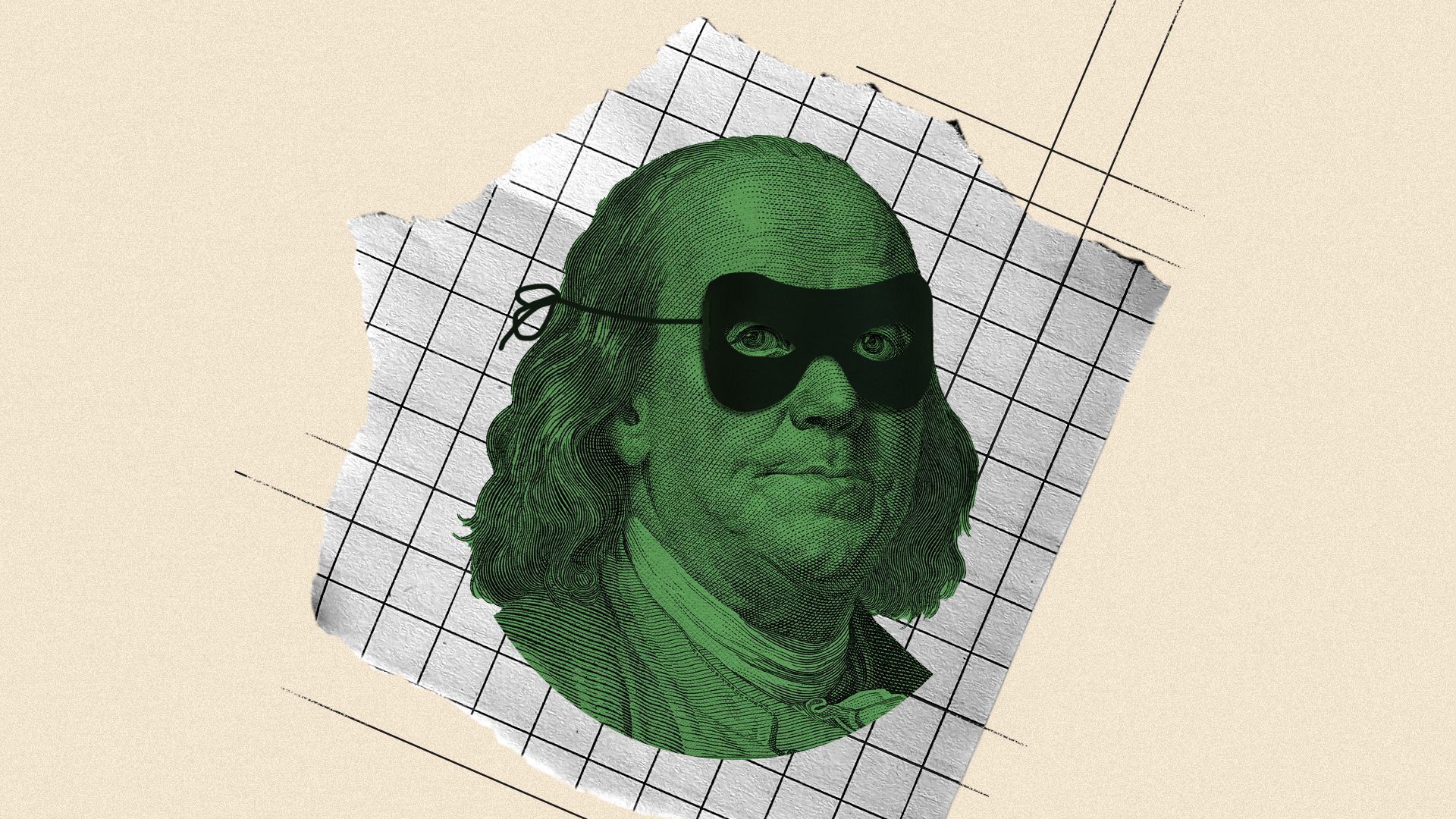
Bull markets engender trust that verges on complacency, or even gullibility. When they start to drop — as they are doing right now — there is a sharp rise in mistrust, as frauds are uncovered and shady dealings condemned, Axios' Felix Salmon writes.
Why it matters: Regulators have signaled they're more serious about cracking down on financial criminals than they have been in decades. Such activity is unlikely to be hard to find.
Driving the news: Federal prosecutors in New York last month charged hedge fund manager Bill Hwang with federal racketeering charges that could send him to prison for the rest of his life. The Department of Justice is reportedly using big banks as its informants on Wall Street. And the SEC is doubling the size of its division devoted to prosecuting crypto fraud.
- Be smart: "The everything crackdown" seems to have arrived. The resulting headlines are only going to increase the degree to which normal Americans think that the market is rigged against them.
Between the lines: Hwang didn't profit at the expense of others — in fact, he was the biggest loser in his scheme. But losing money is no defense.
- In cases like these, losing money can be precisely what causes shady activity to be uncovered. The allegedly defrauded counterparties — ultra-sophisticated financial institutions who had their eyes wide open at all times — only realized something was wrong when they (and Hwang) lost billions.
- Prosecuting Hwang will be hard and will take many years. In the crypto world, by contrast, it's hard not to find activity that thumbs its nose at securities law.
The big picture: In general, economies grow faster the more that participants can trust each other. But there will always be bad actors who take unfair advantage of that trust.
- When markets turn, more investors tend to want to take their money out. That's when victims of fraud find out the money has disappeared. The Bernie Madoff fraud is a prime example — it couldn't survive the downturn of 2008, since the higher Madoff marked his clients' positions, the more likely they were to want to cash out.
- Until the point of discovery, the money is gone, but the victim feels no loss. Economist John Kenneth Galbraith, writing in 1955, named this "net increase in psychic wealth" the bezzle, and explained that it invariably increases in bull markets, only to shrink when "money is watched with a narrow, suspicious eye."
The bottom line: As John Mills wrote in 1867: “Panics do not destroy capital; they merely reveal the extent to which it has been previously destroyed by its betrayal into hopelessly unproductive works.”
3. Charted: Pandemic jobs recovery, by industry
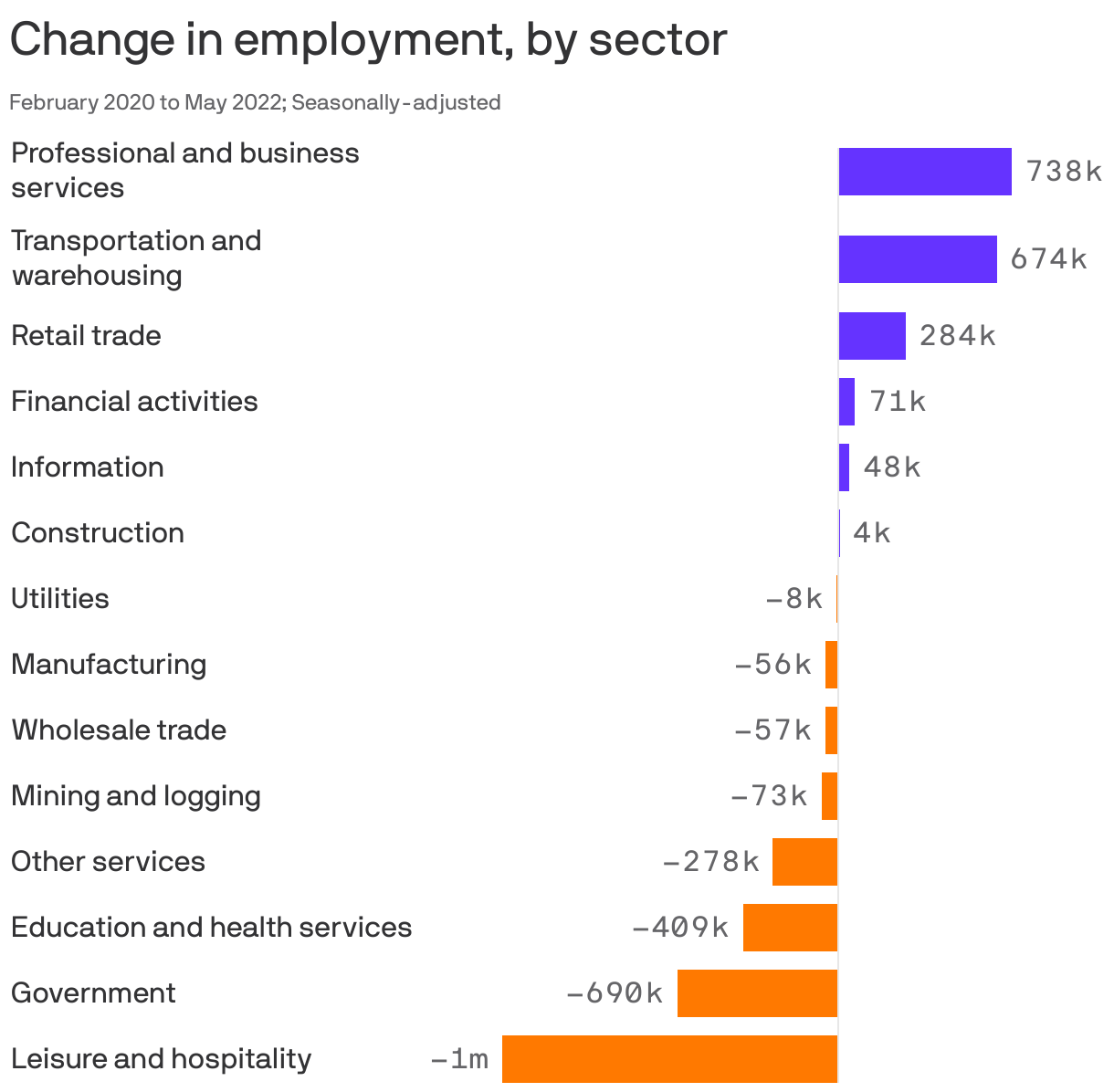
Some sectors bounced back to pre-pandemic levels faster than others, as evidenced by this nifty chart comparing details of the April 2022 jobs report to February 2020, Emily writes.
The big picture: The total number of U.S. jobs hasn’t yet climbed back to pre-pandemic levels. But underneath the headline, areas of the economy like professional services, or transportation and warehousing, have recovered any ground they lost in the pandemic — and then some.
- Others, not so much: Employment in the leisure and hospitality sector is still down by 1.4 million — or 8.5% — from its pre-pandemic level in February 2020, according to the Bureau of Labor Statistics.
- That could be as much about the labor shortage as anything else. Job growth was strong in the sector in April and wages are up 8.4% from last year.
4. Zero-COVID collides with corporate outlooks
Illustration: Natalie Peeples/Axios
COVID’s spread in China comes as the rest of the world sees the pandemic fading, Axios' Hope King writes.
Why it matters: Prevention measures like lockdowns of major cities are a double whammy for companies that rely on China for production as well as consumer demand.
- We wrote last month about how that could hurt global growth. Now we’re hearing from companies on specifics.
What's new: Under Armour and Adidas, which both source from China, reported huge declines in quarterly sales in their businesses in the country.
- Starbucks said it was suspending its fiscal 2022 outlook due to the lockdowns in the country.
- And Apple warned last month that the lockdowns would limit sales growth due to both supplier and consumer constraints.
State of play: A new Omicron variant caused a spike in COVID cases in China starting in March, prompting the country’s officials to partially or fully lock down major cities including Shanghai, which has been in lockdown for six weeks.
What they're saying: "72% of the 225 cities we're in experienced Omicron outbreaks, including Shanghai and Shenzhen," Starbucks China chairman Belinda Wong told analysts on an earnings call.
- Under Armour CFO David Bergman told analysts that revenue in the company's Asia Pacific region has been affected not only by inbound shipping delays but also by "significant reductions in retail traffic" due to restricted store hours and closures.
What to watch: Expect more companies to warn of similar impacts as earnings season continues.
5. 🥵 Electricity costs are heating up


U.S. natural gas soared last week, as the war in Ukraine continues to inject a fear premium into global energy markets, Matt writes.
Driving the news: Prices for U.S. benchmark Henry Hub natural gas — named for a pipeline junction in Louisiana where physical delivery occurs — jumped more than 10% last week alone, to over $8 per metric million British thermal units.
- The surge erupted as Europe appeared close to imposing an embargo on Russian crude oil, a move that would raise global demand for other kinds of energy that can be imported, like liquified natural gas.
Why it matters: Natural gas is the fuel for about 38% of American electricity generation — so higher natural gas prices mean higher electricity prices.
The bottom line: Electricity prices were already up 11% from the prior year as of March, according to the latest Consumer Price Index. That's the fastest one-year rise since 2006. Don't expect any relief over the next few months.
Sign up for Axios Markets

Stay on top of the latest market trends and economic insights