Axios Markets

February 25, 2026

🐪 Wednesday! The state of the union was…long. President Trump went on for an hour and 48 minutes, breaking his own record from last year and announcing a couple new economic policies. More on that below.
- First, Axios' Nathan Bomey has a look ahead to Nvidia earnings, and I dig in to a new paper that offers a less dystopian take on AI.
All in 1,180 words, a 4 minute read.
1 big thing: Nvidia's big day


Nvidia will release its latest earnings report today in an uncertain landscape marked by rising questions about the sustainability of the AI economy.
Why it matters: Nvidia is the darling of the AI boom, so its performance and outlook will be parsed for insights into where things are headed, and whether there's truly cause for concern.
The big picture: The explosion in Big Tech's spending on data centers and computing power is a welcome development for the dominant maker of AI chips. It's also unnerving investors.
- Alphabet, Amazon, Meta and Microsoft alone are expected to deliver capital spending of around $650 billion this year, up from $31 billion a decade ago.
- "You're talking about a very, very significant escalation in capex getting pumped into the market," S&P Global Visible Alpha analyst Melissa Otto tells Axios. "So I think shareholders have stepped back and said, 'Whoa, that's cash that we're not getting. What about us?'"
State of play: For Nvidia, much of that cash is coming in the form of purchases of Blackwell, the most advanced chips it currently sells.
- Investors will be scrutinizing details about Blackwell orders, both past and future, and guidance on its next-gen platform, Vera Rubin.
- "I'll be laser-focused on what they're doing with Blackwell. That will be really important to see what the trajectory of that is," Otto says.
What to watch: After a dystopian vision of the AI future startled investors on Monday, tech bulls expect Nvidia CEO Jensen Huang to do what he's regularly done in recent months — dismiss fears of AI wreckage and declare the future bright.
2. Tech's sci-fi fever dream

The tech sector is "gripped" by an ideological vision of AI rooted in science fiction, but it doesn't have to be that way, three prominent economists write in a new paper that will be discussed today at the Brookings Institution.
Why it matters: The paper argues that despite a flood of essays portraying AI as an inevitable job-crushing force, the technology can be pro-worker.
How it works: Why is job replacement the leading vision for AI?
- It looks cheaper. Businesses like the idea of replacing people and reducing costs.
- It seems cool. The authors explain that the AI community has been consumed by a specific ideology: "Even though it is a technical and highly quantitative field, computer science — and the AI community in general — is nonetheless gripped by an ideological vision that places AGI, meaning machines that exceed all human capabilities, as its highest possible pursuit."
Where it stands: Researchers from the very beginning went with the idea that AI would be just like the human brain, MIT economist and coauthor Daron Acemoglu tells Axios.
- There were alternate visions that saw AI as complementary to humans.
- "But the AI community never got on board with them," he says. Instead, a "replacing humans agenda" took hold and it happens to get a lot of support from science fiction.
Between the lines: Science fiction is fiction.
Zoom out: The paper is coauthored by MIT economists David Autor, known for his work on "The China Shock," and Simon Johnson, who shares a Nobel Prize with Acemoglu for their work on political systems and economic growth.
What they found: AI can be pro-worker in a couple of ways, they say.
- Disruptive technology creates entirely new occupations.
- For example, six out of 10 workers in 2018 were employed at jobs that did not exist in 1940, Autor found in research from 2024.
- Tech can also enhance expertise and productivity. Think of how the spreadsheet has impacted finance, accounting and consulting.
The big picture: Technology is under human control, despite apocalyptic visions to the contrary.
- The authors have several suggestions for redirecting the conversation. These include more federal government investment in AI through grant-making and changes to the tax code to incentivize hiring more workers.
The bottom line: The future of AI is up for grabs, and some economists are disputing the notion that it will lead to our doom.
3. Trump's stock market push
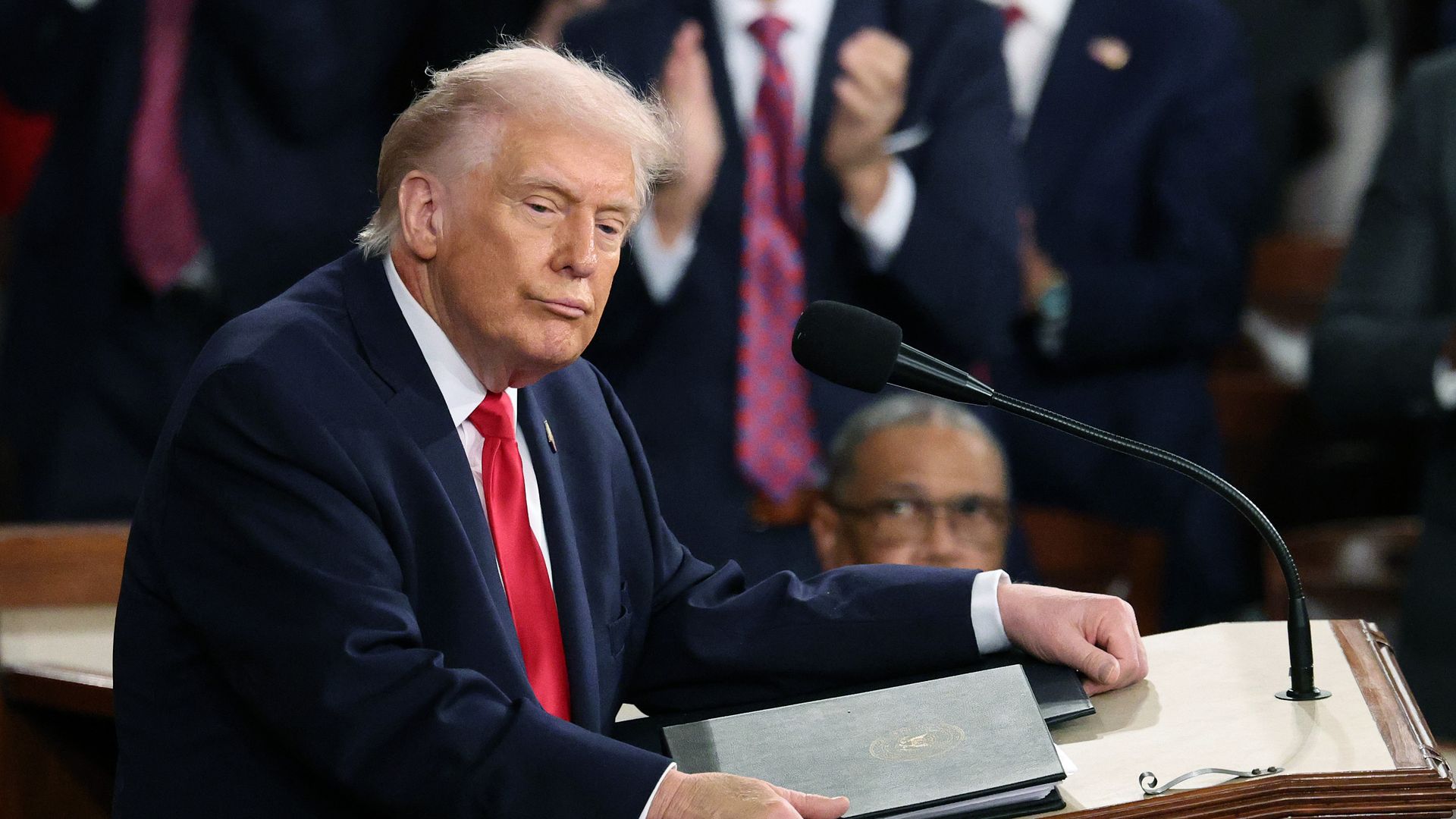
Trump announced a new retirement account last night for Americans who don't have access to one at work.
Why it matters: The plan could mean millions more workers get invested in the stock market.
Zoom in: A White House official tells Axios that it would be similar to one offered to federal employees called the Thrift Savings Plan, which offers access to a handful of low-fee funds that invest in things like short-term Treasuries and the S&P 500 index.
Zoom out: The idea is part of a broader push by the White House to get more Americans invested in stocks, and comes on top of its new Trump accounts, a way to get kids into the markets as young as possible.
Between the lines: The White House says it's expanding on an existing law passed under former President Biden called the Secure Act 2.0 (which is an update of a law passed during Trump 1.0).
- A piece of it takes effect next year, offering workers who have retirement accounts and fall below a certain income level up to $1,000 in matching funds (a 50% match if they contribute $2,000).
State of play: This new policy would expand that program by setting up retirement accounts for people who don't already have one.
- Instead of these folks opening up an IRA on their own — a hurdle most don't take — they would just check a box on their tax form to get things started, says Teresa Ghilarducci, a progressive labor economist at the New School who is familiar with the plan.
"This is a big deal," Ghilarducci says. "It finally recognizes that most people don't have anything saved for retirement, and they don't save consistently."
- She worked on an early version of this plan with White House economic adviser Kevin Hassett in 2021. (Read that here.)
- "The idea was to get someone far on the right and far on the left to come together," she says.
The intrigue: A White House official tells Axios that, like with the Trump accounts for kids, "philanthropic interests will be able to contribute."
Reality check: The one big looming threat to people's retirement savings is still on deck, as the Social Security trust fund is set to be depleted in 2033, at which point recipients would see a steep cut if Congress doesn't act.
What to watch: Keep an eye out for more details. Retirement experts tell Axios that even the most well-intentioned plans can go sideways.
Send comments, story ideas and your favorite dystopian and/or sci-fi novels (I'm a big fan of "The Road") to [email protected], or simply reply to this email.
Thanks to Jeffrey Cane for editing and Anjelica Tan for copy editing.
Sign up for Axios Markets