Axios Markets

June 08, 2026

👋 Welcome back! U.S. stock futures are higher, despite a rocky night in Asia — South Korea's chip-dominated KOSPI plunged 8% — a fresh pop in crude oil and a rise in Treasury yields.
- Today, we're thinking about this week's expected SpaceX IPO as a test of Elon Musk's superpower: convincing investors to pay a premium for whatever he's selling. Plus, the latest reminder that the stock market is not the economy.
Let's go! In 1,205 words, a 4.5-minute read.
1 big thing: The Musk premium's big test
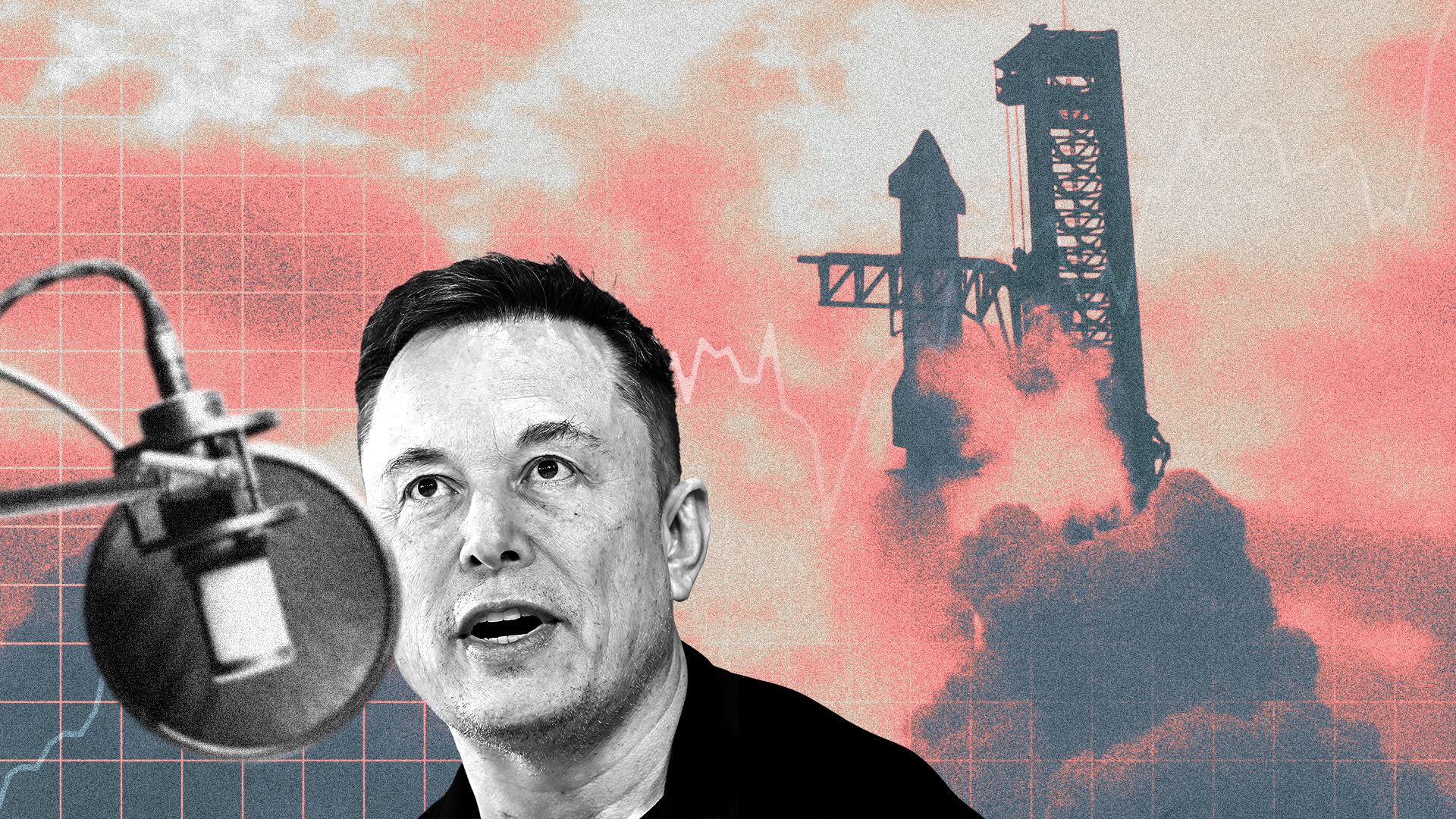
We'll find out this week if Musk still has the magic touch to abracadabra the biggest IPO ever.
Why it matters: A successful trading debut for Musk's SpaceX would confirm his knack for using sci-fi-worthy pronouncements, outlandish personal behavior — and, to be fair, some actual innovations — to grab investor attention and turn it into cash for his companies.
The latest: Up to a quarter of the shares set to be sold to the public next week are earmarked for smaller retail traders and individuals, the Financial Times reported, calling it a "record IPO allocation."
- Large investors like mutual funds, ETFs and hedge funds typically receive preferential IPO treatment, with smaller traders largely an afterthought.
- The FT says only 5%-10% of IPO shares are typically reserved for retail.
Between the lines: The decision likely reflects the huge role that individual investors played in the rise of Musk's other $1 trillion-plus company, Tesla.
Flashback: After Tesla's 2010 IPO, the company was embraced by an army of intensely loyal, highly online true believers known as "Tesla fanboys."
- For years, they championed both the cars and the shares, even as Tesla posted persistent losses that pushed it toward the brink of bankruptcy.
- It wasn't just online chatter. Tesla's shares largely held their value, enabling it to repeatedly raise cash by selling more stock, staving off disaster.
By the numbers: Between 2015 and 2020, Tesla sold over $5.5 billion in stock, which allowed it to not only survive, but achieve steady profitability and eventually be included in the S&P 500.
Fun fact: That partnership worked out, not only for Tesla, but for the fanboys too. Between the end of 2019 and today, Tesla shares are up nearly 1,400%.
- Gains over the last 10 years are roughly 2,400%.
- Since the IPO, the stock is up almost 25,000%.
Yes, but: A lot has changed since the days when Musk was seen as a somewhat dorky purveyor of well-designed, environmentally friendly vehicles.
- Tesla sales have faltered, in the U.S. and worldwide, as a chunk of Tesla's customer base was repelled by Musk's politics and alliance with the Trump administration.
The intrigue: Even so, the company's stock has performed well, with an enduring premium compared with what might be expected of companies with similar growth and earnings outlooks.
- Nobody can clearly explain precisely why that premium, sometimes called the "Elon Premium" exists.
What they're saying: Some see it as a more extreme version of the "founder premium" that academics have studied in the past.
- Others say it could be due to the futuristic nature of Musk's companies, whose prospects are especially difficult to estimate, since few precedents for them exist. Retail investors seem especially attracted to these kinds of companies.
- Or it may be related to the heavier presence of retail shareholders in the companies or Musk's personal je ne sais quoi.
- It's likely all of the above, to some extent.
The bottom line: One thing we can say for sure is that the premium is real. And it's valuable. But the SpaceX offering will tell the limits of just how valuable.
2. Why stocks didn't like a strong jobs report


The job market is holding up way better than expected, and when that became clear on Friday with the release of the May employment report, the major stock indexes fell.
Why it matters: It was just the latest reminder that the stock market is not the economy.
Driving the news: The S&P 500 broke its streak of nine weekly gains, and the tech-heavy Nasdaq had its worst week since the "Liberation Day" sell-off last year, per FactSet.
Zoom in: The semiconductor sector, on an epic run of AI exuberance all year, took a hit.
- The iShares Semiconductor ETF, which holds big chip stocks like Nvidia, Broadcom, Micron, etc., tumbled 7.3% for the day.
Where it stands: This all started happening Friday after the Labor Department reported that the U.S. economy added 172,000 jobs in May — more than double economists' forecasts.
Between the lines: Investors had been banking on job growth slowing and the Federal Reserve cutting interest rates.
- The report Friday changed the equation — markets are now pricing in rate hikes.
- That puts a damper on stocks, particularly those of high-growth AI companies.
- Among other things, rate increases mean higher borrowing costs — making it more expensive for the big hyperscalers to continue their spending spree.
The intrigue: A few analysts also say that investors are pulling money out of certain stocks to free up capital for the SpaceX IPO.
The big picture: At the start of the Iran war, Wall Street was talking about stagflation — where inflation goes up and unemployment rises at the same time.
- They got it half right. Inflation is rising, but jobs are doing OK!
What to watch: Investors will find out more about inflation this week. The CPI report is due out Wednesday morning.
- Analysts are forecasting a scorcher.

3. Schwab: Investors remain bullish, yet cautious
Stocks rallied like gangbusters in May, so perhaps it's not surprising that retail investors were net buyers of stocks for the month, new data from Charles Schwab shared exclusively with Axios shows. Yet investors also showed some caginess.
Why it matters: Investors remain bullish amid an AI-fueled rally that has lifted the S&P 500 and Nasdaq indexes to new highs even as they may be seeking to limit their risk.
What they're saying: Many investors rotated out of individual stocks into diversified exchange-traded funds, which "suggests a degree of caution remained," says Joe Mazzola, head trading and derivatives strategist at Charles Schwab.
- A separate attitudinal survey conducted by Schwab showed that 36% of clients are preferring ETFs over individual stocks. "That's really a shift," Mazzola says.
- Three of the 10 most bought individual names in May were ETFs.
- Another sign that investors were hedging their bets was with the growing use of options, in particular selling puts on tech stocks, during May.
By the numbers: The Schwab Trading Index, or STAX, rose to 55.08 in May, from 50.10 in April, although it was still below levels reached in March and February.
- Schwab calculates the STAX score by examining the stock positions and trading activity of millions of its customer accounts.
What to watch: The attitudinal survey found that geopolitical risk is the main worry for investors right now — and possibly more so after this weekend's events showed how fragile the ceasefire in the Middle East is.
- 73% of Schwab clients said geopolitical developments were among their top three concerns, with 42% saying it was their No. 1 issue.
🙏 Thanks for starting your week with us! Send tips and story ideas: [email protected] and [email protected] or reply to this email.
Thanks to Jeffrey Cane for editing and Carlin Becker for copy editing this edition.
Tell your friends to sign up here. You can also hit Emily up on X.com or Bluesky at EmilyRPeck.
Sign up for Axios Markets