Axios Markets

September 16, 2026


1 big thing: Investors are now paying close attention to rates
If rising interest rates are stock market kryptonite, investors are confronting a big chunk of that otherworldly mineral right now.
The big picture: The yield on the 10-year Treasury note, seen as the most important interest rate in the world, has hit its highest level — 5.04% — since 2007.
- This means that the price of money has gone up for everyone from the middle-class homebuyer to the behemoth corporation.
Zoom out: In the past, higher rates on government bonds, or yields, have often meant lower stock prices. There are a few theories why:
- Higher borrowing costs for corporations can slow economic growth and eat into profits, thus making stocks less attractive investments.
- It also makes riskier investments like stocks less alluring relative to higher-yielding and safer Treasury securities.
- Higher rates are also a key input for the discounted cash flow formulas used by finance and investment professionals to calculate what stocks should be worth. (TL;DR: When rates rise, all else equal, the stock values produced by these formulas go down.)
The intrigue: So far, there hasn't been too much of an adjustment from the stock market to the spike in bond yields.
- The S&P 500 is still up 10.8% for the year as of yesterday's close and not far off the all-time high it touched just over a month ago.
Yes, but: If you listen carefully, you'll hear the uncomfortable murmuring of investors, as they eyeball rising rates alongside portfolios often heavily weighted to equities.
Case in point: Results of a new Bank of America survey of stock market fund managers showed that they see a "disorderly rise in bond yields" as the biggest "tail risk" to the market in September, replacing worries about an AI bubble.
- And the net share of respondents who expect short-term rates to go up is now higher than it was back in 2022, when the post-COVID inflation was starting to rage.
- U.S. equities market analysts at Goldman Sachs noted that "our recent conversations with both corporate executives and portfolio managers have focused on the impact of higher rates on equities."
- Likewise, JPMorgan equity analysts wrote in a note yesterday that "investors are nervous with respect to inflation and bond yield moves."
The bottom line: After years when the AI trade seemed to be the only thing investors cared about, bonds are making a play for attention.
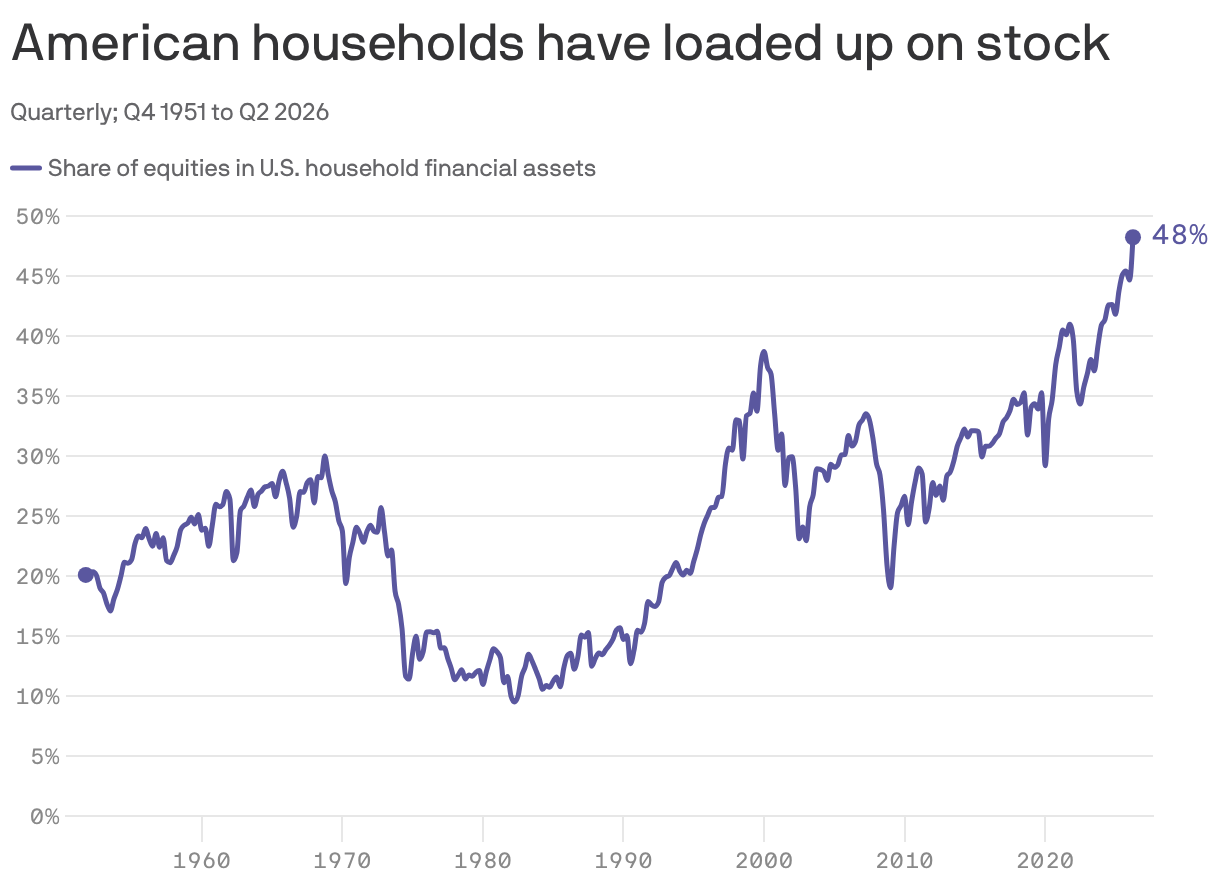
What to watch: American household portfolios are packed to the gills with stocks, which could make a downturn a painful event.
- Stocks accounted for a record 48% of U.S. household financial assets in the second quarter, according to the Federal Reserve.
- That's roughly 10 percentage points above the high-water mark set during the peak of the dot-com tech boom in early 2000.
What's next: The big event, of course, is the Federal Reserve's rate decision later today and Warsh's news conference.
- While the market is almost certain that the central bank will raise interest rates by a quarter point, a more important question for investors will be how much further they will go from here.
- That's not completely under the control of the Fed.
- "If we do have higher and higher oil prices, or let's say a longer and longer conflict," Ralph Axel, interest rate strategist at Bank of America, tells Axios, "central banks will hike more and more."
2. Rise in yields takes some shine off stocks
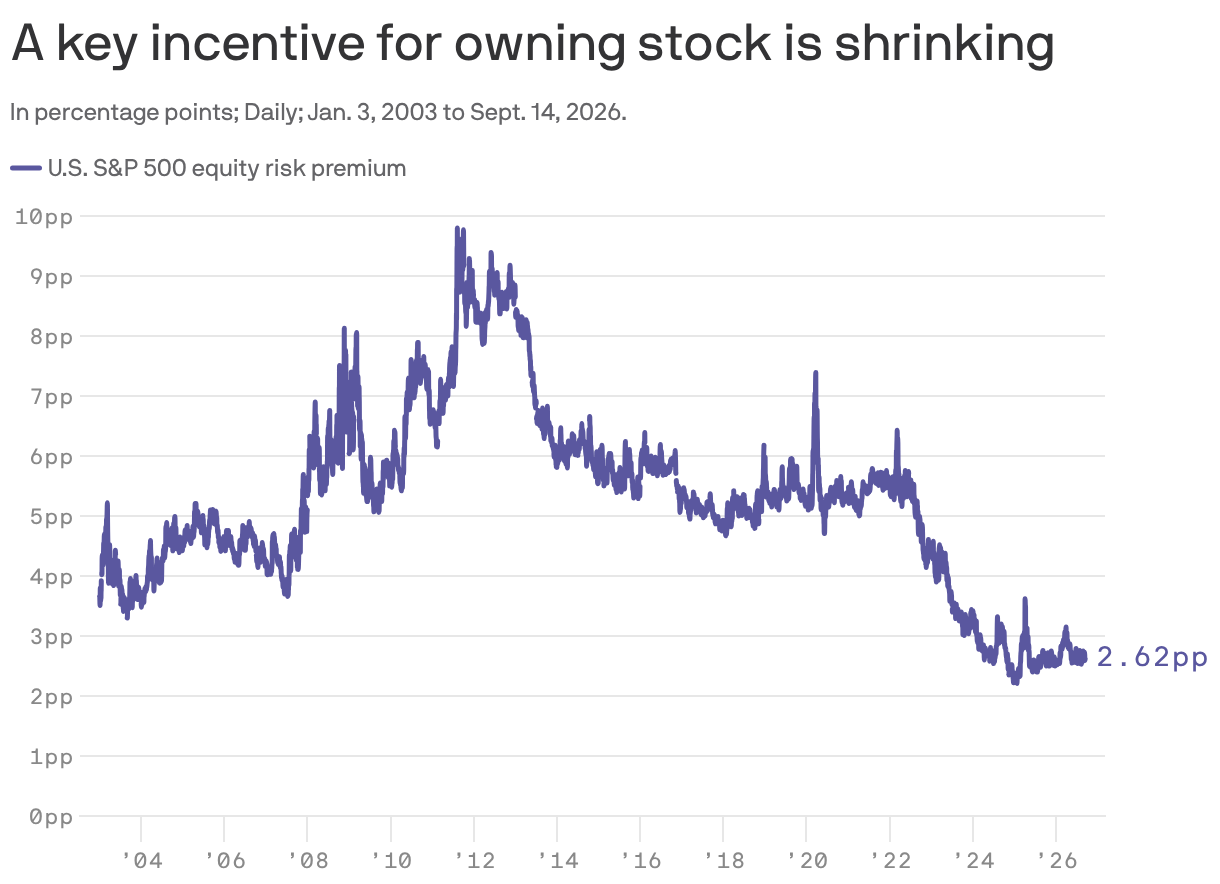
The recent surge in bond yields is keeping the pressure on the premium investors earn for taking their chances with stocks rather than bonds.
Why it matters: The skimpiness of the slab of extra returns the market typically offers stock market investors — which is known as the equity risk premium — raises the prospect that, at some point, investors decide they're just not being paid enough to expose themselves to the vagaries of equities.
Reality check: The equity risk premium can't be observed directly, and there are a few different versions of it.
- The proxy we're using above is sometimes called the "yield gap." It takes the earnings yield on the S&P 500 (roughly 5.2%) and subtracts the yield on the inflation-adjusted 10-year Treasury note (2.60%).
What they're saying: In a note published last week, analysts at JPMorgan suggested that the low levels of equity risk premiums we're currently seeing typically coincide with a period when stocks are more sensitive to moves in Treasury yields.
- "This greater sensitivity to bond yields, particularly in the event real rates drift higher from current levels, could provide multi-asset investors with an incentive to increase bond allocations," they wrote, adding that "flows from equities to bonds could become more pronounced than those seen in recent years."
The other side: It is worth noting, however, that equity risk premiums have been near multi-decade lows for a couple years now, and investors haven't suffered much, as excitement over the possible returns to AI has continued to keep investors attached to stocks.
Axios Markets
