Axios Markets

September 30, 2026


1 big thing: Investors' P-doom scenario: No profits
The AI buildout is entering a show-me-the-money phase: A growing chorus warns that the pace of spending on the technology is far outstripping the money coming in, and that may be true for a while.
Why it matters: With so much of the economy riding on investor bets on AI, it could all end in tears.
The latest: A new analysis from two Stanford economists finds a nearly $1 trillion gap between spending from the hyperscalers — Alphabet, Amazon, Meta, Microsoft, Oracle and SpaceX — and the revenue they have taken in from AI since 2024.
- And time is running out to make those investments pay off, they contend.
Zoom in: That's because a big chunk of hyperscaler spending is on chips that lose value after around five years.
- "If our assessment is correct, investor patience is likely to run out, and, depending on the pace at which they rush for the exit, the bubble will either pop or start to deflate," wrote Jared Bernstein and Ryan Cummings, economists with the Stanford Institute for Economic Policy Research.
- They found that the companies would need to triple or quadruple their AI revenue next year and every year after that for the next decade for this to work out.
- That's not impossible, but extremely difficult to say the least.
Friction point: Their analysis assumes that the cost of capital doesn't increase meaningfully, even though interest rates are now rising.
Where it stands: These economists are not outliers.
- A Goldman Sachs analysis last week found that the hyperscalers' AI revenues remain below what they need just to break even on their capex. (That's short for capital expenditures, or the money they spend on chips, data centers and real things to build AI computing capacity.)
- The bank is more optimistic that companies will ultimately see a return on their investments.
Meanwhile, leaked information about AI giant Anthropic shows that its revenue is exploding — but spending is super high. Last year, revenue was $4.6 billion, with an operating loss of nearly twice that, Reuters reported, saying that it had seen the IPO prospectus.
- This year, Anthropic's revenues look on track to be far higher: Its annualized revenue run rate topped $65 billion in the second quarter.
- And the company has told investors that it will have profitable quarters.
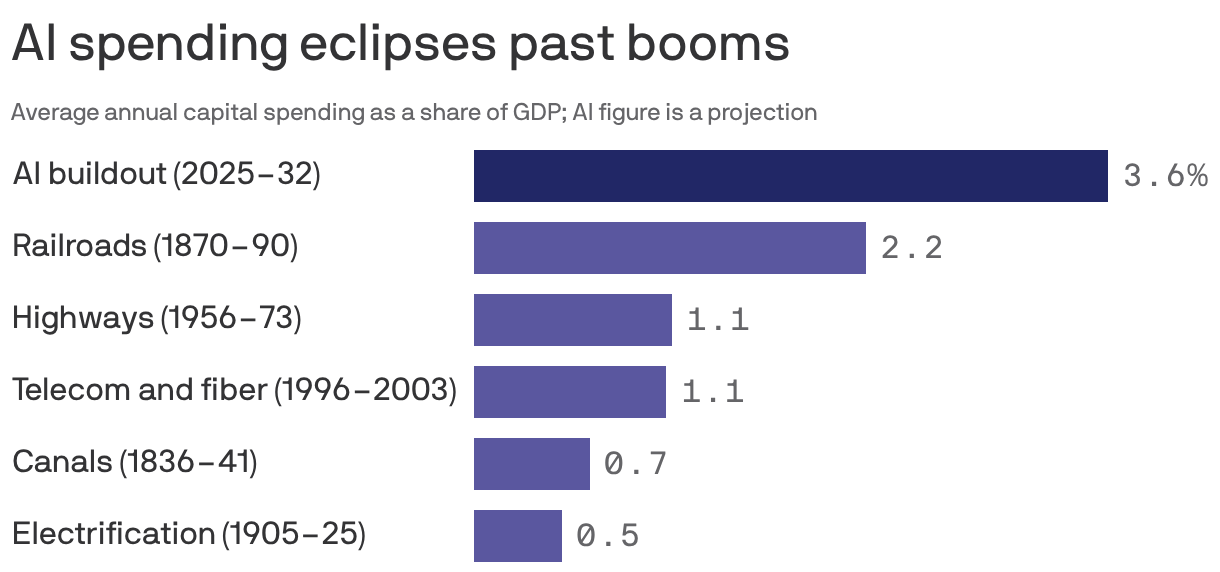
By the numbers: The spending required for the AI buildout exceeds anything we've seen before: $10.3 trillion in infrastructure investment through 2032, according to one estimate.
- That amounts to 3.6% of GDP a year, dwarfing the investment booms that built America's railroads, highways, electric grid and telecom networks, Axios' Courtenay Brown reported.
What to watch: The bet is that over time there will be massive payoffs — as there were for the other big infrastructure buildouts: electricity, railroads, the internet. But it may take longer than hoped.
- The Stanford economists note that it took decades before the benefits of electrification filtered into the factories.
- The 1990s dot-com stock bubble burst when investors started to realize that profits were further off than they'd initially believed.
The bottom line: "Can all these people eventually turn this into something profitable? I think they will," Cummings tells Axios.
- "Now I'm not sure who's going to do that, but I do think there will be trillions of dollars of profits that are up for grabs in the future, but just not in this super-accelerated timeline that is required to justify the investments."
2. 🪟 The softness in the IPO market
Oura's decision to put off a planned $2 billion initial public offering may be a sign of cooling in this year's piping-hot American IPO market.
Why it matters: Does it reflect an ebbing in some of the market's animal spirits, in the face of the 10-year Treasury yield at ~5.25%?
- That seems to be the takeaway from Axios' Dan Primack, who writes that "Oura was basically unable to get the price it wanted, in part due to market turmoil tied to the bond yield and oil price volatility, per a source familiar with the situation."
Zoom out: More broadly, the IPO slowdown could reflect a sort of calm ahead of what's expected to be a giant offering from Anthropic before year-end.
- It would be rational for CEOs to want to avoid a potentially disastrous turn of bad luck if they had to sell shares into the market at a time when the AI titan was sucking up market and investor attention — not to mention their money.
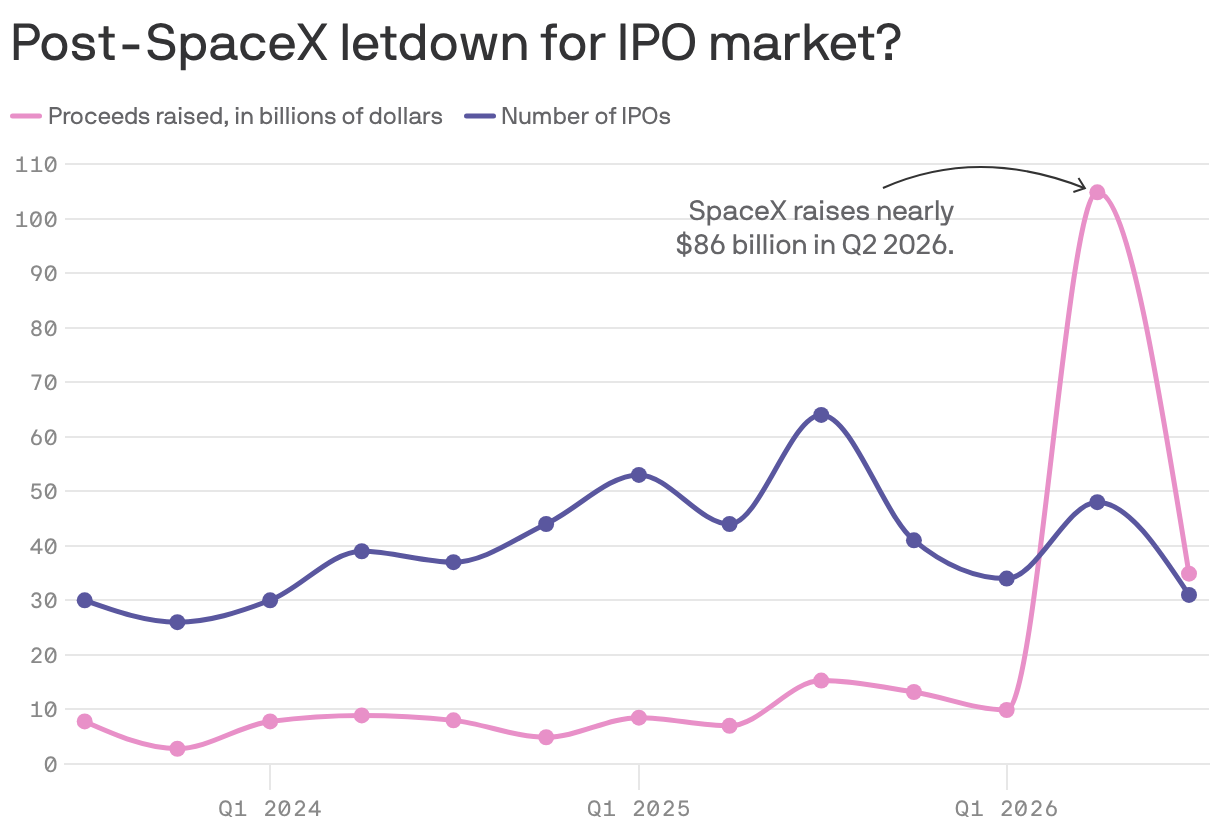
The latest: Still, in terms of dollars raised in the market, it has been a great year for IPOs.
- Year-to-date, offerings of new shares have pulled in roughly $145 billion in proceeds, up nearly 400% from last year.
- But that's largely attributable to supersized offerings from tech giants like Elon Musk's SpaceX, which raised a record of nearly $86 billion in its June offering.
- South Korean memory chip giant SK Hynix also contributed, with a $26.5 billion offering of U.S. depositary shares in July.
Zoom in: Performance of these newly minted shares has been solid.
- The Renaissance IPO exchange-traded fund, which tracks a market-weighted basket of recent U.S.-listed IPOs, is up roughly 16% in 2026, outperforming the S&P 500's roughly 12% gain.
Between the lines: Though lately momentum-driven stocks — which IPOs are often related to — have hit headwinds from the rise in interest rates.
- But the market whale that is Anthropic, hovering somewhere beyond the horizon, is also likely prompting some investors who take fliers on new issues to keep their powder dry.
The bottom line: The Anthropic IPO is expected to make its debut on the Nasdaq in November.
- It may be the largest ever, with its bankers targeting a valuation of over $2 trillion and proceeds of $100 billion or more, according to various reports.
Axios Markets