Axios Markets

June 03, 2026


1 big thing: AI dash for cash
Alphabet, one of the most cash-rich companies in American history, has decided to sell new shares to help pay for its AI data centers.
Why it matters: It's an object lesson in how the AI boom may be disrupting trends — such as the steady "shrinkage" of the stock market due to share buybacks — that have been sources of market stability for years.
State of play: Alphabet's plan to sell $80 billion in shares — announced after Monday's close — caught the market by surprise, sending the stock down by roughly 4% as investors digested the dilution the sale represented.
Context: It was the latest in a flurry of plans from tech giants to raise cash through stock sales to pay for the AI boom.
- Top AI lab Anthropic — recently valued at nearly $1 trillion by private investors — announced Monday that it had confidentially filed plans with the SEC for its public offering. (The details of the offering have not been finalized, but it is expected to be one of the largest in history.)
- OpenAI is also reportedly close to a confidential filing in advance of its own public offering.
- And last week, Elon Musk's SpaceX publicly filed plans to raise an expected $75 billion in a share sale, which, if successful, would eclipse Saudi Aramco's IPO as the largest-ever initial offering. (SpaceX owns Musk's AI lab Grok.)
By the numbers: The scale of those offerings has supercharged expectations for the market in new stocks this year.
- Goldman Sachs U.S. equity analysts now expect large companies to raise a record $225 billion in IPOs this year, almost six times as much as last year.
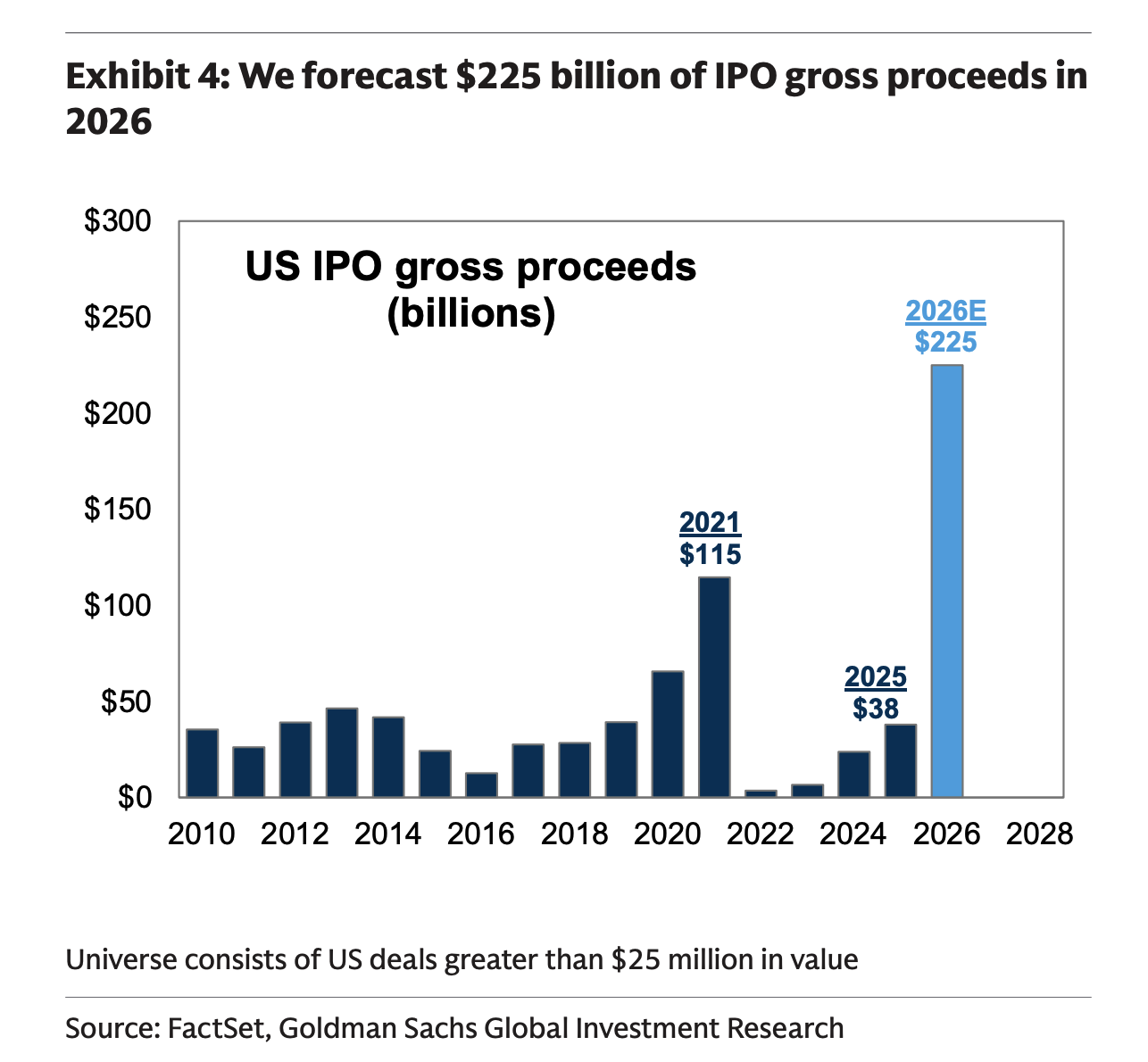
The intrigue: The IPO surge has prompted a flurry of questions about where the money to buy the stock will come from. Wall Street doesn't seem worried.
What they're saying: "Public equity markets remain capable of absorbing a materially larger AI financing cycle than current issuance levels imply," wrote Morgan Stanley analysts in a note last week.
Yes, but: Even so, these sales of stock may represent a milestone for the structure of the U.S. stock market.
- "Since the early 2000s, a confluence of factors systematically reduced available public equity year after year," wrote Savita Subramanian, head of U.S. equity and quantitative strategy at Bank of America Securities.
- "More buybacks, longer private incubations, more take-privates, low rates, ample liquidity, etc. Today, an issuance deluge may be imminent."
2. Jensen Huang's hot stock tips


Nvidia CEO Jensen Huang said yesterday that Marvell Technology — which you probably haven't heard of — is the "next trillion-dollar company," and investors listened: The stock soared nearly 33%.
Why it matters: As leader of the most valuable company in the world, Huang is one of a select few who can move markets simply by saying stuff — a kingmaker of sorts.
- An investment from Nvidia can also drive investor interest.
Zoom in: In this case, Nvidia in March announced a $2 billion investment in Marvell, which makes semiconductors and high-speed networking technology used in data centers.
- The company, like many chipmakers, is seeing remarkable AI-driven growth. Revenue was $2.4 billion in its most recent quarter, a 28% increase from last year — and profits were up by a similar percentage, the company said last month.
Where it stands: But it was Huang's comments that really gave the stock liftoff.
- Speaking at a trade show in Taiwan, alongside Marvell CEO Matt Murphy, Huang said the company's chips were "essential" to data centers.
- Marvell's stock soared to $290.79 from $219.43 the day before.
Stunning stat: Marvell's market cap shot up to just under $250 billion — last year it was $53 billion.
Reality check: That's still a ways off from $1 trillion, but what even are numbers these days?
Zoom out: Huang on Monday also drove software stock prices higher when he said, contra conventional wisdom, that AI is good for the software industry.
- "This is actually an incredible time to be a software company," he said, per MarketWatch.
Flashback: Huang can move stocks down, too. Last year, after he said that useful quantum computers were still decades away, companies in that sector lost billions of dollars in market cap.
3. Bitcoin stumbles



While stocks stay frothy, bitcoin is losing its fizz.
State of play: Since hitting an all-time high of $126,080 in October, the price of bitcoin fell over 40% through last week.
- Investors pulled $2.8 billion from U.S.-listed spot-bitcoin ETFs in nine-straight sessions through May 28 — the longest stretch of withdrawals in the funds' two-year history, Bloomberg noted.
The big picture: Analysts point to several overlapping pressures:
- The Iran war, and investors' waning appetite for the riskiest risk assets amid soaring oil prices and fresh inflation worries.
- The boom in AI-related stocks (see chart above), leading some institutional investors to rebalance portfolios and go even lighter on bitcoin.
- In short, there have just been so many better ways to find returns, Bloomberg's Joe Weisenthal notes.
Zoom in: And then there's Michael Saylor's Strategy. A so-called bitcoin treasury company, its entire business is based on holding bitcoin.
- Strategy disclosed Monday that it sold 32 bitcoin in the last week of May, raising $2.5 million to help fund a dividend on its preferred stock.
- That's a tiny fraction of the 843,706 bitcoin the company still holds in its treasury — but it's the signal that mattered.
Between the lines: Saylor, after all, has made a habit in recent years of saying that Strategy would "never" sell bitcoin, and it hadn't since late 2022.
- Its disclosure has helped send bitcoin down another 8% since Monday morning, and it now trades around $67,000.
The bottom line: Never say never.
Axios Markets