
Axios Markets

March 04, 2023
Happy March! The days are getting longer, at least for those of us in the northern hemisphere, the first shoots of spring are arriving, and optimistic equities investors are going underweight carbon-intensive industries as they buy into the vision of a net-zero future.
- In this newsletter, 1,567 words, a 6-minute read: Politics is interfering with those investors. Also: banks struggling with solvency issues; colleges losing humanities students; and investor-day words from Goldman Sachs.
- 🚨 Breaking news on the Compound Banc front: The "Banc," which I wrote about two weeks ago, has disappeared from the company’s name, and compoundbanc.com now redirects to a site offering “Compound Real Estate Bonds.”
1 big thing: Investors get caught in political crossfire
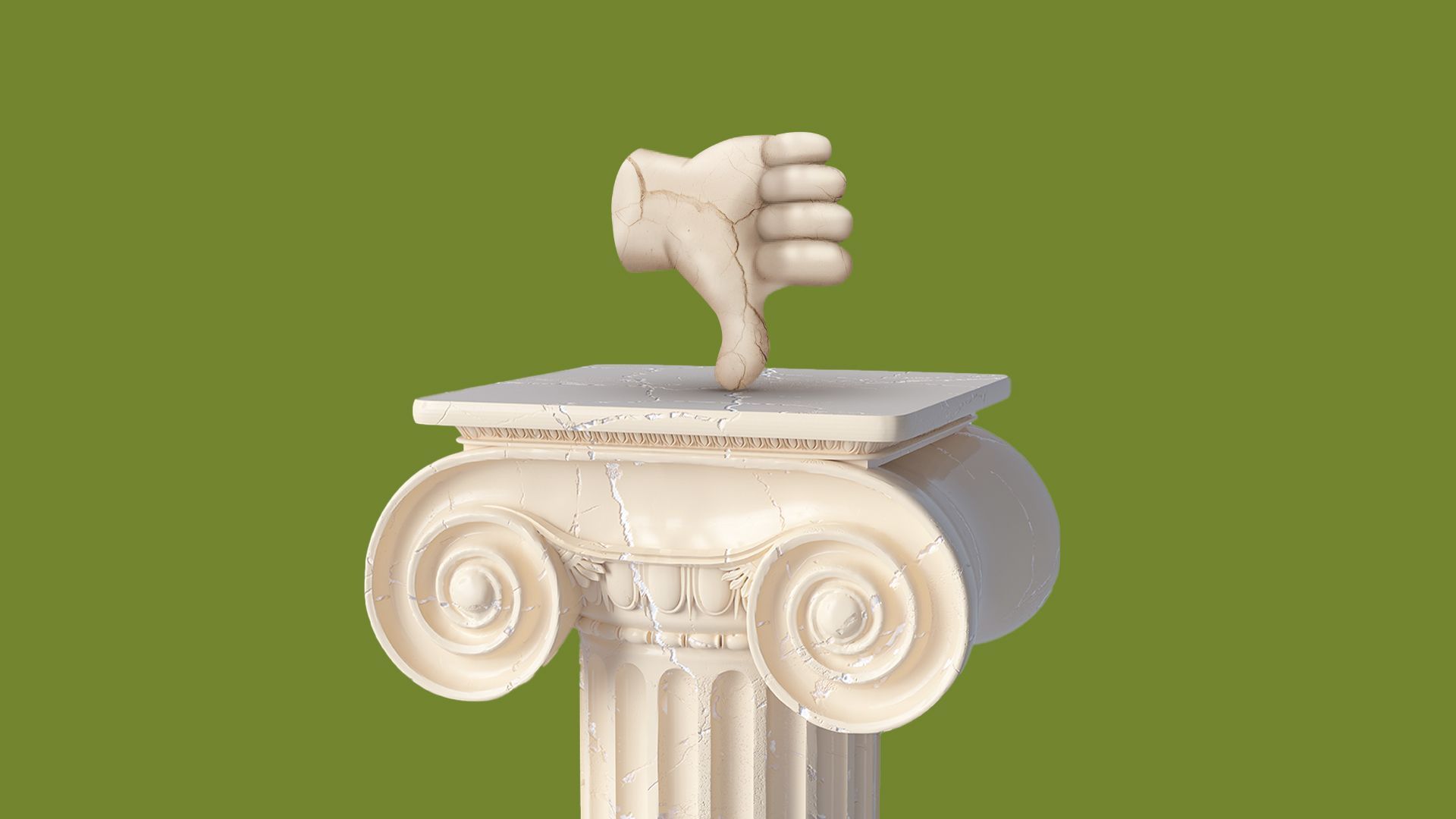
Illustration: Natalie Peeples/Axios
Republicans in Congress have teed up the first veto of the Biden presidency. Curiously, the vetoed bill has nothing to do with children's books, unisex bathrooms, or even fiscal policy. Instead, it focuses on stock-market asset allocation.
Why it matters: The environmentally conscious global consensus of institutional investors is highly unlikely to be derailed by U.S. political point-scoring. But no good can come from the way in which investment officers increasingly need to navigate a political gantlet.
Driving the news: Both the House and the Senate this week passed legislation overturning a Labor Department rule designed to ensure that fund managers remain capable of considering environmental, social, and governance (ESG) factors when making investments.
- The aim of the bill was not to change the law — a veto was always certain — but rather to create a 2024 campaign issue.
- Politicians like Sen. John Barrasso, a Republican from Wyoming, characterize the Department of Labor rule as creating "regulations to invest retirement money in far-left liberal causes." That's false — the rule mandates nothing at all — but Republicans are hoping it might prove an effective attack vector all the same.
What they're saying: The bill "has to be the ne plus ultra of hysterical overreaction to any policy with the word climate in it," writes NYU law professor Jack Lienke, an expert on environmental law.
- "The actual regulatory text here is a nothingburger. We’re fighting about a subtle vibe shift in preamble text."
In other words: A decidedly anodyne Department of Labor rule has become politicized — characterized as being "far-left" — when in fact it's really more of a laissez-faire attempt to reiterate that investors are free to follow any investment thesis they like.
How it works: Climate change is probably the biggest risk facing global markets over the long term. Investors therefore have a clear financial incentive to invest in the companies that are best placed to mitigate or adapt to climate risk, as a way of maximizing their own long-term returns.
- There is always a fiduciary reason for ESG investments, but a Trump-era rule tried to discourage such strategies anyway. Even the U.S. Chamber of Commerce and the American Petroleum Institute were unenthusiastic about the Trump administration's stance.
- The Department of Labor rule the current bill tries to overturn was written to make it clear that investors don't need to fear the potential ire of regulatory agencies when they adopt ESG investment frameworks.
Between the lines: Insofar as there's a substantive issue here it's that ESG investors tend to underweight carbon-intensive industries, including oil companies. Those companies' executives then worry that the ESG consensus is weighing on their share price, and hope that discouraging ESG investments could give those shares an upward boost.
- Joe Manchin, one of the two Democratic senators to vote with the Republicans, has extensive shareholdings in the coal industry.
The bottom line: As 2024 approaches, Republicans are trying to reach swing voters by presenting anything climate-conscious as being part of a far-left agenda.
- Americans really don't care about the exact wording of Title I of the Employee Retirement Income Security Act of 1974, as amended — the narrow concern of this bill. Nevertheless, Republicans have found a way to weaponize it. That means the issue isn't going away any time soon.
2. Insolvent banks


The implosion of Silvergate Bank has a lot to do with the fact that it was crypto's bank of choice. But it's also a prime example of the hidden insolvency that exists across much of the banking sector.
Why it matters: Silvergate had an unusually strong balance sheet — but that wasn't enough to save it because in today's high-rate environment, even strong balance sheets can tip into insolvency when they start to shrink.
How it works: A bank's deposits are its liabilities — it owes that money to its depositors on demand. On the other side of the balance sheet are assets, which are generally in the form of bonds and loans. When interest rates rise, the value of those bonds falls, eroding the value of the bank's assets.
What they're saying: "The financial world has been massively long bonds in a rising rate environment, a troubling scenario that has left many banks insolvent on a mark-to-market basis," writes bank analyst Chris Whalen.
- Under Generally Accepted Accounting Principles, or GAAP, banks don't need to mark their bond holdings to market so long as they're holding those bonds to maturity.
- Sometimes, however, as with Silvergate, an outflow of deposits means that a bank has to sell down its assets to meet withdrawals. The minute that happens, it has to start marking all such assets to market.
By the numbers: Silicon Valley Bank, reports the FT, was awash in deposits in 2021, when rates were low. It took $91 billion of that money and invested it in mortgage bonds — bonds that today are worth just $76 billion.
- "The unrealized $15bn loss disclosed by SVB," notes the FT, is "greater than the total profits reported by the bank over three decades."
The bottom line: The losses at banks aren't realized unless and until a forced sale occurs. But stock-market investors see them all the same and have been marking down many banks' share prices, including SVB's, accordingly.
3. Why studying English makes increasingly little sense

Illustration: Annelise Capossela/Axios
The four-year undergraduate liberal-arts degree is one of the last great bastions of inefficiency — even of dilettantism — left in America. For better or for worse, it is beginning to die, withering under the heel of the inescapable imperatives of capitalism.
Why it matters: The genteel ivory tower is unlikely to live much longer. Familiar capitalistic forces are shuttering some schools and reconfiguring many more, as students increasingly question the value of spending 4 years studying Philosophy and Art History.
Driving the news: You can't major in English at Marymount University any more — or history, or philosophy.
- "These programs are all very low performing with low enrollment rates," spokesman Nick Munson told local TV station WUSA.
The big picture: Higher Ed Dive has found a staggering 87 colleges, nearly all focused on the liberal arts, that have either closed entirely or been merged into a bigger neighbor since 2016 — including nine just in Massachusetts.
- "Cazenovia College has survived through many difficult and challenging times — the Great Depression, World War II, a major campus fire in 1959, and more, but the current financial challenges are more than the College can overcome," said one New York institution in December.
How it works: There are two main forces at work here.
- First is rising prices, driven by the fact that it's hard to make productivity improvements in English Literature courses. That just makes it more expensive to go to college — in a world where the burden of having large student loans is now (thankfully) broadly understood.
- The second is the rising opportunity cost of going to college. Employers no longer require a college degree for many jobs — which significantly increases the amount of money you can expect to make when otherwise you'd be earning nothing at college.
By the numbers: Between the rising cost of college and the rising opportunity cost of going to college, the extra money you need to be able to earn as a result of getting a degree, over and above the amount you'd earn without one, has to be larger than ever in order to financially justify such a major purchase.
- That calculation is driving students overwhelmingly into STEM fields.
- As one student told The New Yorker's Nathan Heller, "you don’t go to Harvard for basket weaving."
My thought bubble: Over the many decades of an entire career, the skills I learned while studying Philosophy and Art History at Glasgow University came in very useful over and over again. They're terrible at getting you onto the bottom rung of the career ladder, but they're surprisingly useful once you're halfway up.
- Still, I'm resigned to such studies reverting to what they always used to be — something that in practice is restricted to people who were already born into the elite. (About 6% of art history graduates are in the top 1% of earners, but that probably has more to do with their parents than it does with their choice of degree.)
The bottom line: Capitalism has caught up with the academy.
4. Words
Illustration: Aïda Amer/Axios
Goldman Sachs is the anti-Softbank: Its corporate slides, rather than lying somewhere in the uncanny valley between genius and deranged, sometimes seem as though they're an entry in a contest for sheer emptiness.
Why it matters: Goldman is going through something of an identity crisis at the moment and is placing a large bet on reinventing itself as an asset manager. In doing so, however, it seems to have removed most if not all of its institutional personality.
For the record: Goldman's investor day presentation features slides with titles like these:
- "Committed to Deliver on Our Medium-Term Targets"
- "Intensely Focused on Executing on Our Key Priorities"
- "Breadth and Depth Across Various Dimensions"
The winner, however, has to be this one:
- "Platform Solutions: Innovative Platforms Delivering Solutions to Clients"
Between the lines: "Platform Solutions" is the hollow name bestowed upon Goldman's troubled consumer-banking operation. (If you have an Apple Card, you're a customer.)
- CEO David Solomon seems highly reluctant to give a straight answer to the question of whether or not it's going to be sold, in the wake of billions of dollars in losses.
Many thanks to Kate Marino for editing this newsletter, and to Lisa Hornung for copy-editing it.
Sign up for Axios Markets

Stay on top of the latest market trends and economic insights