Axios Markets

June 17, 2026


🎇 Welcome to Wednesday. Some discomfort was afoot in the financial markets yesterday despite global crude oil tumbling back below $80 a barrel.
- The U.S. has yet to release the text of its deal with Iran, and there are conflicting reports on what's in it.
- Still, this morning, stock futures are pointing to a positive open.
🗓️ Today, we're looking at another worry burbling in the background for investors, the increasingly heavy hand the U.S. government is taking in its dealings with Anthropic, which could have big implications for the future of the AI business — the critical driver of the rally in stocks.
- Plus, the Kevin Warsh era begins in earnest today with the Federal Reserve's policy announcement, opening new options to Wall Street's punsters.
All in 868 words, a 3.5-minute read.
1 big thing: Anthropic export ban sounds alarms for AI industry

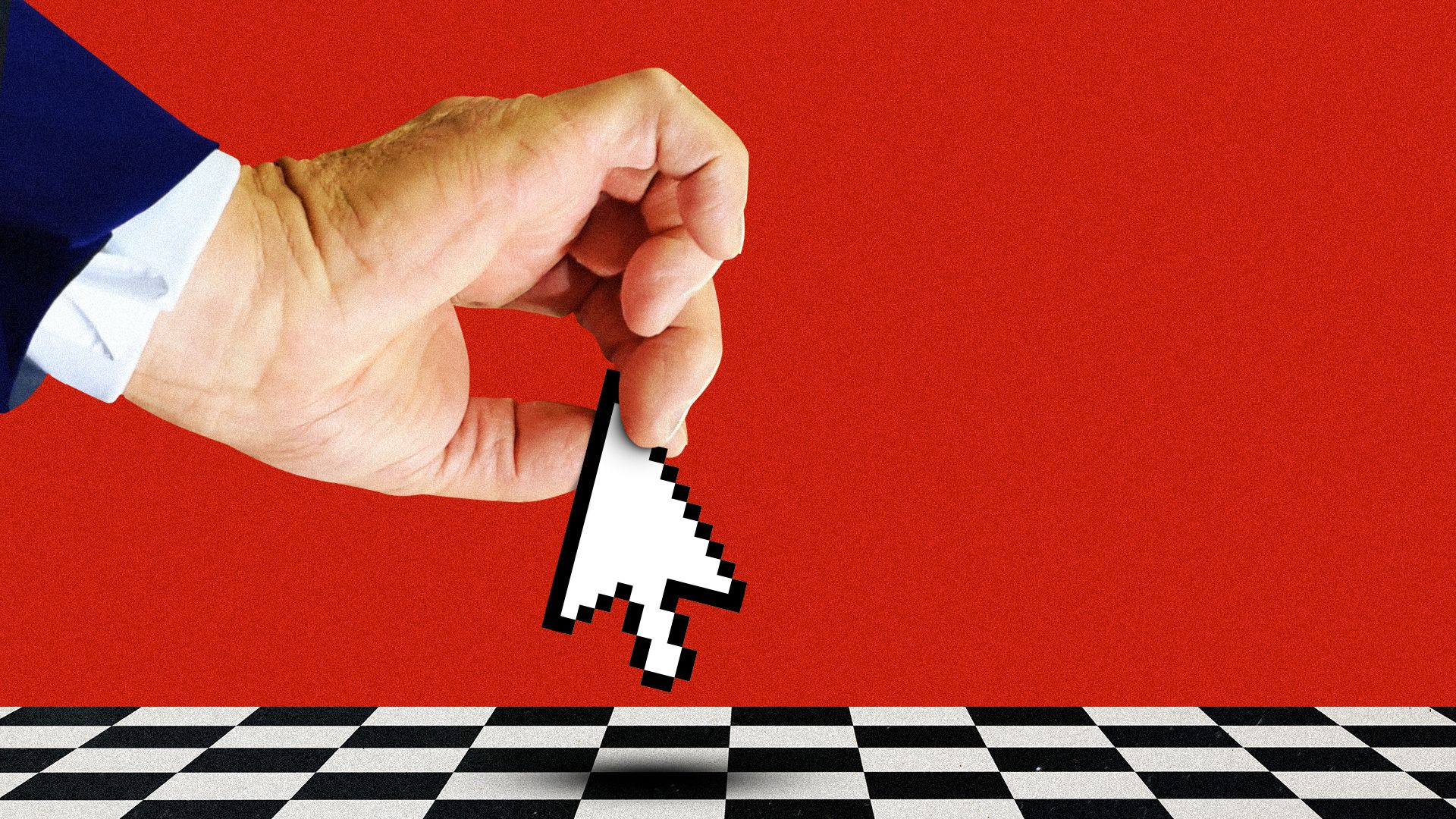
The White House's move to restrict access to Anthropic's latest AI model — using what is known as export controls — could harm the long-term financial prospects of the entire U.S. AI industry.
Why it matters: Anthropic and OpenAI's valuations depend on the global adoption of their most advanced models, and government restrictions could limit that growth.
Zoom in: If this move is more than a temporary blip, "it's not great news for U.S. tech firms or for those assuming breakneck speed of AI adoption," Jim Reid, global head of macro at Deutsche Bank, wrote in a research note.
- Hundreds of billions of dollars are being spent by the data center hyperscalers and the AI labs to fund their ambitions, seeking to eventually profit from having the best models.
- Their calculations can work only if the government doesn't cut off access every time they achieve that goal.
How it works: Businesses that pay for AI models need to make sure they can keep access to them.
- "You can't rely on something that could be switched off," Reid says.
The big picture: It's not just about Anthropic.
- "Everyone who uses AI will see the writing on the wall that future AI models from OpenAI and Google are also going to be seen as having potential serious security risks," says Martin Chorzempa, a senior fellow at the Peterson Institute who researches technology and national security issues.
Follow the money: Companies are already wary about locking in contracts with major AI labs in case a competitor comes out with a better model.
- Now, they can add "potential regulation" to the list of reasons to keep their AI tools diversified.
- If companies don't want to sign contracts with OpenAI or Anthropic, that could put a ceiling on revenue growth for the two AI labs just before both are expected to go public later this year.
Between the lines: Export controls can be used in the interest of national security, yet can also be a powerful tool of leverage — recall when China cut off access to rare earths to get the upper hand in trade negotiations with the U.S.
- But they also have significant downside risk: Countries and companies will start looking for alternatives.
- "The challenge with export controls is anytime you do it, you encourage the development of alternative suppliers," Chorzempa says.
- In the case of rare earths, other countries are now looking to mine their own.
Zoom out: Even before the move against Anthropic, there were already concerns, particularly in Europe, over the U.S. government using AI tool access as a lever of geopolitical influence.
- The latest move could be short-term.
- Still, it could provide some momentum to Chinese AI models that are open source.
- "You have no idea whether the U.S. government is just going to shut off your access to any future models," Chorzempa says. "That's a big advantage to open models."
2. Wall Street Warsh watch (say 3 times fast)
New Federal Reserve chairman Kevin Warsh takes the mic this afternoon in a press conference following the first interest rate decision of his tenure at the central bank.
Why it matters: For much of the public, it will be their first exposure to the world's most important central banker and one of the country's most powerful economic policymakers.
- Conventional wisdom on Wall Street is that the markets like to "test" new leaders of the Fed, meaning that market moves can be slightly extreme early in their tenure until traders feel as if they understand how the new chairman communicates and how the central bank will react to different economic information under their leadership.
Yes, but: Very few expect a big change in interest rate policy today.
- The overwhelming expectation is that the Fed will leave interest rates at their current range of between 3.50%-3.75%.
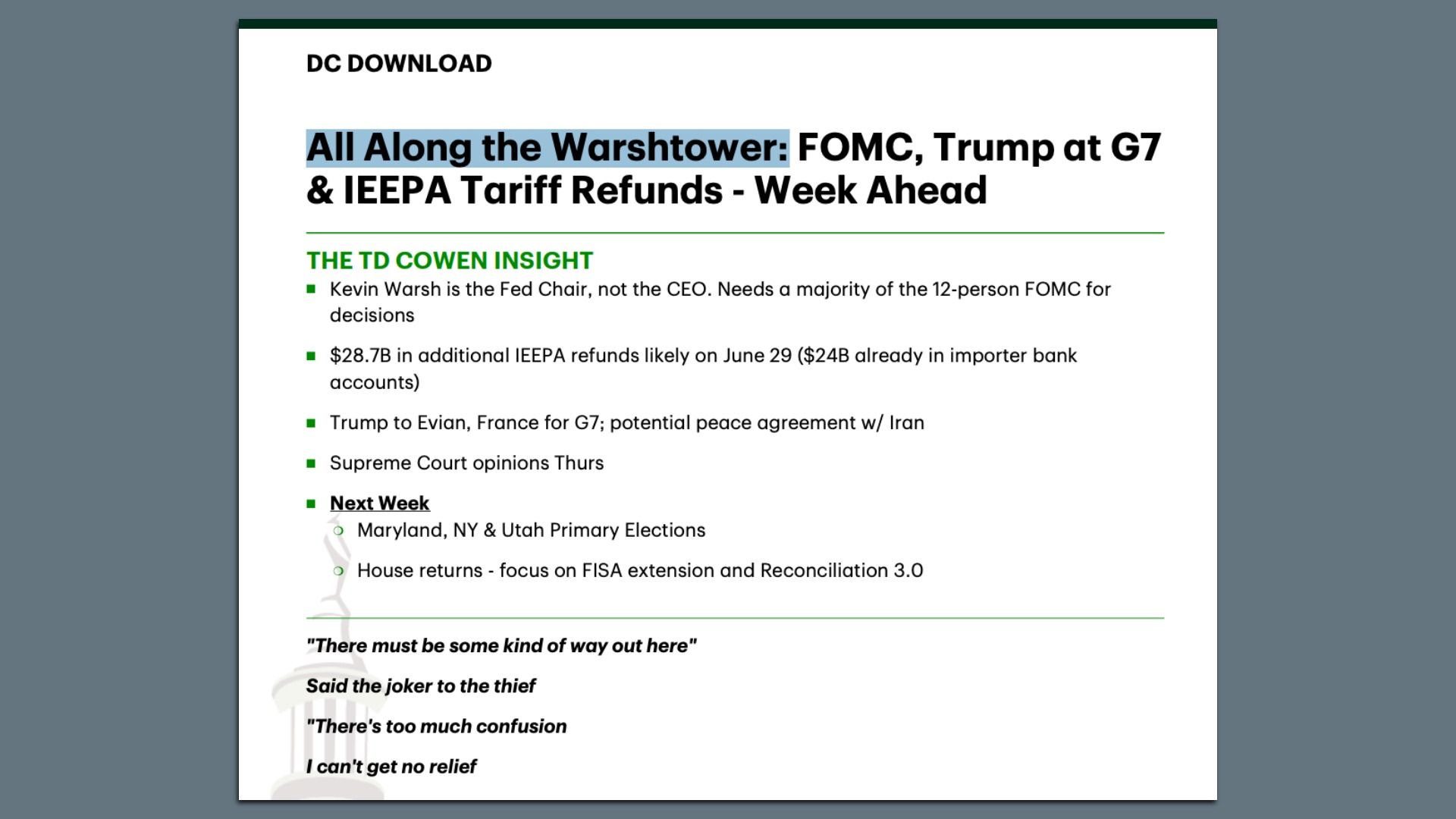
What they're punning: If nothing else, Wall Street's Fed watchers will have the new chairman's phonetically flexible surname as a source of potential puns for years to come.
- See TD Cowen's recent work, above.
- OK, that's bad. But it's perhaps better than the June 14 offering from Bank of America bond market analysts, titled "Caught between a strait and a Warsh place."
Thanks for reading! Send tips and story ideas or just check in: [email protected] and [email protected] or reply to this email.
Thanks to Jeffrey Cane for editing and Carlin Becker for copy editing this edition.
Tell your friends to sign up here. You can also hit Emily up on X.com or Bluesky at EmilyRPeck.
Sign up for Axios Markets