Axios Markets

July 22, 2022
🔥It's Friday and here at Axios Markets, we are "expanding the definition of hotness" with an update on how the heat wave overseas is pushing European energy markets to the brink, the latest on oil, and, well, there's more. I'm not gonna spoil this whole thing! Let's go.
Today's newsletter, edited by Kate Marino, is 1,143 words, 4.5 minutes.
1 big thing: Oil under $100
Illustration: Aïda Amer/Axios
Oil prices have slipped below the $100 a barrel mark, amid a roughly 20% sell-0ff since early June, Matt writes.
Why it matters: Falling prices could disrupt the doom loop of rising inflation, rising interest rates, and rising expectations of further Fed hikes that have crushed the stock market this year.
Driving the news: Worries about weakening demand, which sent crude oil prices down 3.5% to $96.35 yesterday.
- A surprise increase in U.S. gasoline stockpiles — during peak driving season — suggests high gas prices are pushing consumers to cut back. Some think next week's GDP report could imply the U.S. is in a recession — at least by one technical definition. (A shrinking economy uses less oil.)
- Europe is slowing fast, amid an energy shock and inflation of its own. In response, the European Central Bank yesterday delivered a larger-than-expected rate hike, which will slow the economy even more, further cutting fuel demand. (The EU, if it were a single country, would be the world's second-largest consumer of crude.)
- China's economy — the actual second-largest crude consumer — is still in terrible shape.
The intrigue: Simultaneously, investment in crude production is picking up steam, says James West, head of oilfield service research at Evercore ISI.
- "We are starting to see some urgency and some acceleration in activity," he says.
- Mideast state-owned oil giants, international oil majors such as Exxon and independent Texas drillers unbeholden to Wall Street shareholders are all starting to pump more or ramp investment in order to do so, he says.
The impact: The combination of slipping demand and potentially increasing supply would support lower oil prices, though perhaps not drastically lower.
- "Nobody wants $100 oil," says West. "I think $80 is probably something people on both sides, producers and consumers, are very comfortable with.”
The bottom line: Add investors to the list of those who'd love to bid adieu to the energy price spike, and to the overall inflation and Fed rate hikes that helped produce.
- With crude oil down 9% this month, stocks are enjoying their best month of the year — the S&P 500 is up over 5%.
3. 🥵 It's hot


While crude oil prices are starting to slip, the extreme heat hitting the U.S. has sent natural gas prices up roughly 45% this month, Matt writes.
Why it matters: Even as prices at the pump ease, natural gas will keep utility bills high for the foreseeable future, as Americans run their air conditioners on overdrive.
- Natural gas is the fuel used to generate roughly 40% of U.S. electricity.
Extreme heat across the U.S. — while not quite as bad as over in Europe — is driving electricity consumption sharply higher, and keeping upward pressure on prices.
The bottom line: The energy pinch might be easing — but it isn't over yet.
4. Power bailouts
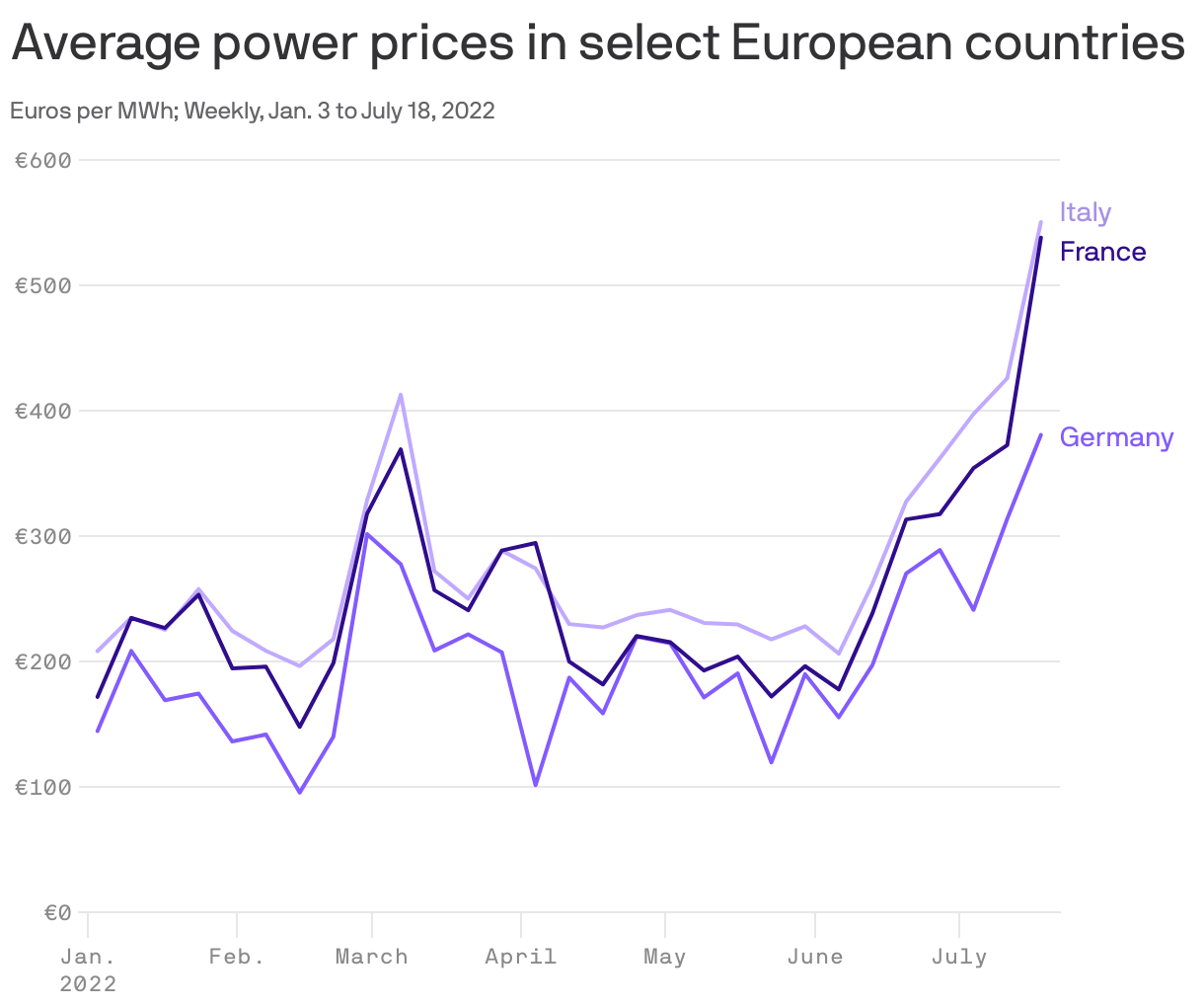
Electricity prices in Europe are headed to record-breaking territory — and government bailouts are getting underway to save the energy market, Axios’ Kate Marino writes.
- In Germany, France and Italy, July is on track to be the highest-priced month ever for spot power prices, according to Rystad Energy.
The big picture: A perfect storm of soaring natural gas prices triggered by Russian supply issues, high coal prices, low wind speeds and scorching weather is driving the price moves, the research firm wrote in a recent note.
State of play: Some of Europe's electric utilities — faced with passing on higher costs to customers or taking losses themselves — are failing.
- Germany’s Uniper SE today agreed to a bailout deal in which the government will take a 30% stake in exchange for €15 billion euros.
- Électricité de France agreed to a full takeover by the French government, which will inject €10 billion.
What to watch: Bloomberg’s Javier Blas estimates the bailouts have only just begun — and may ultimately cost European taxpayers $200 billion. And that's being conservative, he adds.
5. The cost of fake reviews

Illustration: Brendan Lynch/Axios
Fake online product reviews cost shoppers 12 cents for every dollar they spend, and increase the likelihood they buy inferior products, according to a new working paper to be presented today at the NBER Summer Institute, Emily writes.
Why it matters: Intuitively we know fake reviews are bad, but the paper offers a deeper picture of how phony write-ups and inflated star ratings change shopping behavior.
Zoom out: Online markets that bring together large groups of buyers and sellers, with more information on pricing and quality, should theoretically be more transparent and better functioning than brick and mortar markets.
- That's never been quite how it works on the internet. Platforms endlessly battled with fakers and fraudsters to gain user trust. (Just ask Elon Musk about Twitter bots.)
Context: Amazon does try to keep fake reviews off the platform, including by cracking down on Facebook groups where people are offered money or stuff to write them. But smaller sellers, with little brand recognition, have a big incentive to keep trying.
- The pandemic led to a surge in both online shopping and fake reviews — during the 2020 holiday shopping season, about 42% of the reviews on Amazon were fakes, according to one estimate.
How it works: The researchers recruited 10,000 online participants in the U.K. to shop on an Amazon-like platform they'd created. "Shoppers" were asked to pick a product to buy from a group of five identically priced items (either a dash-cam, pair of headphones or a cordless vacuum).
- All of the items were real and rated for quality by a nonprofit consumer advocacy group in the U.K. that sponsored this study.
- Researchers showed some participants fake reviews or inflated star ratings — or both. Others didn't get any phony reviews. A few participants received guidance on how to spot a phony review.
- Those who saw fake written reviews were 7 percentage points more likely to buy faulty products. Inflated star ratings also decreased the likelihood that a shopper would buy a superior product.
- In a separate survey, participants were asked how much money they'd pay for the various items — when fake reviews were in the mix, they were more likely to overpay for products by about 12% on average.
Worth noting: The researchers found that shoppers who use Amazon more frequently were more likely to be affected by phony ratings.
- "That's kind of like the opposite of what most economists think happens in marketplaces," says Robert Metcalfe, an economics professor at the University of Southern California, who co-authored the paper.
- Typically, you think more sophisticated participants would be less likely to be duped — but frequent Amazon users shop the platform faster and tend to trust it more, he says.
What's next: Metcalfe says that online platforms could do more to warn users or guide them on how to spot fake reviews. That would "improve consumer welfare immediately."
🐦Fun fact: You can follow us during the day on Twitter for news, sandwich thoughts and gardening updates: @EmilyRPeck and @MatthewPhillips.
And please keep the questions coming (just reply to this email) about all things markets, money, economics, etc. Provide your name and location and we might feature your question in a newsletter.
Sign up for Axios Markets

Stay on top of the latest market trends and economic insights