
Axios Markets

April 26, 2024
Happy Friday! Today's newsletter is 826 words, 3.5 minutes.
1 big thing: Annuities are back (kind of)

Illustration: Annelise Capossela/Axios
When you retire, you can take your retirement funds, convert them into an annuity, and rest assured that you have a guaranteed income for life. At least in theory. In practice, almost no one ever does this, Felix writes.
Why it matters: One of the biggest problems with the defined-contribution retirement plans most Americans have is that they don't provide an income upon retirement, just a lump sum. At that point, retirees are largely on their own.
- Annuities are the way the market converts a lump sum to an income, but they're generally seen as being opaque and unpopular.
Driving the news: BlackRock officially launched its LifePath Paycheck product on Wednesday after teasing it last month.
How it works: A handful of corporate partners, including Adventist HealthCare Retirement Plans and the Tennessee Valley Authority Retirement System, will default new employees into LifePath Paycheck funds, which are replacing traditional target-date funds.
- The new funds behave identically to existing target-date funds until the employee is 55. At that point, the fixed-income component starts to get switched over to something called "lifetime income," which includes things like forward contracts rather than just plain vanilla bonds.
- The returns on the lifetime income component will be similar to returns on a normal bond portfolio β but because of the way it's constructed, the new component will be particularly easy to convert to an annuity.
- Once the owner of the fund turns 59Β½, they have the option β at any point for the rest of their life β to convert the lifetime income funds into an annuity provided by an insurer.
The catch: The annuities won't be indexed to inflation, so the guaranteed income will shrink in real terms over time.
- Retirees are also taking on the counterparty risk of the insurers, and need to trust that they won't go bust.
Meanwhile, the insurers are acutely aware of the so-called adverse selection effect: The kind of people who opt for an annuity tend to be precisely the kind of people who have reason to believe they're going to live longer than a dry actuarial table might suggest.
- The amount annuities pay out is therefore conservatively calculated β which is to say, the insurers try to err on the side of paying out less rather than more.
- Because retirees are advised to annuitize only about 30% of their funds, the monthly income can often end up being so small that most people don't think the deal is worth taking.
The big picture: There are more than $3.5 trillion in target-date funds, which are a simple, low-fee way to save for retirement and automatically reduce risk over time.
- By contrast, there is no such thing as a simple, low-fee annuity.
- While index funds generally charge less than 0.1% in fees, the fees on annuities are generally between 0.5% and 1%, per Morningstar annuity expert Jason Kephart.
The bottom line: Annuities will never be as simple as index funds β but BlackRock's new product does at least move them in that direction.
2. When the working-age population shrinks


For all of modern history, economic growth and population growth have gone hand in hand. That's now changing, as Charles Kenny and George Yang write in a new paper from the Center for Global Development, Felix writes.
- Countries like Japan, Germany, and Spain β now China, too β have continued to register economic growth even as their working-age population has been shrinking.
The big picture: More than a quarter of the world's population now lives in a country where the working-age population is shrinking rather than growing.
- China reached that point in 2016; India will get there in 2049.
Why it matters: When a country's labor force stops growing, its economic growth slows, and government expenditures rise.
- Labor-intensive industries will suffer when there isn't enough labor to fill existing jobs.
Between the lines: If a country's labor force is shrinking, that can change the national rhetoric around immigration.
- "That shift helps explain a U-shaped relationship between aging populations and attitudes towards migrants in Europe," writes Kenny. "First, aging is associated with a rise in anti-migrant sentiment but then, as concerns over who is going to look after all the old people begin to rise, that trend reverses."
The bottom line: Don't hold your breath waiting for pro-immigration sentiment to rise in the U.S. We aren't going to reach the point of negative working population growth until 2054.
Bonus: America's falling fertility rate
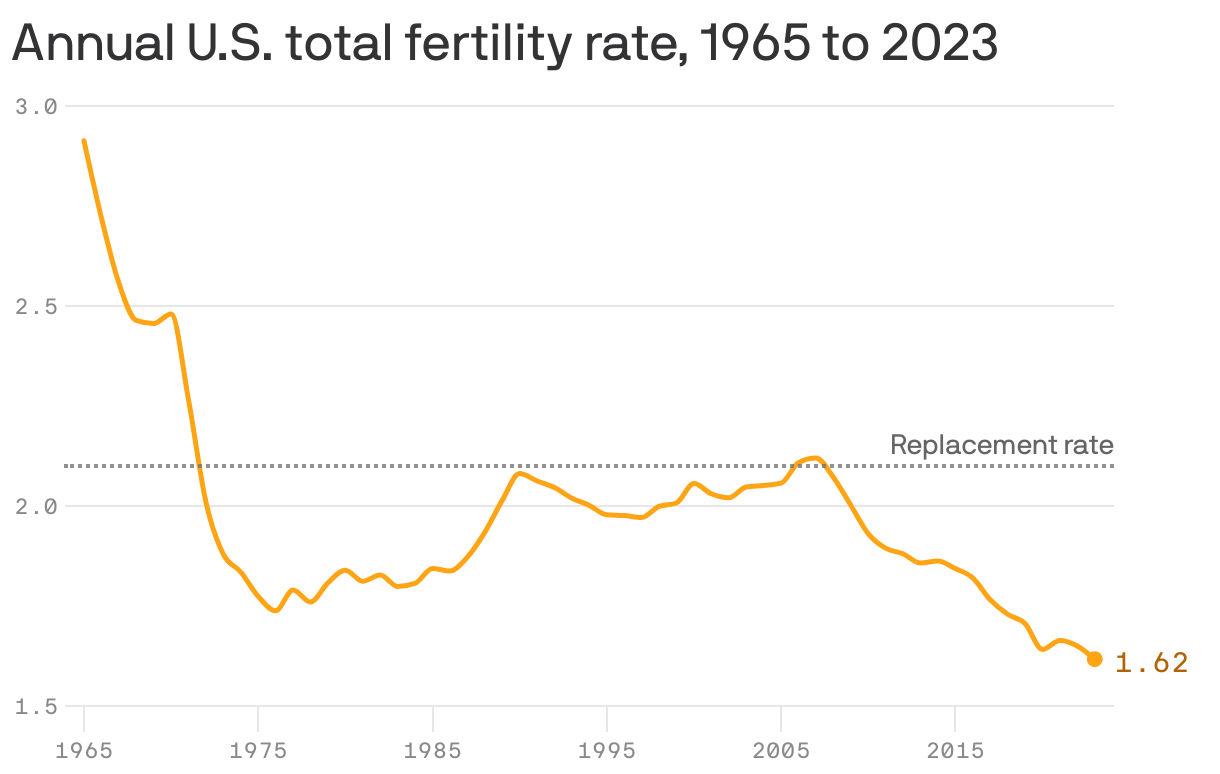
The U.S. fertility rate is well below replacement. The country still has 30 years of a growing workforce ahead of it, though, thanks in large part to immigration.
3. Alphabet joins the dividend club


Paying dividends pays dividends. That's the lesson learned in February, when Meta did it, and learned again yesterday when Alphabet did it, Felix writes.
- Alphabet shares shot up from $156.93 at the close to as high as $182.94 in after-hours trading, after the Google parent company announced its first-ever dividend of 20 cents per share.
- The company also announced a stock buyback of as much as $70 billion.
Thanks for starting your day with us! If this email was forwarded to you, subscribe here.
Axios Markets is edited by Kate Marino and copy edited by Mickey Meece.
Sign up for Axios Markets

Stay on top of the latest market trends and economic insights