Axios Markets

January 15, 2025

🐪 Hump day! There's a lot of talk about Corporate America pulling back from DEI in the Trump 2.0 era, but will employees vote with their feet?
- Plus: The CEOs are cautious, but the CFOs are going shopping.
All in 960 words, a 3.5-minute read.
1 big thing: Ending diversity efforts = less diversity
Meta's push to diversify its workforce actually seems to have worked, as its own statistics show. Now that the company is pulling back on DEI, there will likely be backsliding.
Why it matters: The most obvious, and perhaps least-mentioned, part of the corporate retreat on diversity, equity and inclusion is that it could reduce, well, diversity, equity and inclusion inside these companies.
Catch up quick: Last week, Meta was the latest company to cut diversity efforts, detailing a host of changes similar to other employers' moves and attributing the change to a "shifting legal and policy landscape."
- Critically, Meta said it will no longer have "representation goals," or targets for hiring from certain underrepresented groups.
- Goals are more aspirational than quotas, which are illegal. Still, companies have been turning away from them since the Supreme Court's decision banning affirmative action in colleges put corporate DEI in the crosshairs.
Zoom out: The research on these goals is pretty clear: Firms that set them don't usually meet them.
- But "they make more progress than firms that don't set them," said Frank Dobbin, a Harvard professor and leading researcher on workplace diversity.
- Over the long term, some of Meta's changes "will probably lead to reductions in the diversity of the workforce," he said.
- Meta declined to comment for this story.
Flashback: Meta's goals appear to have worked. In 2019, it committed to doubling the number of Black and Hispanic employees by 2024. "We met and exceeded that goal," the company says in its 2022 diversity report.
State of play: Meta employees told Axios' Ina Fried that they are worried about what the DEI pullback means for them personally, as well as for the company and its products.
- At the same time, there are certainly those inside Meta and corporate America, more generally, who've long bristled at diversity efforts and now feel unleashed by the changes.
- "Anyone who has a marginalized identity is probably feeling pretty nervous right now," said Rebecca Ponce de Leon, a professor at Columbia Business School who studies diversity and inequality.
💭 Ina's thought bubble: Employees from already underrepresented groups — women, ethnic minorities and LGBTQ+ folks — will leave in greater numbers and are likely to be replaced with a less diverse group of workers.
2. Fearing a future tech exodus
The feared exodus from tech companies might take a while, though. Those who are unhappy might be a bit stuck.
Context: The hiring market has slowed, particularly in tech. (While AI employment has been a bright spot, the field is struggling with its own diversity issues.)
- Folks will stick around until they don't have to, said Massella Dukuly, head of workplace strategy at Charter, a future-of-work media and research company. "Right now people are fearful of losing their jobs."
- As it happens, Meta yesterday told employees it was firing the lowest-performing 5% of its staff, roughly 3,600 people. (The roles will be backfilled, a Meta source confirmed to Axios' Sara Fischer.)
Reality check: Many benefits that are effectively DEI — such as paid leave for parents that helps women stay in the workforce — have not yet gone away.
- Meta will still have employee resource groups, where workers of different identities can connect.
Yes, but: "It's too soon to say with any confidence what we'll see in terms of retention and attrition," said Joelle Emerson, the cofounder of diversity consulting firm Paradigm. "I think a lot of this will come down to how these companies actually implement their new approaches."
- She's not convinced companies are actually pulling back on the practices that matter most for employees. "A lot of this seems like semantics, and a desire to move away from the politically charged acronym DEI."
What to watch: It's still early days.
- Right now the vibes are anti-DEI, as noted opponent Donald Trump is headed back to the White House.
- But it's not unreasonable to expect backlash to the backlash. "I have to believe the pendulum is going to swing the other way again," said Ponce de Leon.
3. The new risks under Trump

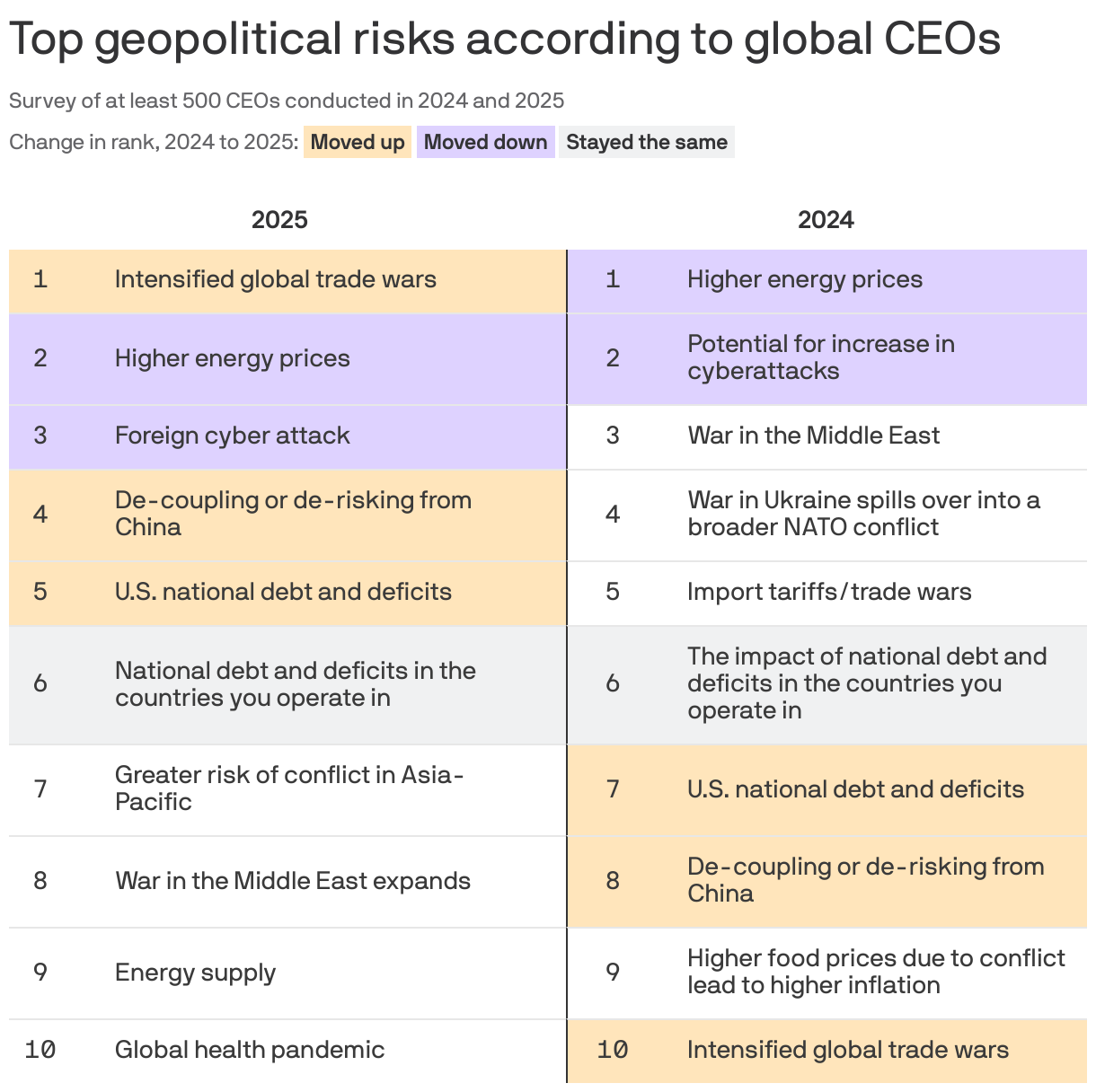
The world's CEOs are much more worried about global trade wars now that Trump has been elected president than they were a year ago, according to new survey from the Conference Board.
Why it matters: While no one knows exactly what tariffs the upcoming Trump administration is going to impose on which countries, the one certainty is that substantially all such tariffs will be met with retaliatory counter-tariffs. Or more simply: a trade war.
- As Axios noted on Monday, rapidly introduced tariffs could trigger speedy retaliation from major allies, including a broad-based 25% Canadian tariff on all U.S. imports.
- Such actions would make the 2018 trade war look minuscule.
Zoom out: The 2025 list of the top geopolitical worries also includes "foreign investment restrictions" and "greater risk of conflict in Asia-Pacific," both of which have risen sharply from their position last year.
The other side: Geopolitical worries don't seem to have dampened broader economic optimism.
- While 55% of U.S. CEOs said the risk of an economic downturn or recession was going to be a high-impact issue in 2024, that number has fallen to less than 40% in 2025.
- Similarly, the proportion of U.S. CEOs worried about high borrowing costs fell from 28% in 2024 to 16% in 2025.
Between the lines: As CEOs get more optimistic on the economy, a new Deloitte survey of North American CFOs shows a huge uptick in their risk appetite, too, since the election.
- 67% of CFOs say "now is a good time to take risks" — a six-year high.
- That's up from just 12% in the third quarter.
The bottom line: Global CEOs seem to have taken Baron Rothschild's admonition to heart: "The time to buy is when there's blood in the streets, even if the blood is your own."
Thanks to Ben Berkowitz for editing and Anjelica Tan for copy editing. See you tomorrow!
Sign up for Axios Markets