Axios Markets

January 09, 2025

🚘 Welcome back! Today we take a deep dive down the regulatory rabbit hole that makes Tesla billions of dollars. Will Trump cut off Musk's money printer?
- And just how much sway does Tesla have over its competitors?
All in 1,100 words, a 4-minute read.
1 big thing: Tesla's easy money at risk under Trump
Tesla has earned $11 billion from the sale of regulatory credits. That money, which is effectively paid to Tesla when its rivals exceed emissions limits, is on the rise — but could dry up if President-elect Trump rolls back Biden-era regulations.
Why it matters: Tesla's billionaire CEO, Elon Musk, is spearheading Trump's effort to cut government red tape.
- In this case, reversing Biden's environmental policy would significantly hurt his own company's bottom line.
Follow the money: In the nine months through September 2024, 43% of Tesla's $4.8 billion in net income came from selling regulatory credits to other carmakers.
- Since 2012, 34% of Tesla's total $32 billion in profits have come from such credit sales.
Where it stands: Absent a change in policy, that revenue stream is likely to soar in coming years as legacy carmakers scramble to buy emissions credits from Tesla, which generates such credits with every vehicle it produces.
- But if those credit revenues disappear, Tesla — facing declining vehicle sales — would see its profit margin lag that of GM.
The big picture: Transportation is the leading source of climate-changing carbon emissions. The Environmental Protection Agency under President Biden has enacted ever-stricter limits on tailpipe emissions.
- Starting with the 2023 model year, automakers' fleet-wide emissions must decrease an average of 8% a year through 2026, compared with a typical 2% annual improvement historically.
- The rules get even more stringent starting with the 2027 model year. From that point on, fleet-wide emissions must fall by about 11% per year through 2032.
Between the lines: While selling hybrid vehicles and more efficient gas cars and trucks certainly helps, lots more EVs are essential to hitting such targets.
- The EPA estimates that compliance would mean 56% of new cars sold will be electric by 2032.
The other side: Trump claims Biden's policies are akin to an "EV mandate" and has said he'd relax EPA standards, as he did during his first term.
Friction point: In the meantime, EV sales aren't increasing as fast as expected, which means carmakers face substantial penalties for noncompliance.
- One way to avoid such fines is to purchase tradeable emissions credits from companies that have exceeded the standards by selling lots of electric cars, primarily Tesla.
- As long as EPA standards keep rising and EV sales lag, demand for credits will increase, driving up the costs of compliance for most automakers — and fattening Tesla's coffers.
State of play: It's already happening.
- In 2023, the first model year that Biden's higher standards went into effect, Tesla sold $1.8 billion worth of credits, including 34 million federal greenhouse gas credits, to other automakers.
- Through the first nine months of 2024, it's already taken in $2.1 billion in credit revenue, with year-end figures expected Jan. 29.
- Tesla said the 53% increase over the prior nine months was "driven by demand for credits in North America as other automobile manufacturers scale back on their battery electric vehicle plans."
Zoom in: Ford Motor is among the companies trying to scoop up emissions credits to ensure compliance while it reins in its EV plans in favor of more hybrids and plug-in hybrids.
- Ford disclosed in July that it had contracts to purchase about $3.8 billion of regulatory compliance credits for use in North America and Europe for current and future model years, including $100 million it spent during the second quarter of 2024.
- In October, Tesla said it has long-term contracts to sell $4.7 billion of credits, including $683 million in sales expected in the next 12 months.
Of note: Credits are also traded to comply with other state and federal regulations, including California's zero-emission vehicle program.
- In Europe, Tesla could collect more than $1 billion in compensation from Stellantis, Toyota, Ford, Subaru and Mazda, which are pooling emissions with Tesla to avoid big fines, according to UBS analysts.
The bottom line: Trading emissions credits is big money, and Tesla is the clear winner, as long as Trump doesn't pull the rug out from under his First Buddy.
2. How emissions credit trading works
No company wants to pay a competitor for help complying with the law, but for most automakers, purchasing regulatory credits — just like buying steel or rubber — is now a cost of doing business.
- There is no central marketplace. Instead credit transactions are handled privately between firms, sometimes under long-term contracts.
How it works: The EPA sets an increasingly-stringent emissions standard, measured in grams of carbon dioxide per mile, for each manufacturer's car and truck fleet.
- The permitted level of emissions is a sales-weighted target based on the average "footprint" (the area between the four tires) of the vehicles each automaker produces. The larger the footprint, the greater the emissions any given vehicle is allowed to produce.
If a carmaker's fleet-wide performance comes in below the EPA limit, they earn credits for that model year. If it is above the limit, they generate a deficit.
- Manufacturers have lots of flexibility to comply, including banking credits from year to year or trading with other companies.
Between the lines: EVs, plug-in hybrids and other alternative-fuel vehicles are incentivized with credit multipliers. That's why Tesla, a pure EV manufacturer, earns the most credits every year.
- Other EV makers, including Rivian and Lucid, as well as hybrid leaders like Honda and Toyota, also earn extra credits but nowhere near as many as Tesla.
- The perennial biggest seller of credits is Tesla. The biggest buyer has often been Stellantis, maker of Ram pickups and Jeep SUVs, which is just starting to add hybrid and electric powertrains.
3. The emissions gap in one chart
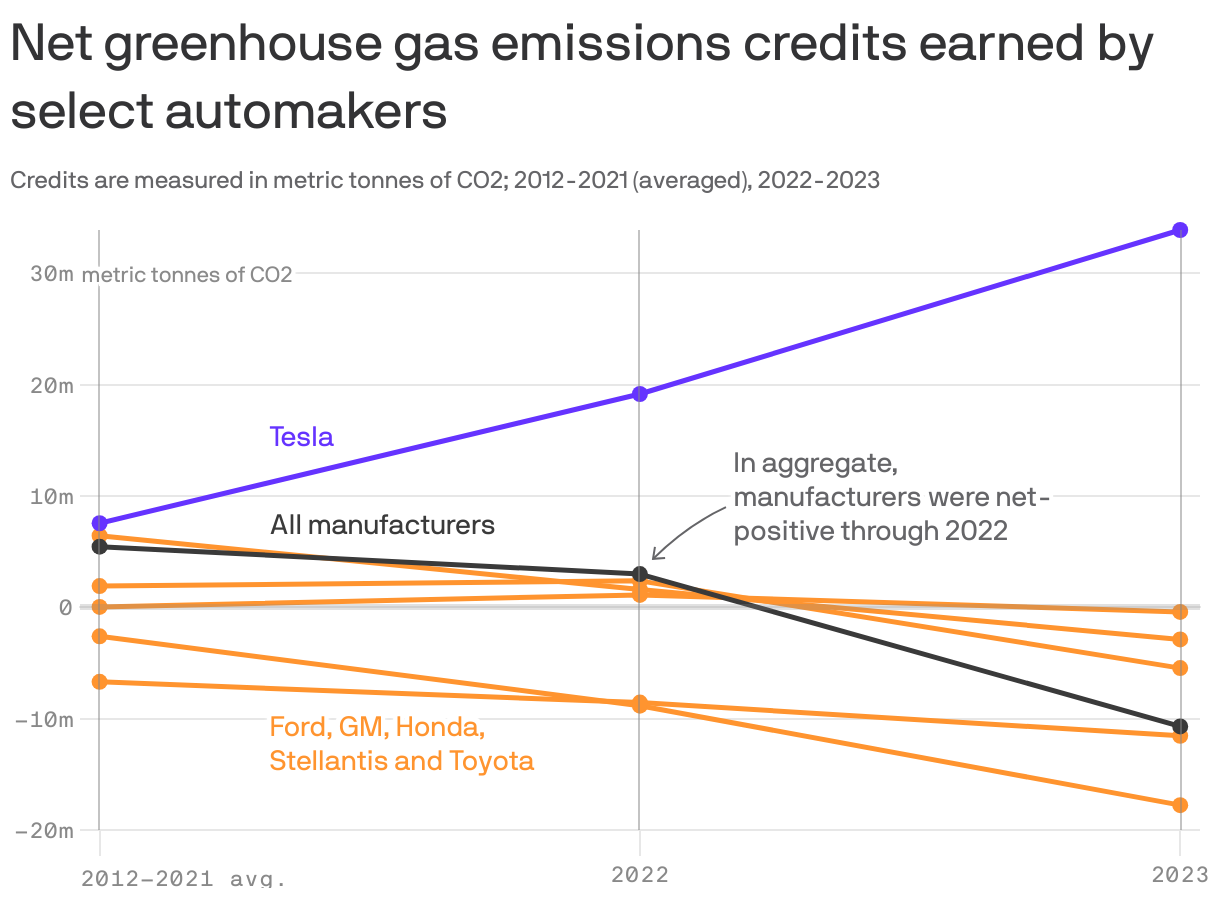
As emissions standards get increasingly stringent and car buyers stubbornly refuse to move en masse to EVs, most vehicle manufacturers are falling behind in terms of compliance with federal rules.
Why it matters: The auto industry as a whole fell out of compliance with the rules for the first time in 2023, to the tune of 10.7 million metric tonnes of carbon dioxide. (One credit is set at 1 million tonnes of carbon dioxide.)
- Tesla, meanwhile, generated a surplus of 34 million credits, all of which it sold to other automakers.
By the numbers: Toyota, which relies heavily on hybrid cars, generated a surplus of 2.4 million credits in 2022. That became a deficit of 5.5 million credits in 2023.
- Honda and Ford also swung from surplus to deficit.
- Excluding Tesla, the overall vehicle industry had a deficit of 16 million credits in 2022, which trebled to 45 million credits in 2023.
The bottom line: Auto manufacturing is facing its own version of a short squeeze, and Tesla is the only company that can help its rivals cover those shorts.
Thanks to Ben Berkowitz for editing and Anjelica Tan for copy editing. See you tomorrow!
Sign up for Axios Markets