Axios Markets

September 24, 2026


1 big thing: Those soaring Treasury yields
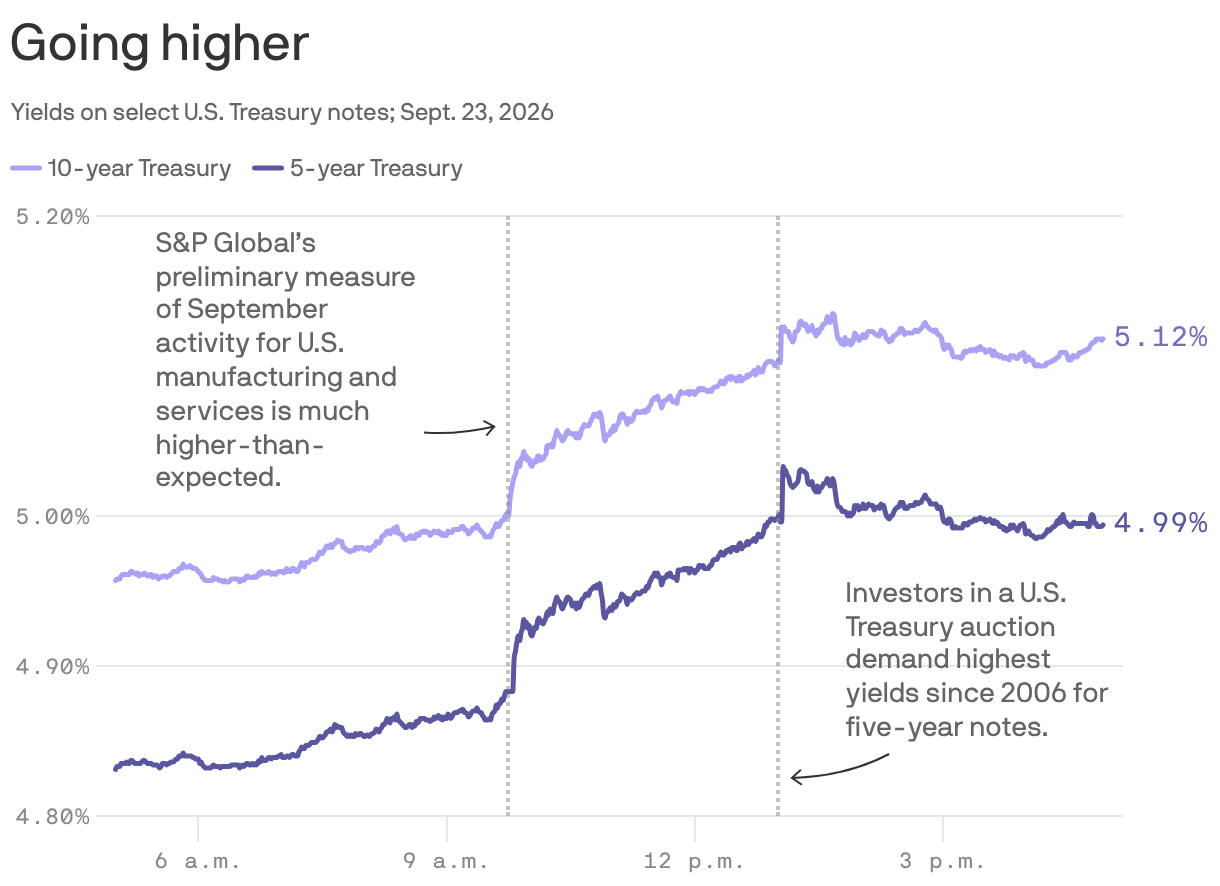
Treasury yields are soaring, with the 30-year Treasury bond climbing to its highest level since 2004 Thursday.
- The selloff in bonds started to accelerate Wednesday after a sizzling early report on the economy in September.
The big picture: The moves were big. Bigly even.
- Yesterday's gain of roughly 0.15 percentage point in the 10-year Treasury yield was the biggest since April 2025, when President Trump's "Liberation Day" tariff announcement rocked markets.
Flashback: Markets heads remember that it was ructions in the bond market — "They were getting yippy," the president famously said at the time — that prompted Trump to walk back some of the most extreme tariff policies.
Yes, but: This time, the dynamics driving the bond market are more complicated, global and difficult to manage.
- Treasury yields have been moving higher for months on a combination of stronger-than-expected economic activity coupled with uncomfortably high inflation.
- The surge in data center-related borrowing in the bond market is also pushing up interest rates, as tech borrowers compete with the U.S. Treasury for investor dollars.
Case in point: The big driver of yesterday's surge in yields — which means, remember, that bond prices were falling — was one of the earliest economic reports on the U.S. economy in September.
- These surveys of corporate purchasing managers suggested booming business in both the U.S. manufacturing and services industries. (JPMorgan economists said they were consistent with a 5% annual run rate for GDP growth.)
- But they also showed that the prices these companies were paying were soaring as well. (In other words, more inflationary pressures are in the pipeline.)
Zoom out: Inflation is anathema for bond market investors as it erodes the value of the interest payments bondholders collect, making them less attractive assets.
Between the lines: Lurking in the background of the inflation-driven market move is the specter of a U.S. diesel export ban, which the Trump administration is reportedly considering.
- But there's deep uncertainty about what such a ban would mean for overall inflation.
- Some industry voices warn that such a ban could actually push prices of other refined products, like gasoline, sharply higher because of the way refineries operate.
What they're saying: "The proposed U.S. diesel export ban will not play out as the U.S. administration expects," wrote Susan Bell, an oil analyst with the consulting firm Rystad Energy. "While it may temporarily lower domestic diesel prices, it will cause the prices for all other refined products to soar as U.S. refineries cut run rates to balance their diesel production with the domestic demand."
- "There is little flexibility to minimize diesel yield without cutting overall refinery throughput," Bell said.
The bottom line: The inflationary pressures appear to be building in the economy, which will be a headache both for politicians in the final stretch of the midterm elections and for policymakers like Federal Reserve chairman Kevin Warsh.
2. Muse is proving to be one tough customer
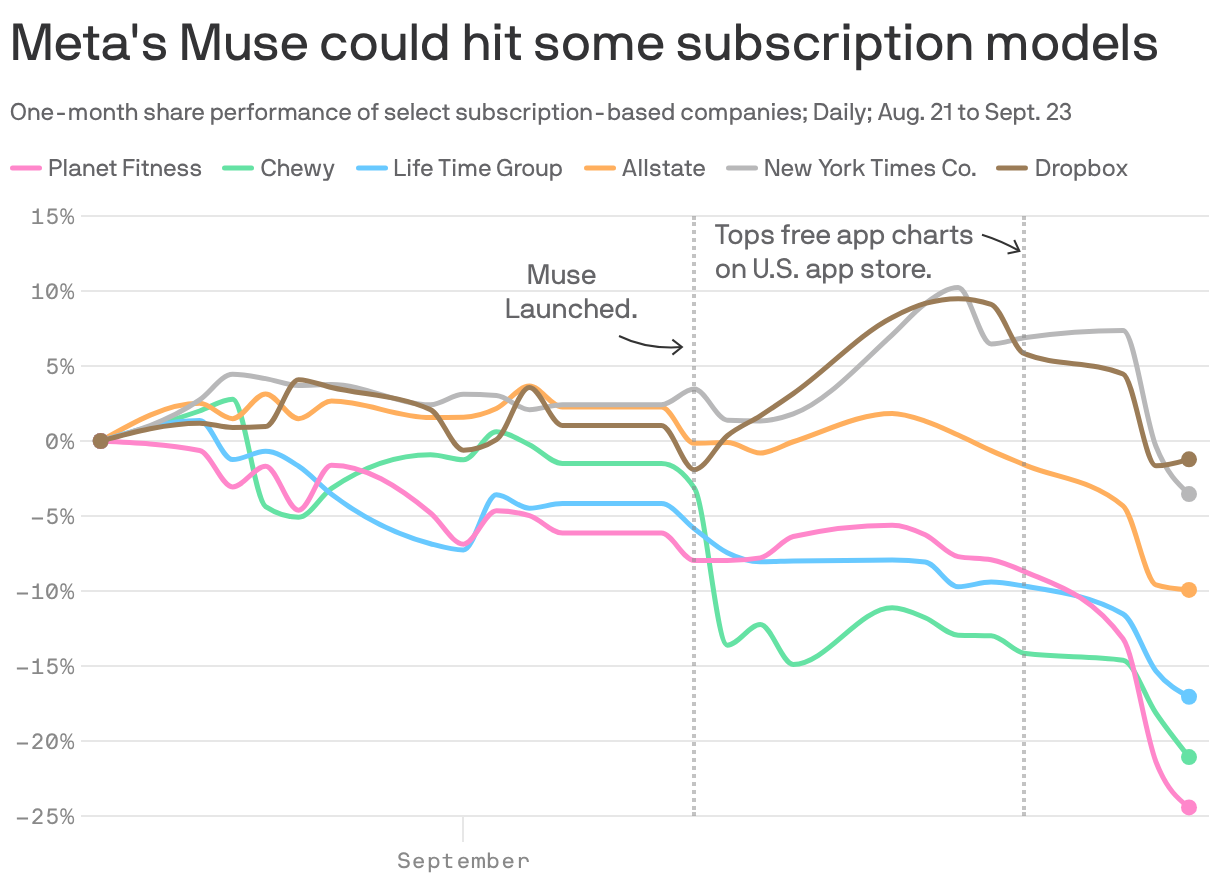
Companies that stand to profit from revenues linked to the kind of auto-renewals that benefit from customer inattention and inertia have slumped since the well-received release of Muse, Meta's new AI agent.
Why it matters: One of the beauties of the subscription model — at least for the companies collecting the revenue — is that customers often keep paying for subscriptions long after they stop valuing or using the service.
The big picture: And that subscription economy has boomed: gym memberships, streaming services, meal kits, home security, video games and dating sites, as well as pricier stuff like GLP-1s and concierge health care.
Stunning stat: Spending on non-utility subscriptions rose 7.7% in July from a year ago, outpacing overall credit card spending, Bank of America said earlier this month, citing its payments data.
Zoom in: A paper in the American Economic Review last year looked at purchase-level data from a payment card network for 10 popular subscription services.
- Using that data, economists Liran Einav, Ben Klopack and Neale Mahoney then tried to estimate the impact of customer inertia on subscription revenues more broadly.
- "We estimate that these cancellation frictions roughly double seller revenues on average," they wrote, while cautioning that there could be substantial differences in the impact that customer inertia has on different kinds of products and services.
What they're saying: "People are paying for many months of subscriptions that they no longer value," Mahoney, a Stanford economist and one of the coauthors, told Axios last year. "That allows companies that don't perhaps have a viable business model to continue bringing in money."
The latest: Meta's Muse seems to be quite good at identifying and keeping track of redundant, seldom-used or soon-to-renew subscriptions and then canceling them.
- In a review, the New York Times' Eli Tan wrote: "I found Muse to be the most useful AI app I had ever used. One clarifying moment came after I connected my credit cards to Muse and asked it to track my spending in Google Sheets. I watched as it spun up tabs with hundreds of rows of data each in minutes, then flagged two duplicate subscriptions, which it canceled for me."
- The specter of such efficient axing of stale subscriptions by consumers has prompted investors to sniff out a number of companies where the prospect of Muse closely monitoring subscriptions could pose a risk to revenues.
What's next: The threat to subscription models could be part of an emerging AI-driven shakeup over who controls the strategically important relationship between sellers and buyers.
- Already, Amazon has moved to curtail Muse from making purchases on its site, citing security reasons.
- Yet sellers that lack the heft of an Amazon will be less likely to opt out of an economic ecosystem increasingly curated by Meta.
Axios Markets