Axios Markets

February 20, 2026

Friday! We did it. Today we pull back on the doomsday software talk, and if you read to the end, well, you're in for a little hip-hop infused treat.
👀 The Supreme Court may issue its long-awaited tariff ruling today.
- If President Trump's import duties are held illegal, analysts are expecting a bump up for stocks. If the justices uphold the tariffs, in whole or part, then things could get…interesting.
All in 1,060 words, a 4 minute read.
1 big thing: Software is not dead yet

There's a rising chorus that the big selloff in software stocks — the dreaded Saaspocalypse — has been overdone.
Why it matters: Yes, AI is upending the software business. No, that doesn't mean software is going extinct.
Where it stands: Over the past few weeks, software stocks had their deepest selloff outside of a recession in 30 years, JPMorgan analysts noted earlier this month.
- Although the decline in share prices now appears to be moderating, investors are still, to put it technically, freaking out.
- "We have been asked more questions on software this past month than in the past 25 years," UBS strategists wrote in a note yesterday.
State of play: "Software is down, not out," says Rich Ross, senior managing director at Evercore ISI (more on him below). That's the growing sentiment among cooler and more seasoned heads inside the tech industry and on Wall Street.
- Those arguments got a little boost after the stock price of Figma, a design software firm, jumped after it reported a 40% increase in revenue from last year, and its CFO said it was "winning in AI." (The stock is still down 30% for the year.)
Zoom in: There's even a case that AI will make software more necessary, says Steven Sinofsky, former head of Office and Windows at Microsoft, in a lengthy Substack.
- "AI changes what we build and who builds it, but not how much needs to be built," he writes.
- JPMorgan analysts put it more wonkishly: "Emerging evidence suggests that AI is more likely to be additive to software workflows."
- In other words, software companies are moving to fold in AI features, "thereby enhancing existing platforms and creating upsell opportunities rather than rendering incumbents obsolete overnight."
Flashback: Sinofsky compares the current AI disruptions to three past pivot points in tech, all moments when people predicted an apocalypse, but what happened was more nuanced.
- Advent of the personal computer. People predicted the data center would be eliminated, among other blown calls. (Data center growth now is a huge and growing part of the economy.)
- Shift to online retail. Amazon was supposed to crush Walmart and all other stores. Walmart now has a $1 trillion market cap.
- Pivot to streaming. Music was going to be free, along with information. (The tally of subscriptions I'm shelling out for each month tells a different story.)
How it works: There is no software apocalypse. That doesn't mean there isn't enormous change and pain. There is a repricing of stocks, and some IPOs will never see the light of day.
Who survives? The software companies more likely to make it have:
- Proprietary data. Some software companies own information you can't get anywhere else, for example, Bloomberg terminals. "You can't just scrape it. You can't recreate it," Nicolas Bustamante, the CEO of Fintool, a financial services AI company, writes on X.
- Regulatory lock-in. This is software, in the health services space, for example, that deals with sensitive areas that can't simply be scrapped.
- Network effects. If everyone is using the same specific tool, they're not likely to pivot to a vibe-coded DIY app.
Reality check: Worth noting that no one knows what is about to happen.
The bottom line: To butcher a line from Mark Twain, reports of software's death are greatly exaggerated.
2. 🦉 When an owl is a canary


Blue Owl Capital rattled the stocks of other alternative asset managers after the company said it was halting redemptions from one of its funds yesterday.
Why it matters: The news sparked concerns about growing risks in the private credit market, which has attracted hundreds of billions of dollars from wealthy investors in funds that lend directly to companies.
- Private credit funds typically allow investors to withdraw money every quarter. Shares of Blue Owl fell 6% yesterday.
- "Is this a 'canary-in-the-coal mine" moment, similar to August 2007"? asked Mohamed El-Erian in a post on X yesterday.
3. 🎤 Hustle and stock flows
Rick Ross is a 50-year-old American rap icon who broke out in 2006 with the hit song "Hustlin'."
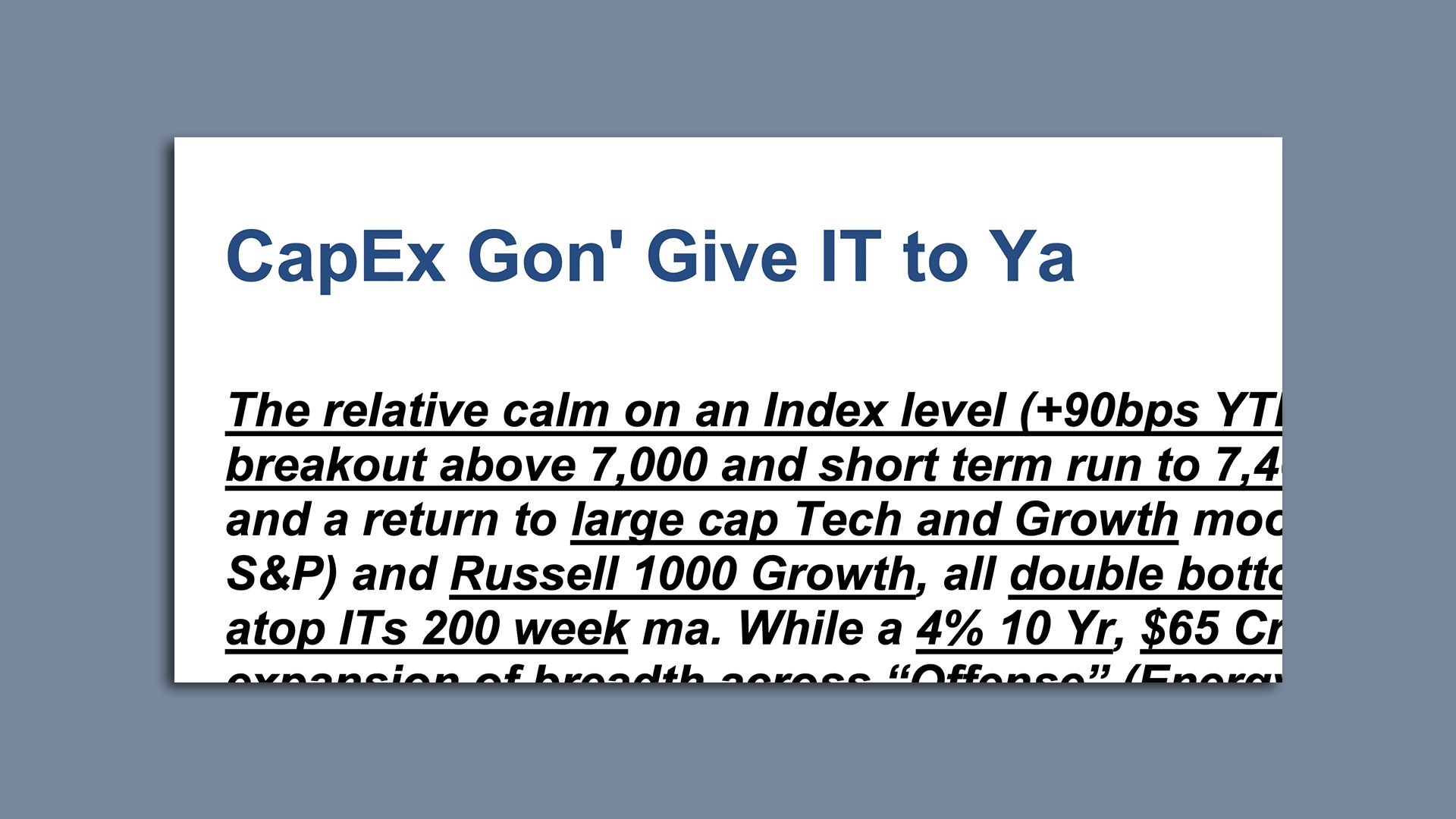
- Rich Ross is a 55-year-old analyst with Evercore ISI based in Westport, Conn., who broke out this week with a research note titled "CapEx Gon' Give IT to Ya," a riff on the 2002 hit song by hip-hop icon DMX.
Why it matters: Ross is one of a few Wall Street analysts spinning a more positive take on the software selloff.
- But as far as we know, he's the only one to zhuzh his work up with copious pop culture references from the past two decades.
Zoom in: A chart on mortgage rates falling is titled: "30 Yr Mortgage: Shawty Get LOW LOW LOW" (a riff on Flo Rida's "Low").
- A section on the importance of software references both the hit Apple TV show "Ted Lasso" — "Software is life" — and lyrics from OutKast, "Forever ever" from "Ms. Jackson," off the group's 2000 album "Stankonia."
By the numbers: Across 20 pages of technical analysis, we counted at least five hip-hop references, one to Linkin Park and one to the Grateful Dead.
- "I'm kind of a deadhead underneath the surface," Ross tells Axios. The word play is "sort of a calling card."
- The titles of his notes in January and December feature riffs on a 1980s Quincy Jones hit, a Nelly reference and one for New Kids on the Block.
Between the lines: Ross says he did not use AI for help on this latest report.
- "I've been trying to build AI insulation" into the job, he says, and the way to do that is by being more creative.
- "You know, I'm an English major in a finance profession."
- "I take my job very, very seriously," he says. "I don't take myself as seriously. I think it's how you survive in this business."
The bottom line: Everyday he's hustlin'.
Send me tips, story ideas and reworked hip-hop lyrics at [email protected], or simply reply to this email.
Thanks to Jeffrey Cane for editing and Anjelica Tan for copy editing.
Sign up for Axios Markets
