Trump's tariffs near their fate before the Supreme Court

Add Axios as your preferred source to
see more of our stories on Google.
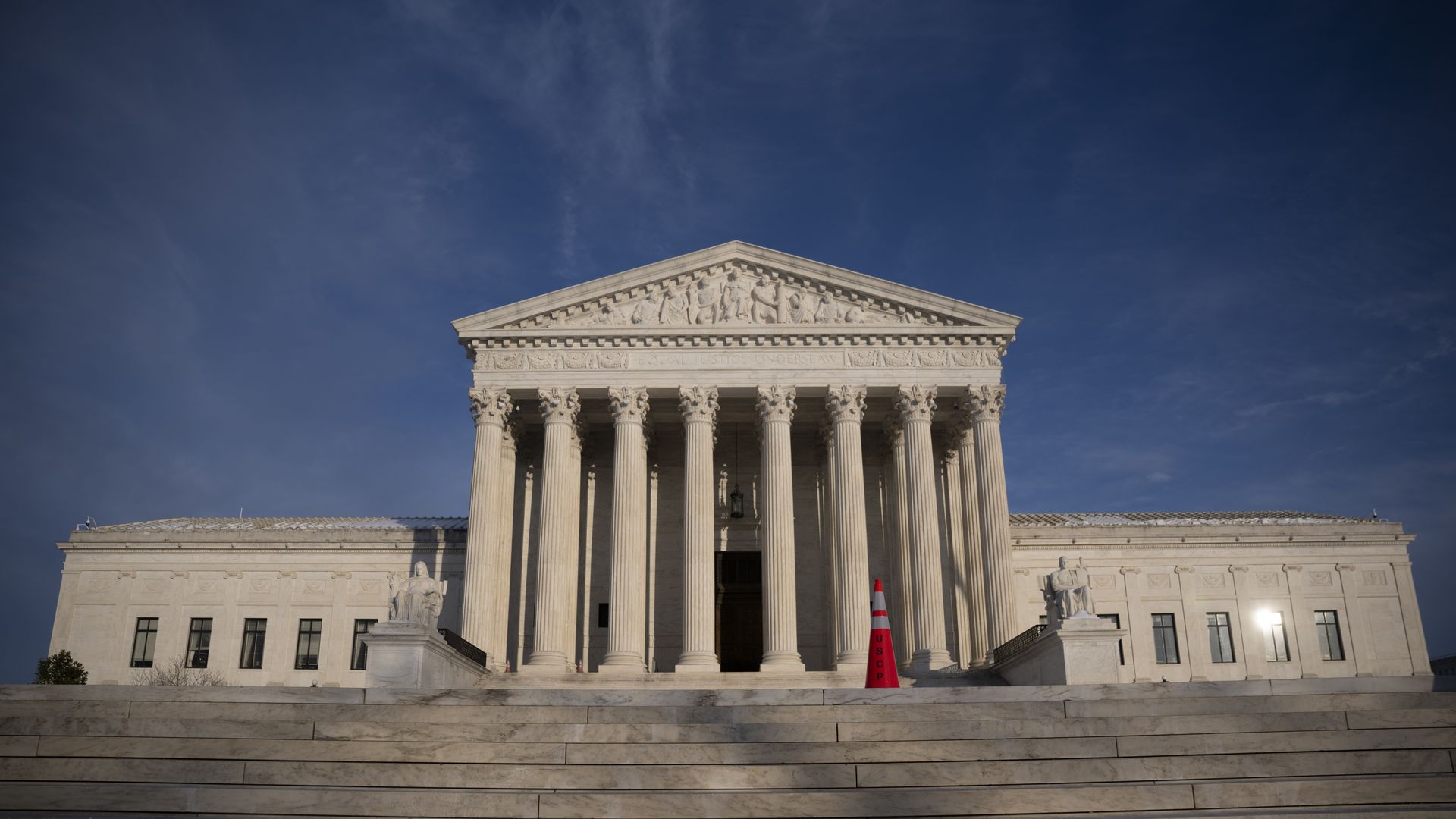
The Supreme Court Building. Photo: Celal Gunes/Anadolu via Getty Images
The Supreme Court may finally decide the fate of President Trump's trade agenda as soon as Friday.
The big picture: Small businesses sued to block Trump's tariffs last spring. Analysts had initially expected a swift ruling from the highest court, but the uncertainty has dragged on for longer than expected.
- The delay is a possible sign of the enormity of the decision that, either way, could rattle the global economy.
By the numbers: Consider the massive chunk of tariffs in legal purgatory.
- Over 60% of total tariff revenue in 2025 stemmed from those imposed under the International Emergency Economic Powers Act (IEEPA), which has never before been used to implement tariffs, according to the Cato Institute.
- The tariffs have been central to trade negotiations and frameworks negotiated by Trump last year.
The intrigue: In November, the Supreme Court appeared skeptical of the administration's defense of its tariffs.
- Chief Justice John Roberts said during the oral arguments that the levies were "an imposition of taxes on Americans and that has always been the core power of Congress."
There have been notable economic and political developments since November:
The goods trade deficit was the biggest on record in 2025.
- Trump cited "large and persistent" trade deficits as a national emergency, the basis for reciprocal tariffs unveiled on "Liberation Day."
- But even with massive tariffs in place, the trade gap widened for goods to a record last year, data released on Thursday showed.
Congress took a (symbolic) tariff stand.
- Half a dozen Republicans voted with Democrats earlier this month to repeal tariffs on Canada, a rare rebuke of Trump's signature economic policy.
- Rep. Don Bacon (R-Neb.) wrote on X that "it was time for Congress to reclaim the responsibility of taxes and tariffs."
Tariff burden research came under a spotlight.
- The latest is from New York Federal Reserve Bank researchers who calculated that households and businesses paid 90% of the tariffs imposed last year.
What to watch: If the Supreme Court rejects the legality of part or all of the tariffs, it could kick off a chaotic process of refunds to companies that have paid the overturned tariffs.
- It would also tilt the nation's fiscal outlook. The Congressional Budget Office estimates that higher tariffs would reduce deficits by $3 trillion in the next decade.
- The administration has promised to reimpose any overturned tariffs using other trade authorities, though it's unclear how long that might take.
Zoom in: Trump has floated sending out $2,000 "tariff rebate" checks to Americans — paid for by tariff revenue, though many estimate there isn't enough cash to cover the plan (let alone the many other plans he has for the funds).
- The White House is paying out $12 billion in tariff funds to farmers impacted by his trade policy.
The other side: Upholding the tariffs would rubber-stamp an enormous expansion of presidential power that could define economic, trade and tax policy in the Trump 2.0 era — and for decades to come.
What's next: If the Supreme Court does not issue a ruling on Friday, the next chance for decisions are next Tuesday and Wednesday.
