Axios Markets

January 26, 2026

⚠️ Investors face a new risk looming: A government shutdown this weekend looks more likely as Democrats push back against a Department of Homeland Security funding measure after the fatal shooting in Minneapolis. Follow more Axios coverage here.
- Today: 2026 kicks off unlike anything investors expected.
- Plus: Companies respond to the situation in Minneapolis.
Let's get into it. All in 1,240 words in 4 minutes.
1 big thing: The 2026 playbook needs to be rewritten
Investors are now confronting a different world, one marked by the Trump administration's aggressive push for a new global order, renewed attacks on the Federal Reserve, increasingly controversial immigration actions and more.
Why it matters: It's not even the end of the first month of the year. Time to throw out your 2026 outlooks.
What they're saying: It's hard to parse the market response to the firehose of news, because any selloff could be "a routine wave or a tidal shift, or worse, a tsunami," Steve Sosnick, chief strategist at Interactive Brokers, tells Axios.
State of play: Since the year began, investors have faced an influx of news.
- Venezuela: The capture of Nicolás Maduro led to a spike in volatility and a drop in energy prices.
- Greenland: President Trump threatened to take control of Greenland then proposed additional tariffs on European countries that did not support the effort, which triggered in part the broadest U.S. asset selloff since 2020. He then walked back the threats on Greenland and the tariffs.
- The carry trade: Japanese bond yields spiked, hurting one of the most lucrative trades used by Wall Street to turn profits.
- Trump vs. Powell: The Justice Department launched an investigation into Federal Reserve chair Jerome Powell, sparking concerns about central bank independence. The market, meanwhile, is still waiting to hear who the next Fed chair might be.
- Canada vs. the U.S.: Canadian Prime Minister Mark Carney dropped tariffs on Chinese EVs and said that "not every partner will share all our values" in a speech at Davos, in a recognition that China may not be the country that Canada needs to worry most about.
- Trump vs. corporate America: The president is suing the largest bank in the nation, JPMorgan Chase, and its CEO, Jamie Dimon, for $5 billion.
- The immigration crackdown. The killing of two people in Minnesota has triggered a response from the CEOs of the largest public companies based in the state, which could signal the start of a return to corporate activism.
Between the lines: Every time investors think they have a hold on the macro picture this year, it changes.
Follow the money: The recent hesitancy in the stock market rally reflects this.
- The S&P 500 is up just 1% so far this year.
- And the top basket of tech stocks, the Magnificent 7, is down 0.4% year to date as investors are also getting more skeptical about the AI trade.
Reality check: A rotation into other stocks is exactly what investors who are worried about an AI bubble have been calling for.
- It's early. Big Tech could still easily lead the market this year. The next earnings reports from the tech giants, which start this week, will help clarify the near-term outlook for these stocks.
What to watch: The market has so far paid only scant attention to geopolitical tensions, attacks on the Fed and other policy moves from Washington.
- How long will that complacency last?
The bottom line: The stock market sits on shaky ground without the strong performance of tech stocks to carry it through if there are additional bouts of policy-driven volatility.
2. Minnesota-based CEOs publicly call for calm

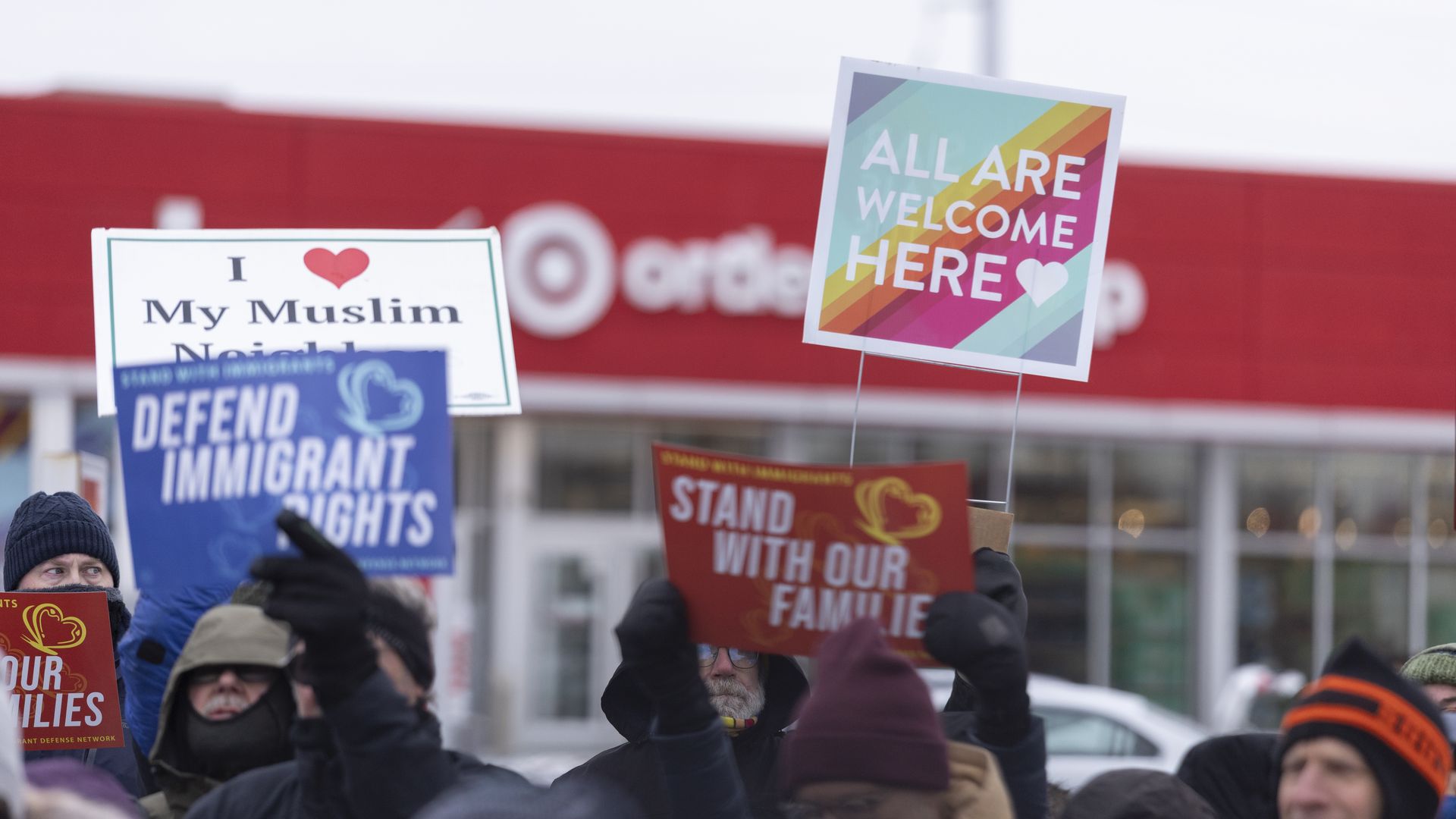
Executives at Target and other Minnesota-based companies have called for federal and state cooperation to ease tensions amid outrage over the ongoing immigration operation and the fatal shootings of two U.S. citizens by federal agents, Axios' Eleanor Hawkins reports.
Why it matters: The milquetoast letter is unlikely to appease local workers, activists and Minnesotans. But it does, however, signal a potential linchpin moment for the return of corporate activism.
Driving the news: More than 60 CEOs signed an open letter calling for a deescalation.
- "We are calling for an immediate deescalation of tensions and for state, local and federal officials to work together to find real solutions," they write.
- In the note, the coalition of business leaders also call for a "durable solution that enables families, businesses, our employees, and communities across Minnesota to resume our work to build a bright and prosperous future."
The big picture: Since the ICE operations began, employees, community members and activists have called on Target, Delta, Home Depot, Hilton, Enterprise and other businesses to denounce the operations publicly, sever contracts with DHS, and ban ICE officials from using their corporate spaces.
- Target, which found itself in the political crosshairs in recent years, faced internal backlash from employees. Many have skipped work out of safety concerns and voiced frustration over the company's silence until this point.
- Other employee and industry-led coalitions are starting to form. Nearly 400 employees across the tech sector — from companies such as Adobe, Google, Apple and Meta — signed a petition demanding that their CEOs cancel all company contracts with ICE and speak out publicly against the violence.
3. Intel reminds us that valuations do in fact matter


Intel shares fell 17% on Friday after the chip maker failed to deliver on the outlook Wall Street wanted.
Why it matters: Well, if it isn't pesky earnings fundamentals getting in the way of a valuation not tethered to reality!
Catch up quick: Intel stock rallied more than 130% in the six months ending just before its latest earnings were released.
- The stock is trading at 90 times forward earnings. For comparison, the most valuable company in the world, Nvidia, trades at 24 times forward earnings.
Follow the money: Investors can take either an optimistic or pessimistic approach to the post-earnings stock decline.
The bull case: The fact that Intel fell so sharply after it failed to deliver on earnings could be seen as investors acting responsibly for a change.
- They know its earnings didn't match up with valuations. The stock was punished for that, which is how efficient-market pricing works.
The bear case: The bears may say Intel shouldn't have become so highly valued in the first place.
- Its run could be indicative of a bubbly market where stocks become inflated thanks to things like the president's involvement (the U.S. government has a 10% stake in Intel) rather than the company's fundamentals.
What they're saying: Intel has become "such a large organization with so much bureaucracy that I think they got away from their roots," which were grounded in the mantra "only the paranoid survive," Don Butler, managing director at Thomvest, tells Axios.
- Even with its new CEO, Lip Bu Tan, at the helm, it's difficult to change culture at a legacy company like Intel, he adds.
- Intel has the potential to become a "strong U.S. foundry" long term, which may not show up in the numbers "for a few more years," Daniel Newman, CEO at the Futurum Group, a research and advisory firm, tells Axios.
The bottom line: The market is a forward-looking machine.
- But it can also be impatient. The investors who once focused on the future upside of Intel turning into an American chip giant are ready to see results.
- They may be tired of waiting.
Got tips? Email me at [email protected]. I would love to hear from you about anything that may be of interest for our investor audience.
Thanks to Jeffrey Cane for editing and to Anjelica Tan for copy editing. See you tomorrow!
Sign up for Axios Markets