Axios Markets

May 06, 2024


1 big thing: Child care crisis
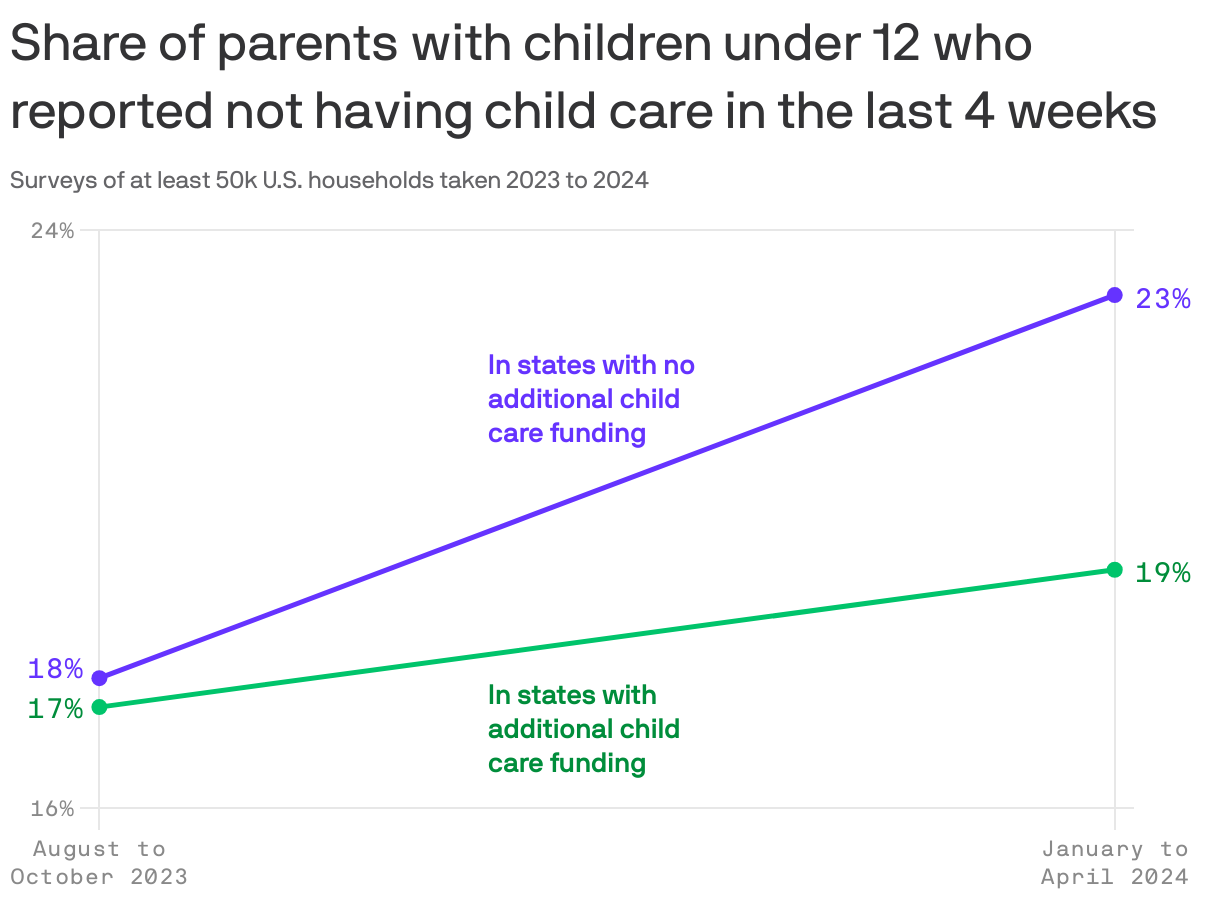
The share of families without access to child care is rising in the wake of the child care cliff, the date last year when pandemic-era federal funding for the industry ran out, according to an analysis of census data shared exclusively with Axios.
Why it matters: The child care industry is in crisis mode with more centers closing, raising tuition, facing staffing shortages, and being unable to operate at full capacity.
Zoom in: Eleven states and Washington, D.C., stepped in with funding to stabilize the industry post-cliff, including Alaska, Illinois and Massachusetts.
- The National Women's Law Center compares the situation for parents in those states to the rest of the country.
- In the funded places, parents are more likely to have access to child care, and women are less likely to have to step away from work because of care issues.
By the numbers: In the states without additional funding, 23% of parents with kids under age 12 reported this year that they had no child care in the prior four weeks, up from 18% in the pre-cliff period.
- States with additional funding saw just a 2-percentage-point increase.
Between the lines: Without reliable child care, parents — typically women — can't go to work, a blow to families' financial security.
- You can see that play out in the analysis. In states that provided additional child care funding, the share of women who said they couldn't work because they had to care for a child out of school or without child care fell to 32% from 45%.
- In states without additional funds, the number only moved to 41%, from 44%, a change that the National Women's Law Center said was "not statistically significant."
The big picture: The child care industry was never really the picture of financial health before the pandemic — it's a low-margin business with a customer base that has limited means to spend — but the pandemic threatened to put it over the edge.
- $24 billion from the Biden administration's massive COVID relief bill in 2021 helped stabilize the situation. The money went to providers, which used it to pay workers bonuses and cover rising expenses for rent, mortgages, utilities and supplies.
- Without it, in a post-pandemic world of higher costs and a tighter labor market, an increasing number of centers are struggling.
Most providers said they were experiencing staffing shortages and were under-enrolled relative to their current capacity, according to a February survey from the National Association for the Education of Young Children.
- The top reasons for under-enrollment? Lack of staff and lack of affordability for families.
- "My wait list is over 400 kids long and yet I have classrooms I can't open due to not being able to hire staff," a center director in West Virginia says in the report. "Parents can't afford to pay more, and the state has decreased subsidy payments."
Editor's note: This story has been corrected to note that in states that didn't provide additional child care funding, the share of women who said they couldn't work due to lack of child care fell to 41% from 44% (rather than to 39% from 45%).
2. Working women make history


More working-age women are employed than ever before in U.S. history, according to Friday's jobs report.
Why it matters: Considering the state of the child care industry that we outlined above, this is even more remarkable.
- The rise in flexible work arrangements is likely helping, in addition to the strong labor market.
- The increase in women working also likely contributed to the recent strength in household spending, Julia Pollak, chief economist at ZipRecruiter, wrote in a note.
Zoom in: The employment numbers — technically the employment-to-population ratio — include part-time workers. So it would include women who want to work full-time but can't due to child care issues.
- Women overall are working less now than in 2019, as ADP research found earlier this year.
- Much of the improvement was driven by college-educated women (those are the ones who can work remotely) with children under 3, Diane Swonk, chief economist of KPMG said in a post on X Friday.
The bottom line: "Moral of the story. Women are working and caring for their families, but a crisis in childcare is making it harder for them to stay at work," Swonk posted. "This could snowball and cause another setback in the pay gap between women and men."
Axios Markets