
Axios Markets

January 25, 2022
Today's newsletter is 919 words, 3.5 minutes.
1 big thing: The mother of all dips was just bought
Illustration: Megan Robinson/Axios
Stocks staged a Patrick Mahomes-esque comeback yesterday, after plunging for the first few hours of trading, Matt writes.
Why it matters: The remarkable recovery suggests that retail traders who upended markets over the last year — most notably during the GameStop bonanza that occurred almost exactly a year ago — continue to be a powerful influence.
Details: Shortly after 12pm, the S&P 500 was down by nearly 4% and the tech-heavy Nasdaq composite was down almost 5%.
- It was shaping up to be the worst day for the market since June 2020.
But starting in the afternoon a wave of buyers emerged, snapping up shares of tech stocks and fan-favorite shares such as Tesla — a potential indication that retail traders could be at work. The rally lifted the market sharply and eventually pushed it back into positive territory.
- The S&P 500 and the Nasdaq both ended with tidy gains on the day.
Our thought bubble: Nobody really knows why the markets behave wildly on any given day. There was no obvious or fundamental news that emerged in the afternoon that should have heartened investors that much.
The big picture: What seems to be happening, however, is a prime example of retail investors buying the dip. Essentially, individual traders are stepping up to buy shares on the expectation that the markets will turn around, because, well, they usually have.
- Fidelity's closely watched scoreboard of retail stock orders suggests there was a massive surge into the hardest-hit corners of the market and longstanding retail favorites such as Tesla, Apple, GameStop and AMC.
Yes, but: It's still been an ugly start to the stock trading year. The S&P is down nearly 7.5% in January.
- That's the fourth-worst start for the S&P since 1929, according to Ned Davis Research.
What's next: We'll see if the dip-buying was more like blip-buying.
- Futures markets suggest we're going to have an ugly opening to the trading day in New York.
2. Catch up quick
Nvidia is preparing to walk away from the purchase of fellow chip maker, Arm. The deal has gathered backlash from regulators and customers, and Arm’s owner, Softbank, is considering a public offering for the unit as an alternative. (Bloomberg)
Investor appetite for stock of unprofitable companies is shrinking as the Federal Reserve prepares to tighten the money supply. (WSJ)
Bitcoin turns 13 this year. It's no longer on the fringes of finance. (Reuters)
3. Charted: Bitcoin's 2021 gains wiped out (again)


Bitcoin has lost nearly half its value since its November peak, wiping away hundreds of billions — and any remaining suspicion that the cryptocurrency isn't correlated to risk assets like equities, Axios’ Kate Marino writes.
State of play: Bitcoin’s latest selloff parallels the recent stock market declines stemming from the Federal Reserve’s hawkish pivot (it even rode the same rollercoaster equities did yesterday).
- Markets Insider charted the correlation between bitcoin and stocks throughout recent market corrections — and notes that “for now, bitcoin is less of a hedge against inflation, and is instead a volatile risk-on asset that does well when stocks do well, and vice versa.”
Worth noting: Despite the staggering losses of the last two months, bitcoin is still five times higher than its price at the beginning of 2020.
4. If you think crypto is still overvalued, try Idaho
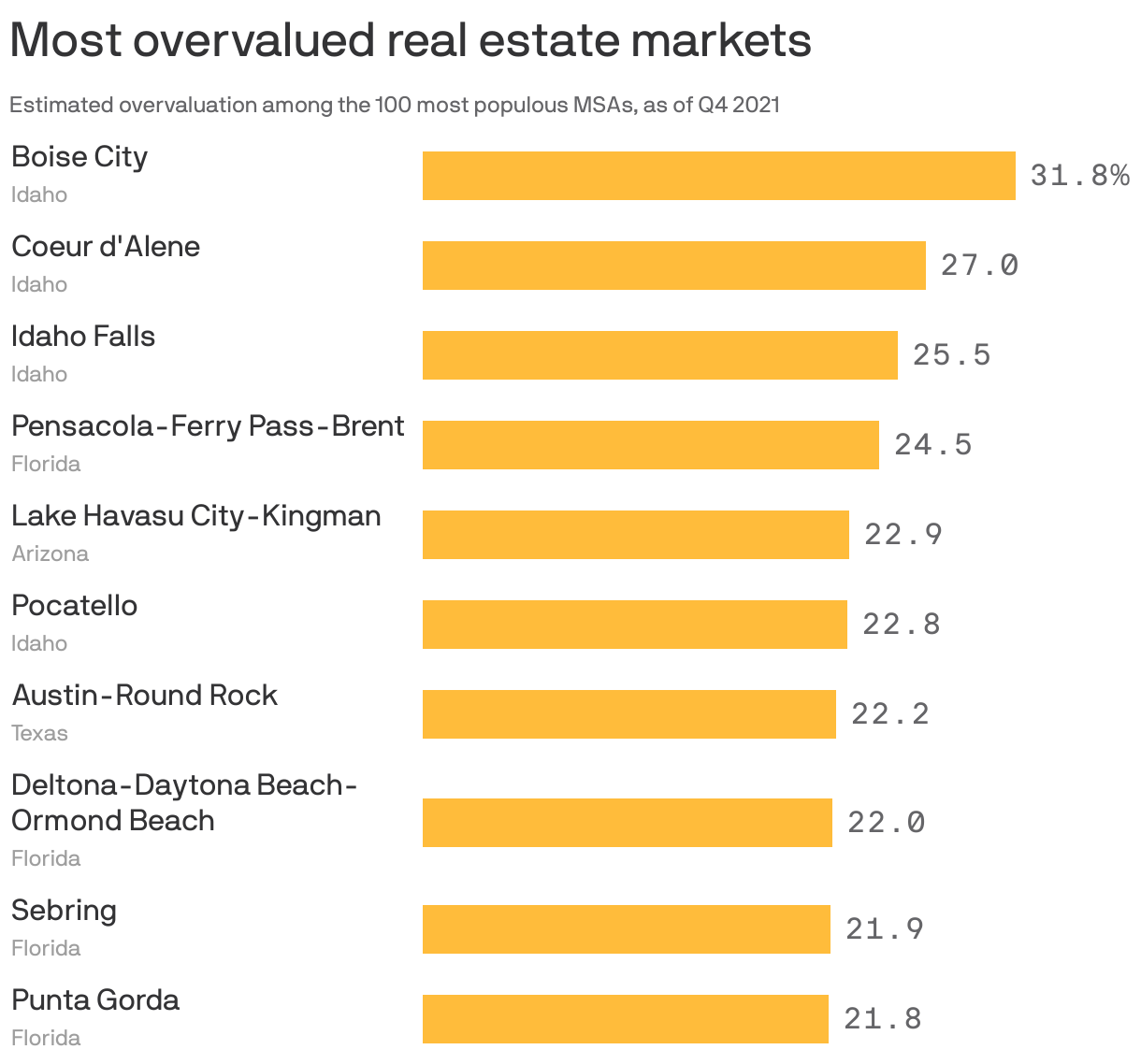
Idaho real estate prices continue to soar, with home prices in ’tater state cities topping the ranks of the country’s most-overvalued markets, according to Fitch Ratings, Matt writes.
- The credit rating company compares current market prices with a proprietary estimate of “sustainable” prices, using the discrepancy to determine which cities are “overvalued” or “undervalued.”
The big picture: Idaho is in the epicenter of two powerful economic forces that have combined to result in explosive price appreciation for its relatively small markets:
- The work from home revolution that's freed remote workers to relocate to areas offering the lifestyle they’re looking for.
- Soaring wealth in nearby California, the source of many of the newcomers buying up houses.
Is it a bubble waiting to burst? Nobody knows. But if the recent sell-off in technology stocks — a key source of Californian wealth — turns into an outright bust don’t be surprised if the flow of Californian cash into Idaho slows a bit.
5. Hybrid wins
Illustration: Eniola Odetunde/Axios
For the first time since the start of the pandemic, most knowledge workers are in hybrid work arrangements, partly remote and partly in-office, a new survey finds, Emily writes.
- 58% said they now work this way, in a survey of around 10,000 knowledge workers from the U.S., Europe, Australia and Japan, conducted last November by Future Forum, a research group backed by Slack.
- Back in May 2021, 46% of workers were hybrid.
Why it matters: These hybrid arrangements could deepen work inequities for parents, especially mothers and workers of color — groups that are more likely to work remotely.
- And yet, caregivers need and want the flexibility; and workers of color do, too. The survey finds that underrepresented groups overwhelmingly prefer flexible, remote arrangements.
State of play: 75% of working parents are remote or hybrid compared to 64% of non-parents, according to the survey.
- Meanwhile, executives are more likely to come into the office, the survey found.
The big picture: The risk is proximity bias: Executives favor the workers they see in the office. (You can read more from Emily on this here.)
- Some managers, cognizant of this danger, are figuring out how to avoid it.
The bottom line: “If we apply the old models of presenteeism and hustle culture we run the risks of widening the cracks of DEI across organizations,” says Brian Elliott, executive leader of Future Forum.
Sign up for Axios Markets

Stay on top of the latest market trends and economic insights

