Axios Markets

December 19, 2024


1 big thing: Why new cars are expensive
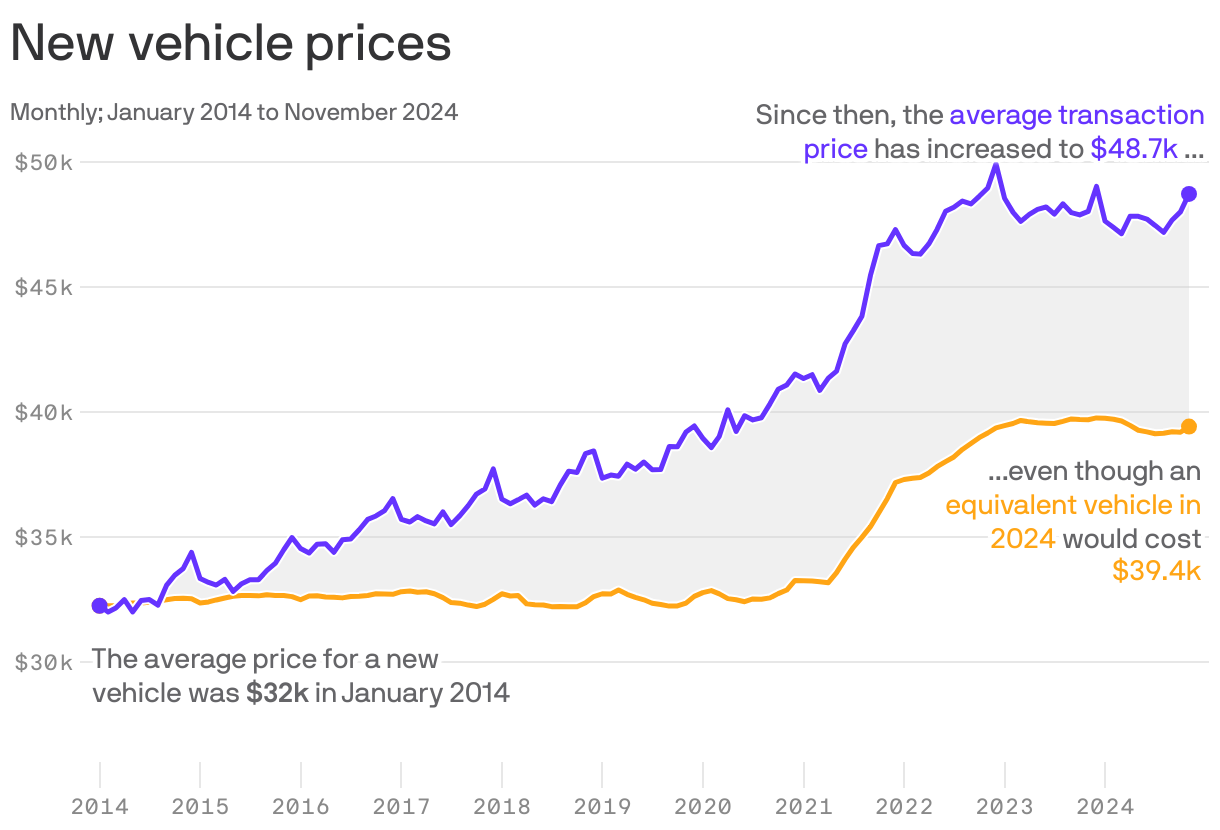
New cars are very expensive — the average transaction price last month was $48,724, per Axios corporate cousin Cox Automotive. But, weirdly, that's not because of inflation in the price of new cars.
Why it matters: Americans are paying more for new cars mainly because they're trading up in size.
By the numbers: The average price paid for a new car at the beginning of 2014 was $32,250. By November 2024, that had risen by $16,500 — or 51% — to $48,750.
- Only $7,000 of that gain, however, can be attributed to inflation in the cost of new cars. That's measured by the Bureau of Labor Statistics, which looks to see how much any given car has risen in price from month to month.
- The other $9,500 of cost increase is a function of the way in which automakers have concentrated on selling expensive trucks and SUVs, while steering consumers away from cheaper cars.
How it works: When consumers buy more big vehicles and fewer cheaper ones, the average transaction price can rise even when any given vehicle isn't going up in price at all.
- Imagine a world where the price of a bottle of prosecco never goes up, and neither does the price of a bottle of Champagne. But if consumers start buying a lot more Champagne and a lot less prosecco, the average price paid for a bottle of sparkling wine will rise substantially.
The big picture: New car prices have actually been coming down in real terms, if you look at the broad consumer price index.
- On an inflation-adjusted basis, a car that sold for $32,250 in 2014 should be selling for about $43,400 today. Instead, it sells for $39,400.
- That's a 9% decline in real terms.
Between the lines: There's a popular (and false) narrative that car prices have outpaced incomes over the past roughly 40 years or so.
- According to the Bureau of Economic Analysis, which uses a different methodology to Cox Automotive, the average transaction price for a new car in December 2023 was $32,559, up from $11,399 in 1984. That's a rise of 194%.
- Median household income, however, has risen from $22,420 to $80,610 over the same period — a rise of 259%.
- In other words, Americans spent about 147 days' worth of their income when they bought a new car last year, down from 186 days in 1984.
The bottom line: Americans have demonstrated a preference for bigger, more expensive cars. One reason is that those cars are becoming both cheaper and more affordable, in real terms.
2. Guest rooms for everyone


Americans have plenty of room for guests — the number of homes with "extra" bedrooms just hit a record high, finds a new analysis.
Why it matters: Houses are getting bigger just as households are getting smaller.
- The number of persons per household in the U.S. has fallen from a peak of 3.1 people in 1970 to a record low of 2.5 in 2023, notes the report from Realtor.com.
The big picture: Americans are having fewer children, more are living alone, and empty nest Baby Boomers don't want to leave their big roomy houses.
Zoom in: The report, which analyzed census data, defines "extra" bedrooms as the number of bedrooms in excess of the number of residents (plus one, to account for the possibility that one room is used for an office).
By the numbers: Last year, the total number of extra bedrooms in the U.S. reached 31.9 million, up from 31.3 million the year prior, and over four times the 7 million in 1980, according to the analysis.
- The share of all bedrooms that could be considered guest rooms rose to 8.8% in 2023, up slightly from the prior year. That's more than double the rate of 3.5% in 1980.
- All that extra space costs a lot of extra money. The typical three-bedroom home in the U.S. costs $336,839, per data from Zillow's home value index. The typical four bedroom? $496,089. (These numbers vary depending on the region.)
Where it stands: The Mountain West and the South have the most extra bedrooms, per the report — since there's more space to build in those regions and the homes are typically built bigger.
The bottom line: "We are in a golden age of extra bedrooms," Danielle Hale, Realtor.com's chief economist, says in a statement.
3. Brazil in crisis

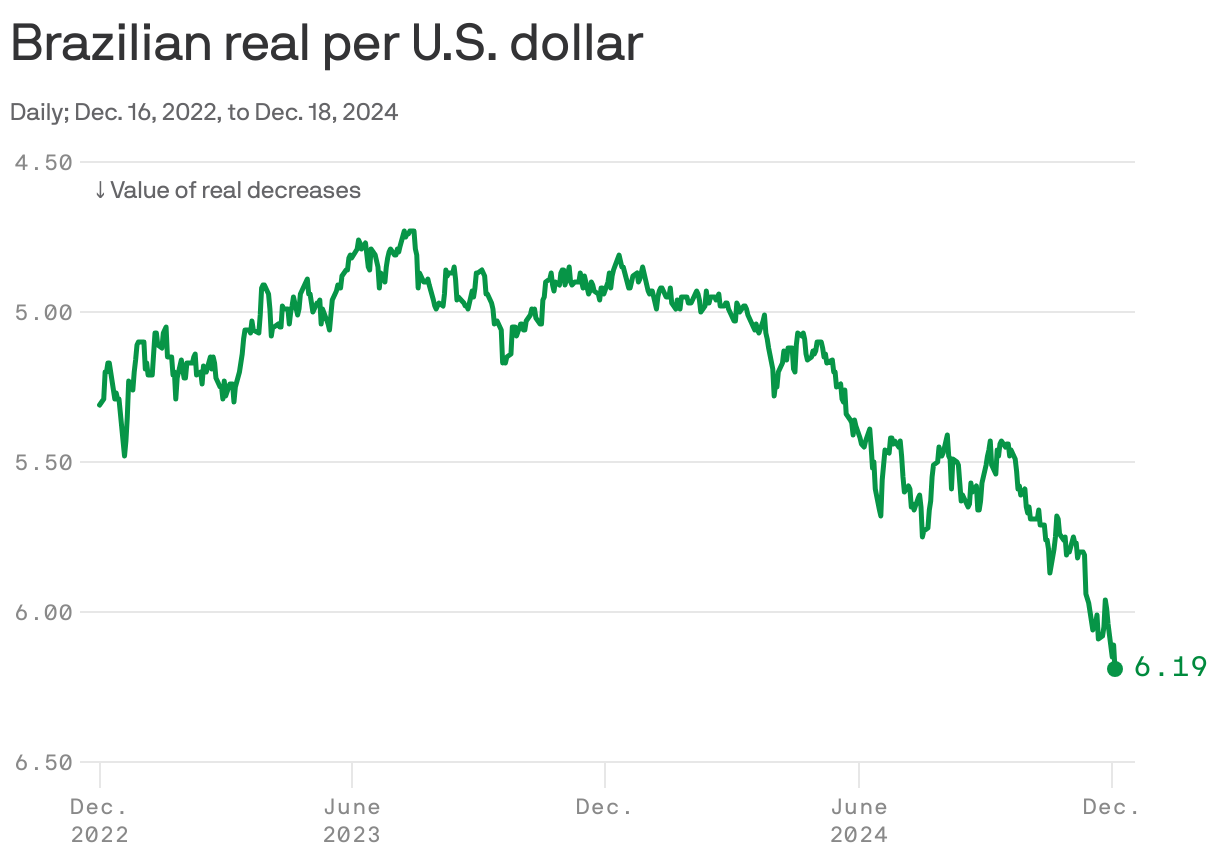
The Brazilian real is plummeting. Never before has the nation's currency been so weak relative to the U.S. dollar.
Why it matters: Yet another huge economy faces a fiscal mess, with investor backlash adding to pressure to cut budget deficits.
- This time the financial market turmoil in Brazil reflects deep skepticism that Latin America's largest economy will rein in spending.
"Brazil is now in crisis territory," Bruna Santos, the director of the Wilson Center's Brazil Institute, tells Axios.
- Santos says the delay in addressing fiscal reforms "has resulted in this self-inflicted crisis."
The big picture: When Brazilian President Luiz Inácio Lula da Silva — referred to as "Lula" — took office last year, the deficit was roughly 5% of GDP. As of October: 9.5% of GDP.
- The leftist three-term president proposed spending cuts of about $12 billion in the next two years — but with tax exemptions for the poor.
- Now the fate of the budget is up in the air, with the possibility of spending cuts getting watered down, Bloomberg reported.
- Not helping matters: Lula just had emergency brain surgery.
What to watch: Brazil's central bank has intervened four times to stem the currency's freefall this week, after hiking interest rates for the third time last week to contain inflation.
Axios Markets