
Axios Markets

June 27, 2024

Good morning! Today's newsletter is 965 words, 4 minutes.
1 big thing: Brokers are scrambling
Real estate brokers are scrambling to figure out workarounds to an industry-wide legal settlement that threatens to upend their businesses starting in August.
Why it matters: The settlement reached in March has the potential to revolutionize the homebuying process, and save people a lot of money — but resistance in the industry could slow down or even block that change.
- Homebuyers and sellers might have to be extra savvy to benefit.
Catch up fast: Right now, if you're selling your home, you pay about 6% in commissions, half to the agent who helped you sell and the other half to the buyer's agent.
- Buyer agents can see the commission sellers are offering when they look at the Multiple Listing Service, the industry database brokers use. There is a "compensation" field.
- That field will go away, as part of a deal that the National Association of Realtors (NAR) reached to settle a class action lawsuit filed by home sellers. They'd alleged the industry group conspired with real estate companies to fix prices.
What's next: By August 17, listings on the MLS won't include that "offer of compensation," Mantill Williams, NAR VP of communications, told Axios in an email.
- The idea, per the settlement, is that buyers should be paying their brokers. That's because when sellers pay the buyers' broker, the latter's interests aren't aligned with their clients.
Yes, but: Consumers can still pursue arrangements in which the seller pays both broker fees, "through negotiation and consultation with real estate professionals," says Williams. The powerful industry group added that it's been "proactively communicating" with stakeholders to prepare for the changes.
State of play: Brokerages are also looking for workarounds — a way to make it clear that sellers will pay a commission to buyer agents, maybe on a brokerage's website.
- Seller agents could also start spelling out the commission in another field in the home listing, says Steve Brobeck, senior fellow at the Consumer Federation of America. They'll write out something like "3% of sales price," and "everybody will know what that represents," he says, adding that it's not clear if that would be permissible.
- "These issues are not resolved yet."
Zoom out: Glenn Kelman, CEO of Redfin, says the settlement probably won't change the industry as much as he initially thought it would. "We think many listings will continue to offer a fee, just via channels outside the MLS."
- Brokers are talking about alternatives on social media.
- "Nothing will change other than the fact that I'll now probably have a lot of calls and texts to confirm that we are paying buyer's agents until some other system is devised," says one agent in a Facebook post.
The bottom line: Ultimately, it will be homebuyers and sellers who control what happens next, experts say.
- The news coverage around this settlement may have raised awareness, says Brobeck, and buyers and sellers might realize they have more power to negotiate.
- Kelman said something similar. "Maybe the real change is that consumers are going to start expecting a better deal."
2. Charted: Broker pay around the U.S.
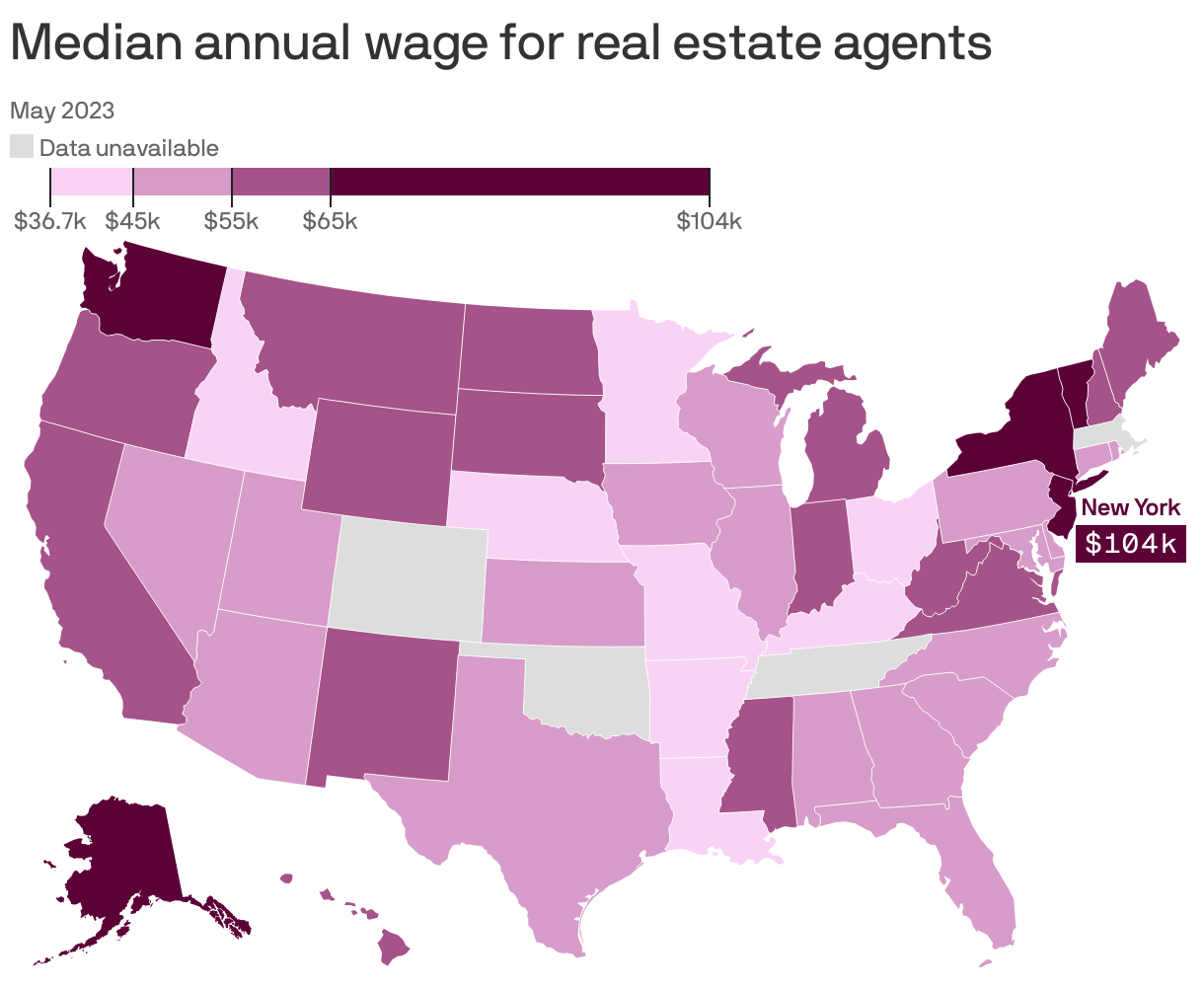
The future of commissions may be murky, but as Faron King, a vice president with the national association, tells Axios' Brianna Crane and Sami Sparber: Buyers' agents aren't going to work for free.
3. The stock market's concentration, in one chart


The stock market has never been as concentrated as it is now — even after the recent decline in Nvidia stock.
Why it matters: A large amount of the value of the stock market is concentrated in a handful of companies — which is to say, the performance of the stock market as a whole is increasingly a function of how just a few megacap tech stocks are faring.
How it works: One generally accepted way of measuring concentration is to look at the Herfindahl-Hirschman Index, or HHI, more familiar from its use in antitrust enforcement.
- HHI takes a sum-of-the-squares approach: It squares the market share of each S&P 500 component, and then adds all those numbers together.
- If every S&P 500 component was exactly 1/500 (0.2%) of the index, then the sum of the squares — the HHI — would come to 20, the lowest possible score.
- Conversely, if 5 stocks each comprised 10% of the index, accounting for half the total capitalization, while the other 495 were 0.1% each, then the HHI would be 505.
By the numbers: The old high point, set in March 2000 at the height of the Wintel duopoly, was 123. That record was shattered in June 2020, as a handful of high-fliers started to dominate the stock market.
- By August 2020, the S&P 500's HHI reached what was then an all-time high of 159. More recently, with the AI boom, it's risen even higher. By the end of May 2024, it reached 184.
Of note: The most recent spike, in May, is in part an Nvidia story — because the AI chipmaker's valuation rose so fast.
- Still, at the end of May, Nvidia's market capitalization was $2.7 trillion, well below the $3.1 trillion at which it closed yesterday. As a result, even after the recent sharp decline in Nvidia shares, the S&P 500 HHI could still set yet another new high this month.
The bottom line: What's far from clear is whether this spike in concentration is bullish or bearish. Concentration will probably retreat from its current highs at some point — but while bears fear devastation in megacaps, bulls look forward to seeing more strength in the rest of the market.
4. 1 fun thing: We're still calling it Twitter
"Since the events of this suit, Twitter has merged into X Corp. and is now known as X. Facebook is now known as Meta Platforms. For the sake of clarity, we will refer to these platforms as Twitter and Facebook..."— A footnote in Supreme Court Justice Amy Coney Barrett's decision released yesterday in Murthy v. Missouri
h/t: @JayShams
Thanks to Kate Marino for editing this newsletter and to Mickey Meece for copy editing it.
Sign up for Axios Markets