Axios Markets

September 16, 2024


Happy Monday! Let's do this. Today's newsletter is 1,152 words, a 4.5-minute read.
1 big thing: Why Harris and Trump can't stop talking about housing
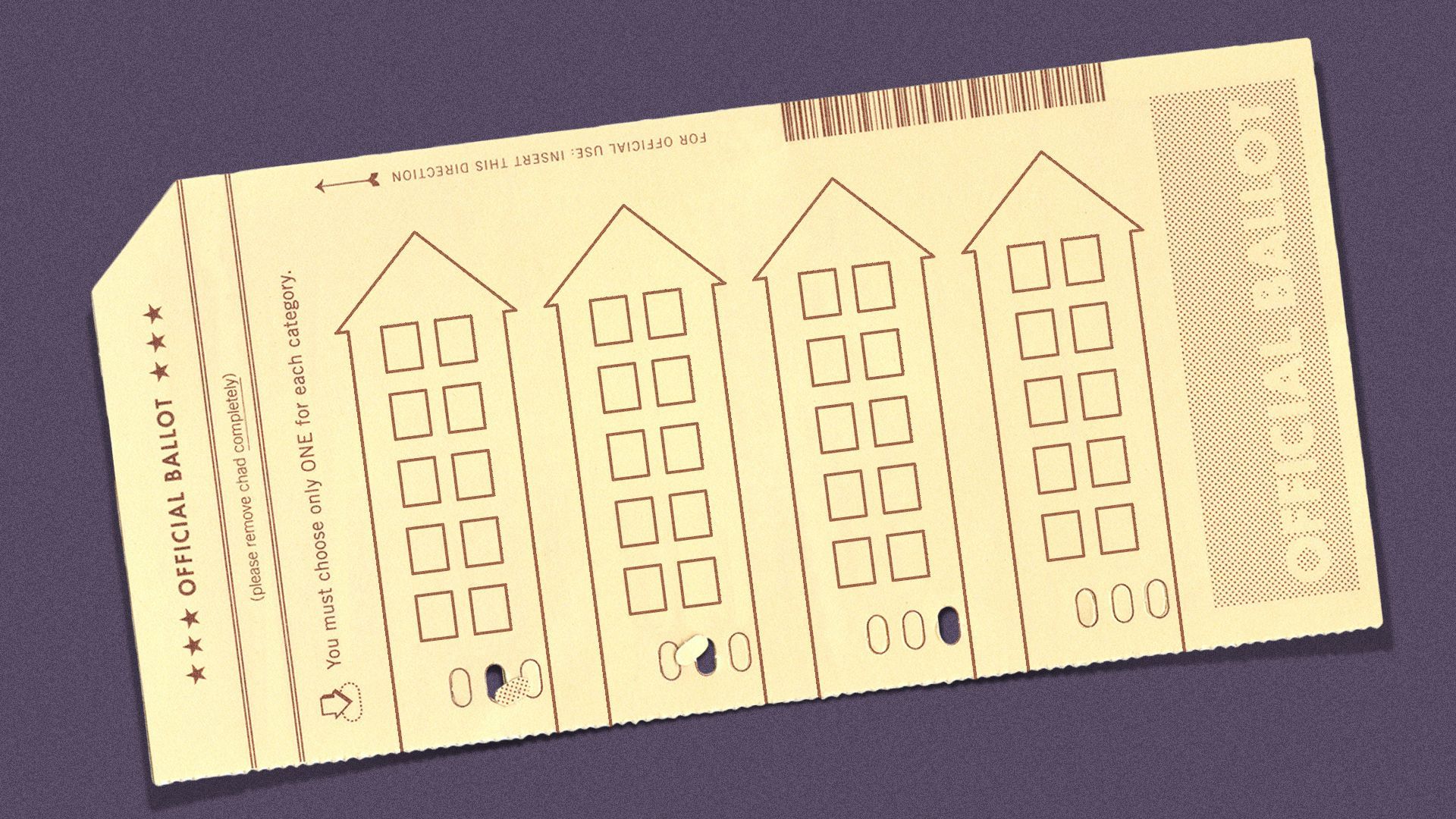
For the first time in decades, the cost of housing is a key issue in a presidential election.
Why it matters: A shortage of affordable homes to buy or rent in the U.S. keeps home prices high. Record-high mortgage rates are putting monthly payments out of reach for many.
- Housing is typically the biggest cost in most people's budgets. Higher costs mean less money to spend on other things.
- That this issue is on both candidates' agendas reflects how urgent the long-simmering shortage has become.
The big picture: There's a core difference between Vice President Kamala Harris' detailed plans and former President Donald Trump's rhetoric.
- Harris frames the housing shortage mostly as a problem of supply. Her solution, broadly, is to build more homes.
- Trump frames this mostly as a demand problem. He and his running mate blame the housing shortage on immigrants.
State of play: Harris highlighted the housing shortage in her first debate answer last week. "We know that we have a shortage of homes and housing, and the cost of housing is too expensive for far too many people."
- Her housing plan, which includes tax breaks and incentives for homebuilders to build affordable homes to buy and rent, was part of her first economic proposal as a presidential candidate. She says it would lead to 3 million more homes; in line with a Moody's estimate of the shortfall.
- (It's worth noting she also wants to give first-time buyers a $25,000 tax credit, which would increase homebuying demand.)
Meanwhile: Trump doesn't have a detailed plan, but he's talking about the shortage. At a rally in Tucson last week he spoke in front of a sign that read, "Make housing affordable again."
- He talked about slashing mortgage rates and easing regulations to let builders build. Neither are things he would be able to control from the White House.
- He also wants to curb demand for housing by limiting undocumented immigrants' ability to buy or rent homes, as well as end the practice of providing shelter for migrants.
For the record: The lack of housing has "little to nothing to do with the surge of immigration in recent years," says Mark Zandi, chief economist at Moody's Analytics.
- Immigrants may be taking some housing stock, but it's a marginal part of a long-developing crisis.
The background: The current housing shortage has its roots in the 2008 housing bust when a huge number of home builders went out of business. The industry never recovered. (See chart below.)
- "It's a very severe shortage," says Zandi. "I think it's as bad as in the wake of World War II when soldiers came home and we just didn't have enough homes."
The bottom line: This is a big, complicated crisis that's going to be hard to tackle for any president.
- Much of the zoning and regulatory issues that folks say hold back building are local and state problems — not things that can easily be solved from the White House.
- The housing shortage has been a generation in the making, Zandi says. It might take just as long to get out of it.
2. Charted: Construction slowdown


At the peak of the last housing boom back in 2005, builders were constructing new homes at a rate of about 2.2 million per year. Now, the number is 1.2 million.
The big picture: Demand for housing spiked in the pandemic, as mortgage rates hit rock-bottom lows and many folks sought more space for remote work or moved due to health concerns.
- But building hasn't returned to the levels last seen in the early aughts.
3. You probably won't bet on the election
/2024/09/15/1726418306039.gif?w=3840)
Prediction markets look set to be a core part of horse race coverage for the foreseeable future — but that doesn't mean they're going to become a popular pastime in which Americans gamble on electoral outcomes.
Why it matters: Even if they're legal, election markets will always be controversial, and at risk of being banned. They're also very unlikely to receive widespread attention outside presidential election campaigns.
- The profit potential is low since prediction markets are pretty low-margin businesses for the companies operating them.
- There are therefore few incentives for U.S. companies to spend a lot of time and money building such markets and selling them to politics junkies.
Between the lines: There are hundreds of futures markets in the U.S., most of them traded on exchanges like CME and Cboe. Participants tend to be both deep-pocketed and highly sophisticated. You'll never see regular individuals, such as Eddie Murphy's character Billy Ray Valentine in "Trading Places," who made a fortune trading orange juice futures on a New York trading floor.
- Election markets could be headed in a similar direction. The largest and most liquid market, the cryptocurrency-based Polymarket, is rapidly closing in on $1 billion in U.S. election bets — but on a typical day, it sees fewer than 10,000 actual traders.
- Last month was the busiest in Polymarket's history, with $473 million of bets placed by 64,000 traders. That's an average of more than $7,000 per trader — a sign of a market dominated by experienced bettors rather than everyday gamblers.
Reality check: While it makes intuitive sense that a legal market open to Americans would be bigger and more popular than a crypto market that isn't, that's unlikely to happen before the election — if ever.
- A successful product takes time to build and needs to be launched with a major marketing campaign. Given the uncertainties around election markets, and the fact that most of the time they're largely dormant, neither is likely to happen in the next three years.
- Election markets, by comparison, are always going to be much smaller than sports betting or crypto markets, especially outside presidential election campaigns. They also feel morally dubious to many people who feel that betting on democratic outcomes violates their ethics.
Driving the news: While election markets have been declared legal in the U.S., an appeals court has prevented them from actually being offered for the time being.
- In the U.S., Interactive Brokers is preparing to join Kalshi, which won the court case, in offering election markets to the general public.
- Both of them have been approved by the CFTC as designated contract markets, or DCMs — something that's necessary before prediction markets can be listed.
What's next: Polymarket isn't a DCM, so there's little chance its product will be legal in the U.S. any time soon.
- By the same token, however, Polymarket, which operates only outside the U.S., isn't subject to American jurisdiction, and can therefore operate continuously while other markets, like Kalshi's, appear and disappear in response to judicial rulings.
The bottom line: Thanks to Polymarket, there is now already enough liquidity that prediction markets can play an important role in giving the public real-time visibility into the probability of certain electoral outcomes.
- A legal domestic market might eventually exceed Polymarket in size — but that's almost certainly not going to happen this cycle.
Thanks to Kate Marino for editing and Mickey Meece for copy editing. Tell your friends, family and colleagues to subscribe.
Sign up for Axios Markets