Axios Markets

October 07, 2023

1 big thing: The problem with the problem with deposit insurance

Illustration: Sarah Grillo/Axios
2. Get ready for 8% mortgages


The interest rate on a 30-year fixed-rate mortgage is the second most salient price in the American economy, after only the price of gas. And it looks like it's going to hit 8% sooner rather than later.
Why it matters: A world of 8% mortgages is one Americans haven't seen in over 23 years. The last time mortgage rates were that high, Bill Clinton was president, Brad Pitt married Jennifer Aniston, and Apple Computer was worth $15 billion — a mere 0.5% of its current value.
By the numbers: A $500,000 30-year mortgage would have cost $1,972 per month at the 2.8% mortgage rate that was available in early 2021. Today, with a 7.9% rate, that payment would be $3,488 — a 77% increase.
- Between the lines: More than 100,000 Americans have taken out mortgages in 2022 and 2023 with an interest rate above 8%, per Black Knight, where a spokesperson tells Axios that "we expect that number could continue to press higher in coming weeks."
The big picture: High mortgage rates are painful for anybody wanting to buy a house, and mortgage brokers have very little business right now. New applications are at their lowest level since 1996, per the Mortgage Bankers Association.
- The non-housing economy, on the other hand, saw much smaller increases in rates. For a big company like Apple, for instance, the yield on its 10-year bonds increased by about 3.2 percentage points since December 2021, per MarketAxess' Bondticker. But the 30-year mortgage rate has risen 4.6 points over the same time period.
- Meanwhile, most homeowners continue to happily sit on mortgages with rates below 4%.
The bottom line: In the Fed's ideal soft-landing scenario, its rate-hiking campaign would slow down isolated areas of the economy while keeping the rest of corporate America going relatively strong.
- As such, policymakers are likely to be perfectly happy with 8% mortgage rates.
3. Why mortgage rates are so high


The main reason mortgage rates are so high is just that long-term interest rates are high. But the main reason mortgage rates are so much higher than other long-term rates is that U.S. mortgages can be prepaid without penalty.
Why it matters: Prepayability is broadly great for homeowners, since it gives them the ability to refinance whenever rates come down. By the same token, however, it's bad for lenders, who are now charging a lot of money to cover their prepayment risk.
How it works: Most lenders make windfall profits when rates go down. The value of the loans on their books goes up, and they can be sold for much greater than face value.
- Mortgages, however, don't work that way. The minute rates come down by a point or two, homeowners tend to refinance — paying back the loan only at its face value.
- The higher interest rates rise, the greater they can fall — and the greater the risk that lenders will see a sudden halt to the interest payments they had been promised for many years to come.
By the numbers: Wendy Edelberg and Noadia Steinmetz-Silber of Brookings have an excellent explainer of the different components that make up the roughly 3 percentage point gap between 10-year Treasury rates and 30-year mortgage rates.
- The so-called primary-secondary spread — basically the amount that mortgage originators keep for themselves to cover their costs and profits — is well within normal levels at about 1.1 percentage points.
- There's also duration risk, which is related to the fact that a typical mortgage lasts for 7 years rather than 10 years. If 7-year rates are higher than 10-year rates, that will increase the spread between mortgage rates and the 10-year Treasury. Right now, however, that gap is tiny, just one hundredth of a point.
- The big increase has come in prepayment risk, which currently stands at 1.1 points, double its level at the beginning of the year.
Between the lines: As Axios' Kate Marino explained last year, mortgage rates are also being elevated by the fact that some of the biggest buyers of mortgage bonds have dropped out of the market.
The bottom line: You could always take out an adjustable-rate mortgage instead.
4. Food shortages, food profits
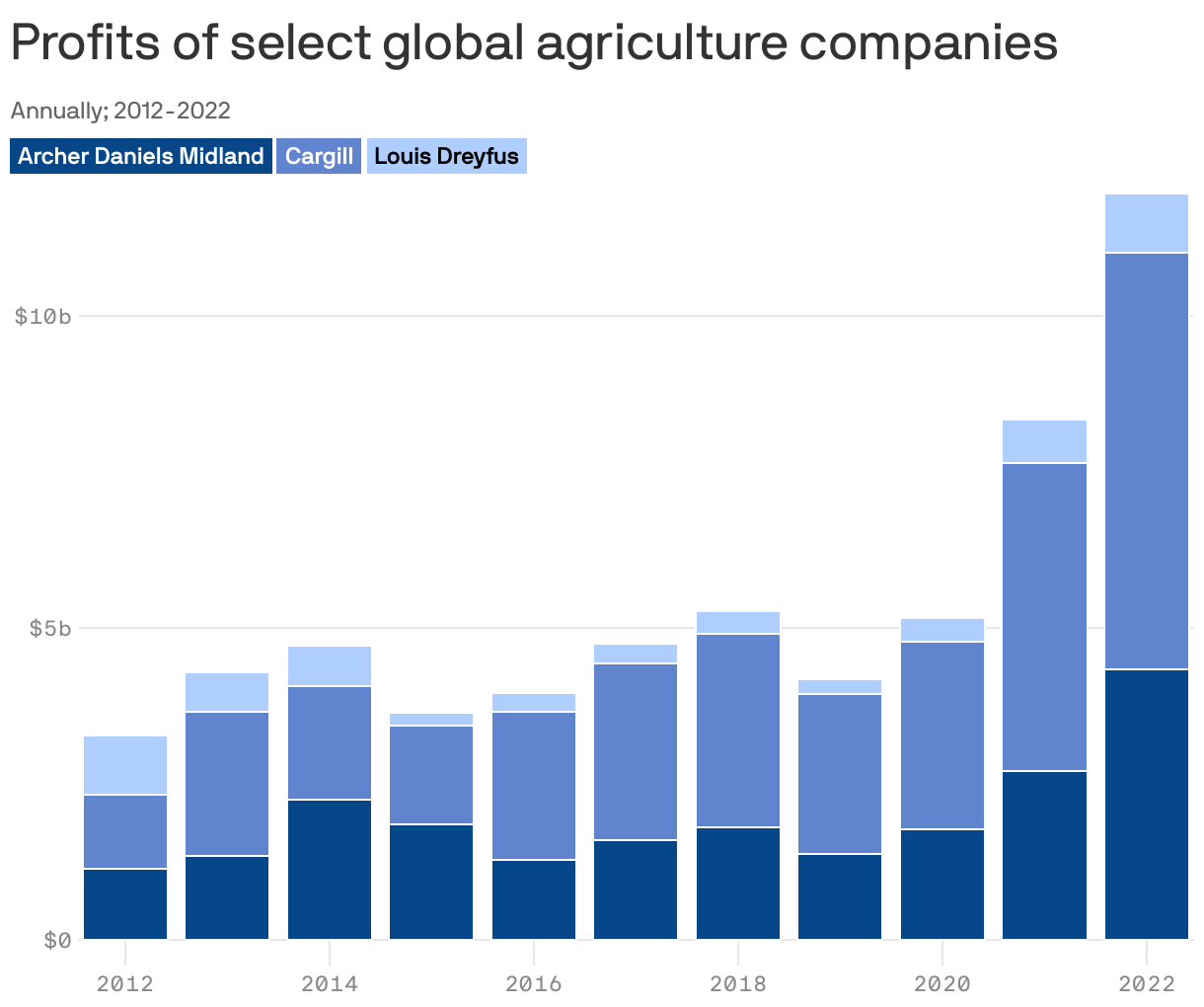
We're in a major hunger crisis — and private corporations are reaping the benefit.
Why it matters: The largest food-trading companies have the status of oligopolies and have become "unregulated financial institutions," according to a blistering 29-page chapter of the 2023 UNCTAD trade and development report, entitled "Food Commodities, Corporate Profiteering and Crises."
- "The profits of four major food traders rise during periods of market volatility and during crises," note the authors.
The bottom line: More than 345 million people are facing high levels of food insecurity this year. That's a rise of 200 million people from where we were pre-pandemic. Private companies can't necessarily solve that problem — but their unprecedented profits do seem rather distasteful, all the same.
Axios Markets

Stay on top of the latest market trends and economic insights