Axios Markets

March 10, 2026

🌮 Tuesday. We're seeing wonderful signs of spring in the Northeast, and markets are seeing possible signs of an end to the war.
- More on that below, plus some musings on a decade of political distrust, economic stagnation and anxiety. We speak of the 1970s, of course.
- And finally, Axios business reporter Nathan Bomey is here with a surprise CEO survey that finds optimism around the AI job apocalypse.
Let's do this. In 1,090 words, a 4 minute read.
1 big thing: War exit reality check
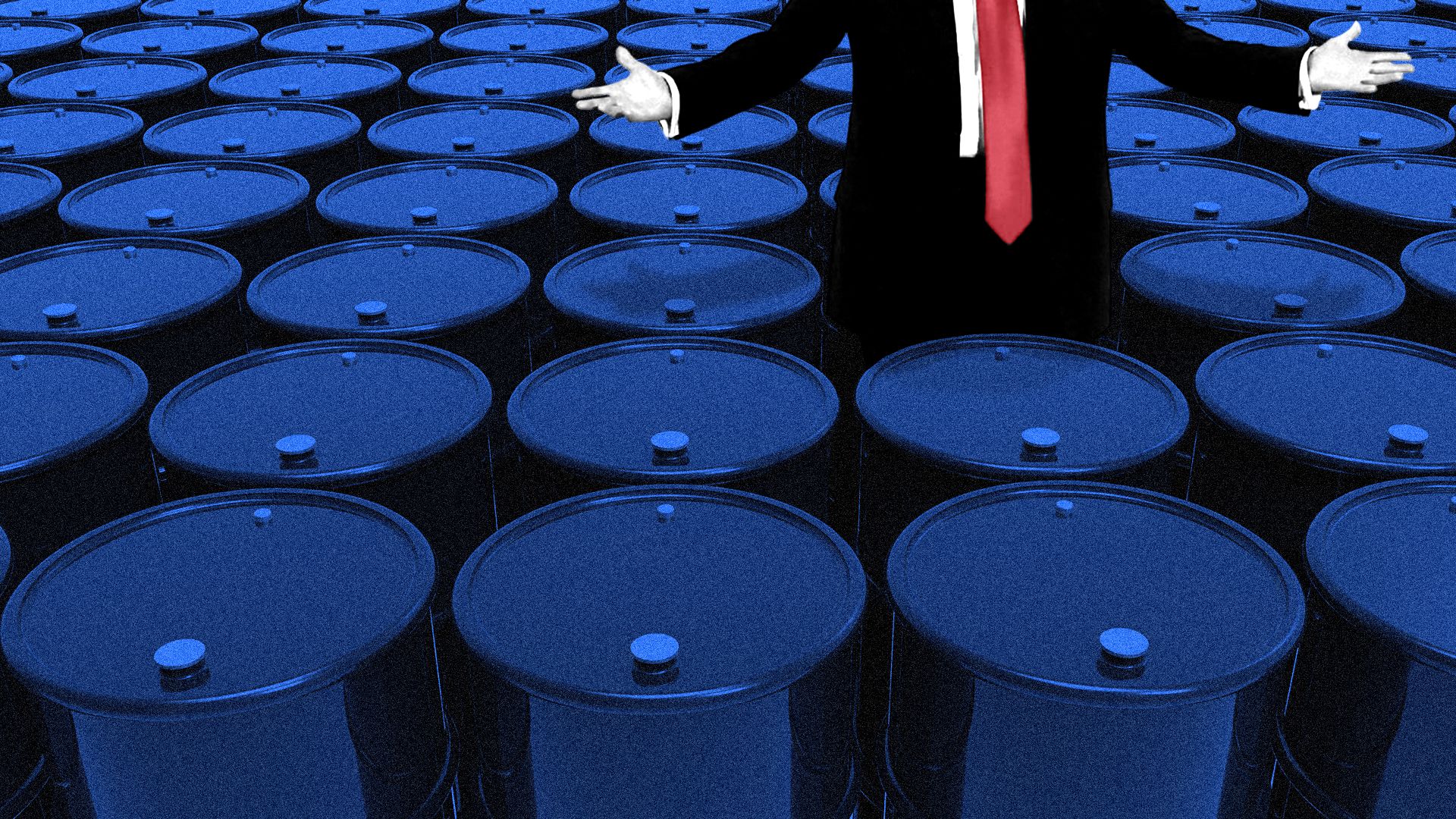
It's been a wild 24 hours. Stock futures are up this morning and oil prices are down more than 10% from their highs yesterday, with markets pricing in the idea that President Trump is looking for a war offramp.
- He told CBS News yesterday the Iran war was "very complete, pretty much."
Why it matters: Investors took it as a sign that the conflict would be short-lived and that oil would soon start flowing, but war might not be as easy to unwind as a tariff increase.
Catch up quick: The Strait of Hormuz has been effectively closed for over a week, as shippers fear Iranian strikes.
- Producers are "hitting a critical point where they must shut in production simply because there is nowhere left to put the oil," per a note from Rystad Energy yesterday.
Between the lines: The measures the White House has floated — escorting ships, paying for insurance, lifting Russian sanctions, releasing oil from strategic reserves — don't really address the problem.
- "The U.S. has to find some compromise with whatever ends up being the government of Iran because they have to restore shipping," says David Kelly, chief global strategist at JPMorgan Asset Management.
- "They need to have a situation where boats can safely pass through the Strait. If you can't do that, you're not going to fix the gasoline problem."
The big picture: Getting oil flowing again isn't a matter of the president's Thanos snap. Shipowners need to feel confident in their safety.
Reality check: Even once shipments resume, don't expect prices to quickly drop to where they were.
- It took only a few days for oil prices to spike to $130 a barrel after Russia invaded Ukraine, but months for them to retreat to prior levels.
The bottom line: If the U.S. had announced it was closing the Strait of Hormuz a week ago, then, yes, we could open it back up, says Michael Madowitz, principal economist at the Roosevelt Institute.
- "But we don't actually control Iran's policy," he notes.
- At least 20 countries are militarily involved in the conflict.
2. Wall Street is going stag

Flared jeans are in style, an oil crisis is driving pain at the pump, and unemployment is rising: It's not 1978, but it kinda feels that way.
The big picture: Talk of stagflation is rising on Wall Street, as investors fret the dreaded pairing of high inflation and high unemployment is making a comeback.
- A lousy jobs report Friday, on top of rising oil prices, is driving the concern.
Zoom in: On Monday alone, at least six notes from investment managers and Wall Street analysts warned of "stagflationary" concerns.
- Media outlets have run with this.
- Last Friday, Chicago Fed President Austan Goolsbee noted that rising unemployment on top of an oil price shock creates "exactly the kind of stagflationary environment that's as uncomfortable as any that faces a central bank," per the Wall Street Journal.
Flashback: Analysts and media started tossing out the "s" word when inflation revved up in 2021.
- The term took off the next year, when Russia invaded Ukraine, spiking energy prices. Everyone predicted a recession that never materialized.
State of play: Today is different for two reasons. First, the job market is more sluggish than it was a few years ago.
- Second, the oil shock from the Iran war is potentially magnitudes larger than from the Russian war, taking 20% of global oil supply off the board.
- "Disruption to the Strait of Hormuz creates a far larger potential supply shock that extends beyond oil," Skylar Montgomery Koning, a macro strategist with Bloomberg, wrote in a note.
- "Shipping flows more broadly are being disrupted. That is pushing up energy and food costs, lifting inflation and squeezing growth."
- "This stagflationary mix is particularly toxic for markets, as it increases the risk that bonds and equities sell off together."
Reality check: It's not the 1970s. Economists believe the Iran war will slow growth and cause an increase in inflation, but not to the extremes seen back then. "If you want the word 'stagflation' with a very little 's,' you could," says Kelly of JPMorgan Asset Management.
- The difference between now and the 1970s is, back then, higher prices led to wage increases, which led to more inflation in a wage-price spiral that got out of hand, he says. Workers don't have the power for that today.
The bottom line: This is not your father's economic shock. Yesteryear's bell bottoms would look a bit weird if you donned them today.
3. CEOs plan few AI job cuts


⚠️ Narrative violation alert: Fewer than 1 in 10 CEOs of large U.S. companies plan to cut jobs due to AI in 2026, finds a new survey from consultancy KPMG.
Why it matters: It's surprising considering all of the handwringing over AI driving layoffs.
By the numbers: 9% of CEOs plan to reduce their workforce because of AI investments this year, per the 2026 KPMG U.S. CEO Outlook Pulse Survey.
- 55% expect to increase their hiring in 2026 as a direct result of AI, while 36% expect no change in hiring.
Zoom in: U.S. CEOs are optimistic about the potential of AI to improve their businesses over the next five to 10 years, but they've been underwhelmed by the impact in the short run, KPMG chief executive Tim Walsh tells Axios.
- "The majority of companies right now are not actually realizing nor can they see the return on investment of the AI they're deploying," he says.
State of play: Part of the challenge is the actual integration of AI into existing processes and systems is proving to be sluggish, Walsh adds.
Threat level: Although the group in the U.S. pulse survey sees growth opportunities via AI, they also see threats in the form of cyberattacks.
The fine print: The pulse survey was conducted Jan. 26 through Feb. 17.
- 100 U.S. CEOs of firms with revenue over $500 million were polled.
The bottom line: The AI disruption story is still being written.
Send comments to [email protected] or simply reply to this email.
Thanks to Jeffrey Cane for editing and Anjelica Tan for copy editing. Tell your friends to sign up.
Sign up for Axios Markets