
Axios Markets

March 10, 2023
π Jobs. Friday. Is. Here. Markets are on edge to see what happens when the Labor Department releases the February employment report later this morning.
- Economists are forecasting that 207,500 jobs were added, per FactSet βΒ that would be a big comedown from last month's half-million number.
But, first, another bank is in trouble. Matt has the latest. Let's go!
Today's newsletter is 1,040 words, 4 minutes.
1 big thing: Behind the crash of Silicon Valley Bank
Illustration: Annelise Capossela/Axios
The bank of choice for Silicon Valley's hot startups is suffering a remarkably sudden reversal of fortune, Matt writes.
What happened: The parent of Silicon Valley Bank (SVB) late Wednesday said that it was seeking to raise over $2 billion in capital, after facing big losses on a giant batch of bonds it sold.
- The specter of a bank seemingly rushing to raise cash spooked investors and depositors.
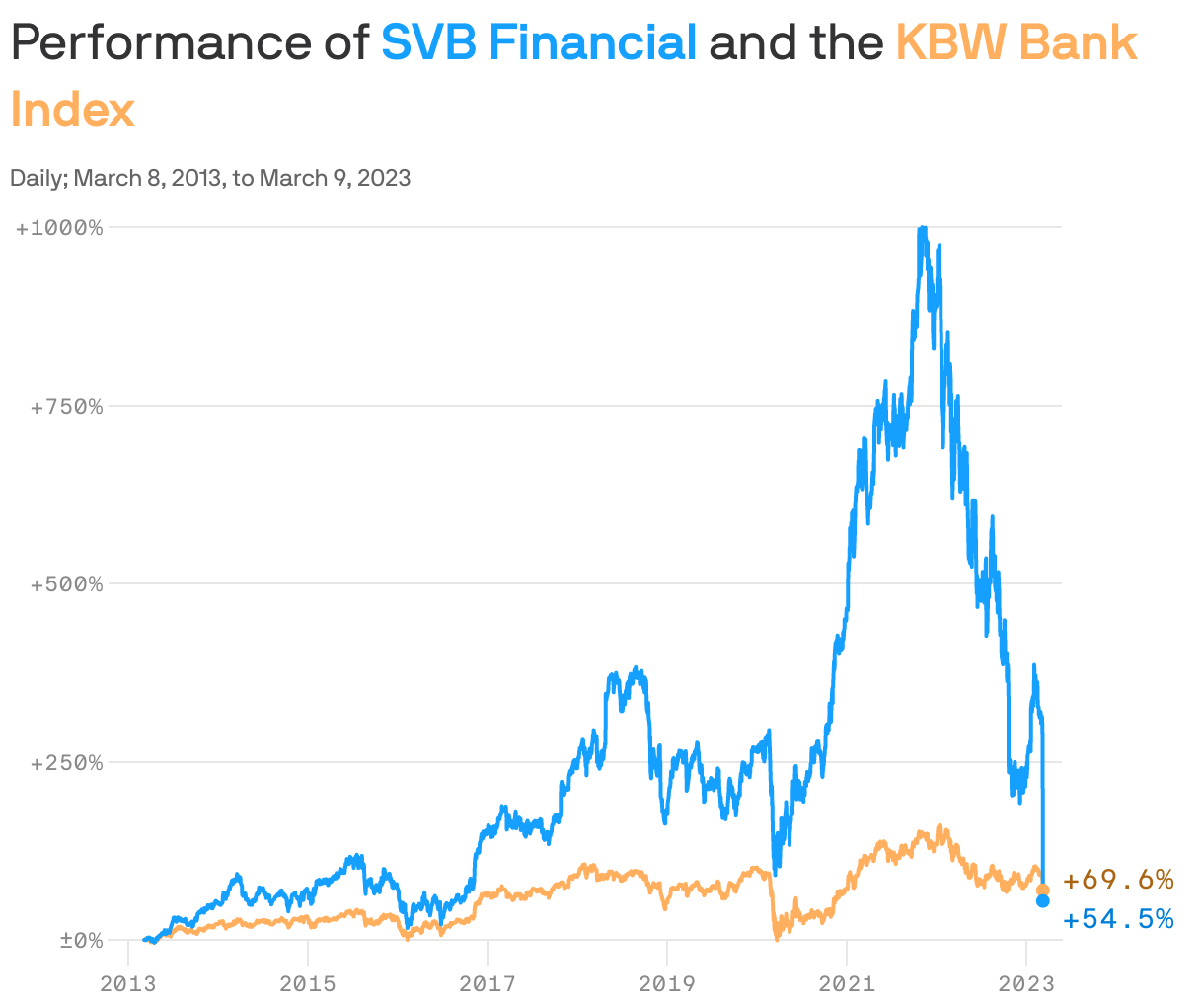
- The stock collapsed by 60% on Thursday β and soon after the close of trading a flurry of headlines about tech firms and founders rushing to withdraw funds from the bank in what seems very much like a run set off another 20% plunge in the after-hours session.
Why it matters: The saga of Silicon Valley Bank is a striking example of how the surge in interest rates over the last year continues to upend once high-flying investors, financial institutions and companies that thrived in a world of low-interest rates.
Be smart: At their simplest, banks are in the business of borrowing short-term, cheap money β typically deposits β and then investing that money at higher rates, often by making longer-term loans or buying safe government bonds.
Zoom in: SVB has been finding it harder to earn money over the last year because a key source of cheap deposits β the venture capital boom β has slowed down, just as losses in its investment portfolios have risen.
- Many of SVB's depositors are venture capital-funded tech companies. The brutal sell-off in tech stocks, and downturn in startup valuations, has slowed the flow of venture capital.
- That means money-losing tech companies are rapidly burning through the cash that previously sat as deposits at SVB, with few fresh investor checks rolling in to help them out and puff up SVB's deposit base.
What they're saying: "Given the pressure on their end markets, especially the elevated levels of client cash burn, [SVB] is seeing continued material outflows of client funds," wrote David J. Chiaverini, an analyst at Wedbush who covers the company.
- "This may have raised liquidity and capital concerns for the bank," he went on.
In banker speak, "liquidity concerns" translates roughly as "the bank needs to come up with some cash, quick."
- To do that, SVB sold a $21 billion slug of government bonds. But because interest rates have risen so much β bond prices fall when rates rise β it sold them at a loss of $1.8 billion.
- To patch that hole in its finances, the bank also moved to raise money by selling new shares as part of a plan to come up with $2 billion in capital.
What we're watching: Whether this is a one-off situation stemming from Silicon Valley Bank's unique role as the banker of choice to venture-funded startups, or if there are broader issues at play for the banking system.
2. Charted: When it was good, it was really good
2. Catch up quick
π Railroad trade group warns of loose wheels on some railcar models, advises taking cars out of service. (WSJ)
βοΈ The FTC will sue to block ICE's $13 billion acquisition of mortgage software and data provider Black Knight. (Reuters)
π‘ More homeowners tap equity to take advantage of big gains. (AP)
3. The U.S. default trade returns


The U.S. has hit its debt limit, which means β given congressional dysfunction β that the chances of a sovereign debt default are real, if small. One consequence has been a spike in the price of credit default swaps (CDS) that pay out if the U.S. defaults, Axios' Felix Salmon writes.
Why it matters: The price action in U.S. sovereign CDS is important, but it can't be used in the same way that other CDS prices can, to infer a probability of default.
How it works: Think of CDS as insurance against a bond defaulting. The seller of a CDS contract is effectively taking on the risk that a certain borrower β like the U.S. government β might default. Buyers of CDS are seeking to hedge that risk.
By the numbers: U.S. CDS hit an all-time high of 83 basis points on Wednesday β meaning it costs $83 to insure $10,000 of Treasury bonds against the risk of default.
- That's higher than the previous record high of 82 basis points set on July 28, 2011, during that debt-ceiling crisis.
Between the lines: If the U.S. Treasury finds itself unable to pay all its bills as they come due, all manner of horrible things would probably happen, both in markets and in the economy as a whole.
- Traders are trying to hedge that risk β thatβs what the rise in the price of U.S. CDS indicates.
- If questions surrounding the full faith and credit of the United States cause markets to plunge, the price of U.S. CDS is almost certain to rise dramatically.
- Buying cheap CDS that soar in value when a crisis hits is a well-worn playbook: Hedge fund manager Bill Ackman famously made billions doing exactly that in March 2020.
Be smart: The bet here is not, really, that a U.S. default will cause the CDS to be triggered and that there is a potentially large profit to be made when that happens.
- People selling the CDS are making the reasonable bet that, ultimately, the recovery value of Treasury securities will be very close to 100 cents on the dollar β even if there is an event of default. Until then, they pocket the income the buyers pay them.
The bottom line: U.S. Treasury securities are considered risk-free assets in the financial world. The U.S. can always print the money it needs to repay its debts.
- If for some short period it fails to do so, however, the resulting tremors could be large, and the price of insurance against that earthquake would spike.
5. π Quoted: Literally speaking
βIn closing this was a train wreck. Thereβs not a script for this. There wasn't a binder for me labeled train wreck."β Eric Brewer, director of emergency services in Beaver County, Pa., at a Senate committee hearing Thursday on the derailment of a Norfolk Southern train in East Palestine, Ohio.
Why it matters: A lack of communication from Norfolk Southern in its initial response to derailment caused confusion, said Brewer, who was part of a team that responded to the derailment last month, Emily writes.
Go deeper: Testimony derailed
Did someone send you this email? That's great. You can subscribe here and send Monday's email to another friend. It's fun!
Markets is edited by Kate Marino and copy edited by Mickey Meece.
Sign up for Axios Markets

Stay on top of the latest market trends and economic insights