Axios Markets

May 28, 2024


1 big thing: "Inflation" doesn't mean what it used to


The meaning of the word "inflation" has changed. It used to mean rising prices; now it means high prices.
Why it matters: Pedants, economists, and style-guide editors might not like it, but if you want to understand what people mean when they complain about inflation, you need to understand how the vernacular has evolved over the past couple of years.
The big picture: Inflation, at least as officially measured by the Bureau of Labor Statistics, has come down sharply from its peak of 9% in mid-2022. It now stands at 3.4%, broadly in line with where it was for the quarter-century between 1983 and 2008.
The other side: The headline measure of inflation is based on something pretty arbitrary — where prices were exactly one year ago.
- The more salient timeframe, especially in an election year, might be what has happened to prices since the pandemic, or since Joe Biden took office.
Zoom out: A more intuitive concept of inflation is just "Am I paying higher prices for things than I used to."
- Under that definition, inflation can be high even when prices are falling.
- On a literal level, that should not be possible — prices that are deflating can't also be inflating. In quotidian usage, however, it's entirely possible for $4 eggs or gasoline to be indicia of inflation, even if they were $4.50 previously.
Between the lines: A nerdy lexicographical schism — the descriptivists versus the prescriptivists — has become a key driver of the 2024 presidential election campaign.
- Voters who think that inflation is high are likely to blame Biden for it, and less likely to vote for him.
- When Biden administration staffers push back by saying that inflation isn't high, they risk being seen as out of touch.
Where it stands: These days, if you read or hear something about inflation in mainstream discourse, then...
- Either "inflation" is being used to mean "high prices,"
- Or else there's an implicit or explicit "actually" in there somewhere, and you're getting the feeling that you're being mansplained to.
The bottom line: Prices are high, therefore inflation is high. Get used to it.
2. Why your grocery bill stings


The inflation rate for "food at home," basically the stuff you buy at the supermarket, is really low these days, with prices rising just 1.1% over the last year.
- But since January 2021, when Biden took office, prices are up nearly 21%.
Why it matters: Every time Americans go food shopping they feel the sting of higher prices, making the grocery store the place where consumers are most regularly reminded about inflation, as Felix defines it above.
The intrigue: Dining out is worse — prices rose 4.1% over the last year, far faster than costs at the grocery store or overall inflation.
- And prices for "food away from home" are up nearly 22% since 2021.
The bottom line: Finding cheap eats is a challenge.
3. Teen jobs are so back

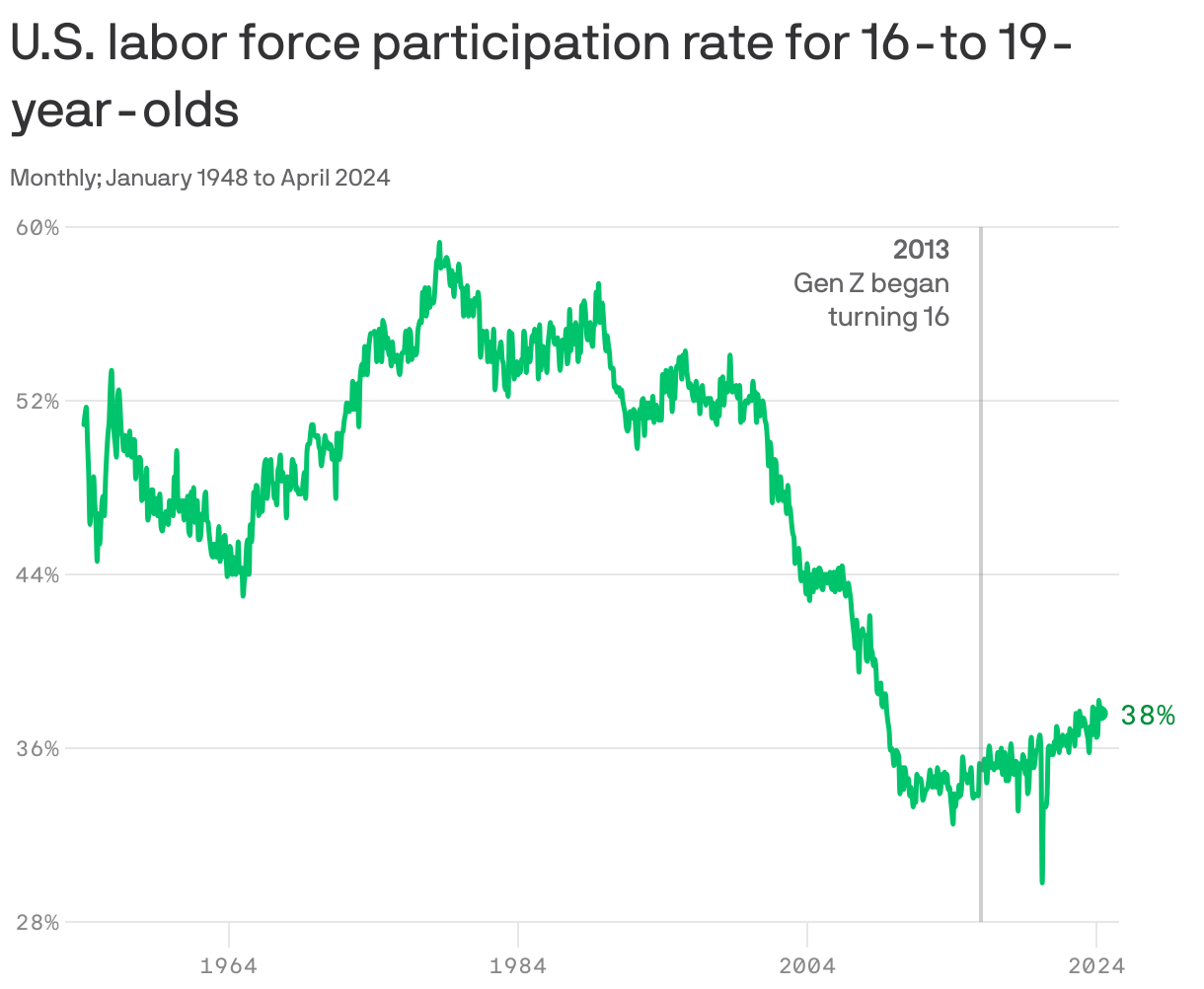
Gen Z is reversing a decadeslong decline in teen employment.
Why it matters: Working for pay can be a rite of passage for teens, but it's not nearly as common as it used to be.
- "There is something lost when there are more young people who enter the workforce after college with no work experience," says Jean Twenge, a psychologist and author of the book "Generations."
- "When they learn those lessons about how important it is to show up on time and do a good job and sometimes you have to listen to the boss, all of it builds conscientiousness for later in life."
By the numbers: In the 1980s, nearly 2 in 3 16- to 19-year-olds were working or actively looking for work.
- That's been steadily falling since then, with teens' labor force participation rate dropping especially low among millennials in the 2000s.
- But Gen Z is starting to bring teen jobs back. The share of teens working or looking for work recently hit a 14-year high — 38%.
- In the coming weeks, employers are expected to add another 1.3 million summer jobs for teens, according to the firm Challenger, Gray & Christmas.
Zoom in: Demand for workers in the jobs teens typically hold — at shops and in restaurants — is still high.
Reality check: While teen employment is rising, it's unlikely it'll ever get close to what it was among boomers and Gen Xers, says Andrew Challenger of Challenger, Gray & Christmas.
- Kids today have more options for activities outside of school, including sports, summer and after-school programs, and volunteering gigs.
Axios Markets