Axios Markets

September 17, 2024


👋 Good morning! We are edging closer to the Federal Reserve's big rate decision.
- Today we dive deeply into another Donald Trump tax policy idea and a business venture he unveiled last night. All in 1,170 words, 4.5 minutes.
1 big thing: The problem with exempting overtime pay from taxes
/2024/09/17/1726536575841.gif?w=3840)
If elected, Donald Trump says he'd stop taxing overtime pay.
Why it matters: The policy, which would likely require legislation, would incentivize more overtime work.
- But part of the reasoning behind the federal overtime laws — included in the 1938 Fair Labor Standards Act — was to discourage employers from giving workers long hours.
How it works: The law requires companies to pay certain hourly workers, typically blue-collar ones, time-and-a-half if they exceed 40 hours a week.
- The idea is to make it more costly to push employees to work long hours.
- "That's really what overtime laws were meant to guarantee," says Paul Sonn, director of the National Employment Law Project Action Fund.
The big picture: The proposal comes at a time when there's increasing attention on how ultra-long hours have real negative health effects.
- "Really what workers need are a decent wage for a 40-hour workweek and work-life balance," says Sonn.
State of play: When asked, the Trump campaign did not provide any details on how this policy would work, referring Axios to the former president's announcement last week at a rally.
- "The people who work overtime are among the hardest working citizens in our country, and for too long, no one in Washington has been looking out for them," he said.
- (When he was in office Trump scaled back an Obama-initiated expansion of the overtime rules that would have made millions more workers eligible for time-and-a-half pay.)
Employers like this type of policy because it's effectively a raise for employees that the companies themselves don't have to fund (similar to the no tax on tips proposal).
- That could help companies retain workers amid a lingering worker shortage. And they may be able to squeeze more work out of their current staff, without hiring more people.
- Alabama last year passed a temporary policy like this into law, as a way to address its labor shortage, Thomson Reuters reported.
Between the lines: Like Trump's proposal to ban taxes on tip income, the overtime tax cut appears to benefit only some kinds of workers. Overworked salaried employees wouldn't see a tax cut on their long workweeks.
- And workers who can't put in long hours, like many parents, wouldn't be able to take advantage of the tax benefit either. Neither would those working two part-time jobs for a total of 40+ hours a week.
- "Workers making the same income ought to be taxed the same way. It's true whether it's tips. It's true whether it's overtime," Howard Gleckman, a senior fellow at the Tax Policy Center, told the Washington Post.
- "As policy, it fails the equity test. And I have no idea what it's going to cost, but the cost will not be trivial."
2. New book details how Trump got rich
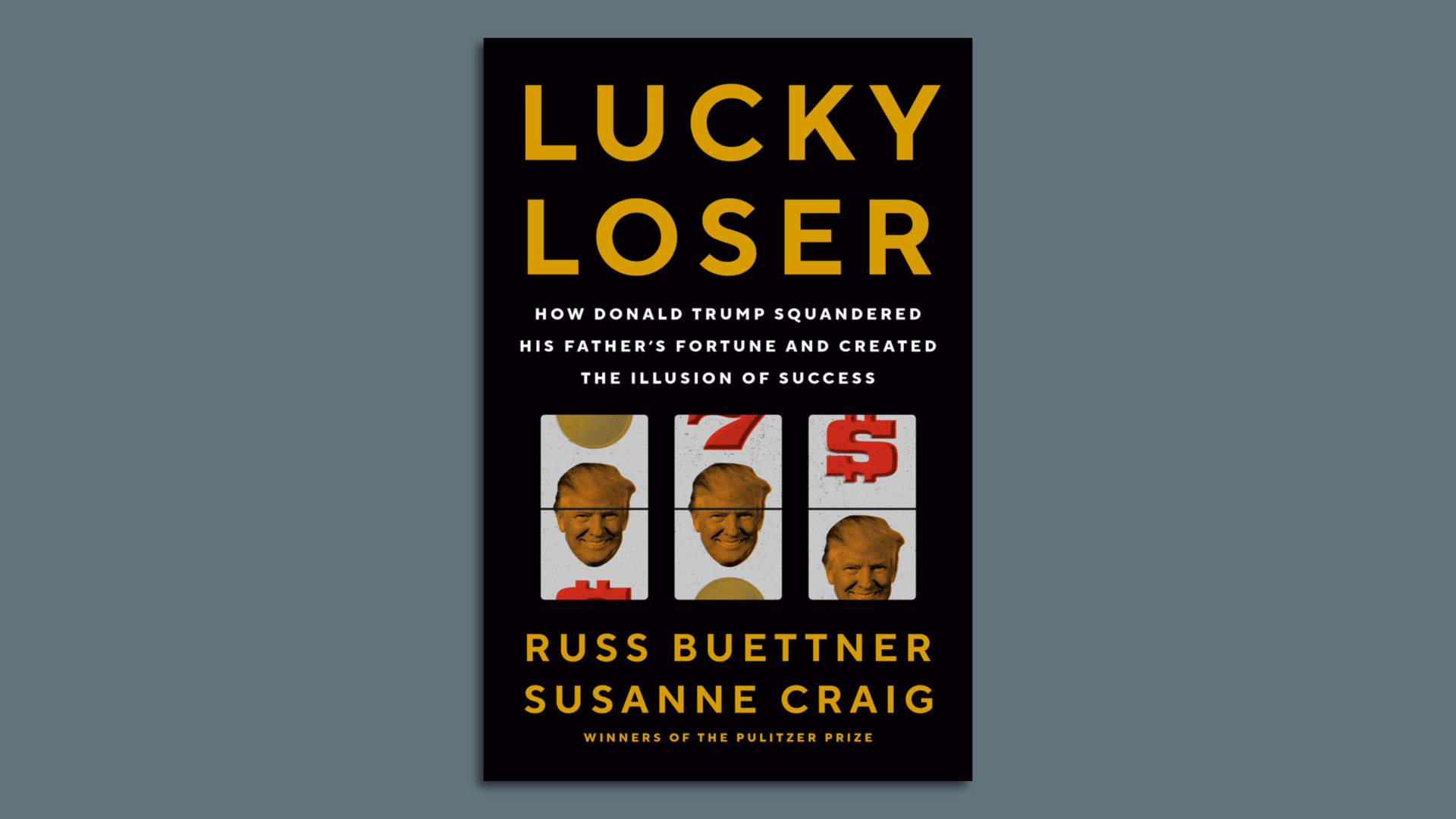
The New York Times reporters who uncovered Donald Trump's tax returns are out with a book today offering a gripping look at how Trump got rich.
Why it matters: Core to the former president's pitch for office is that he's a successful businessman. Relying on interviews with hundreds of former Trump associates, financial statements, confidential business records and public filings, the book dismantles that notion.
- It's called "Lucky Loser: How Donald Trump Squandered His Father's Fortune and Created the Illusion of Success," by Russ Buettner and Susanne Craig.
Zoom in: The authors identify three main sources of Trump's wealth, adding up to more than $1 billion. None appear to have anything to do with his acumen as a real estate tycoon or entrepreneur:
- There's the roughly $400 million Trump inherited from his father, as they reported in 2018. A lot of that was plowed into money-losing businesses, including failed casinos and an airline.
- He cashed in on "The Apprentice," from both being on the show and then licensing deals where he endorsed various products. His appeal to advertisers was enhanced based on a portrayal of him that was manufactured by the TV show's producers. (Read that reporting here.)
- A New York real estate deal that he tried, and failed, to get out of ultimately wound up being profitable.
Between the lines: The book takes down decades of business reporting that portrayed Trump as a successful New York City builder who was a millionaire, even a billionaire — before he had come into that money.
- That includes a 1970s NYT article claiming he was worth hundreds of millions when at the time, he was simply working with his father's money and telling people it was his.
- Mike Wallace — one of the most prominent journalists of the time — teed up a segment on Trump in 1985 like this: "[T]here's a new billionaire in town. Trump's the name. Donald Trump."
- Only a few years before Forbes had estimated his net worth at over $600 million, the authors note. At the time, it wasn't true.
In that segment, Trump says he's going to build the tallest building in New York. That never happened.
For the record: Trump's campaign communications director, Steven Cheung, called the book "a desperate attempt to interfere" in the election.
- Calling the book "lies" and "incoherent nonsense," he said it "either belongs in the discount bargain bin in the fiction section of the bookstore or should be repurposed as toilet paper."
3. Trump's latest venture

Trump is putting his name behind another new project: World Liberty Financial. It's a crypto project he promoted last night in a meandering two-hour livestream on X that was remarkably light on detail.
Driving the news: The former president spoke broadly about the blockchain industry, the success of his NFT collections, and crypto's generational learning curve.
- He didn't speak about the project he was launching before turning the stream over to his sons and partners.
How it works: The platform is reportedly being described as a decentralized finance (DeFi) money market, or a platform where people can borrow, lend and earn interest on crypto.
- The only thing the project team spoke to specifically last night was the fact that the project will launch a new cryptocurrency — sort of.
- It will create a so-called governance token, called WLFI, which will not be transferable and will not earn yield. It can only be used to vote on changes to the project.
💭 Brady's thought bubble: It's unclear why anyone would buy a token if it's non-transferable. What's the point of it? That's the question everyone in crypto is likely to be asking.
Zoom in: Project partner Chase Herro, who spoke on the livestream last night, and Zachary Folkman, who is also reportedly listed on World Liberty Financial's white paper, were said to be behind a similar sounding effort that only lasted a few months, Dough Finance.
- Dough was brought down by a hack that took basically all the funds deposited into it.
The intrigue: Trump's embrace of crypto has been extremely well received by the blockchain industry. But this DeFi side hustle has not been.
- Celebrities who become enamored with cryptocurrency and try to become entrepreneurs tend to end up losing money for their unsophisticated fans.
Read the full story ... and sign up for Axios Crypto.
Thanks to Kate Marino for editing, Mickey Meece for copy editing, and to you for reading!
Sign up for Axios Markets