Axios Markets

March 28, 2025


1 big thing: The multitrillion-dollar debate over "zero"
One word you're going to hear a lot in coverage of budget negotiations is "baseline." It sounds simple enough — but in fact, it's a slippery and contentious concept.
Why it matters: This wonkish terminological tussle is, at its heart, a debate over what counts as zero for the purposes of budgetary impact.
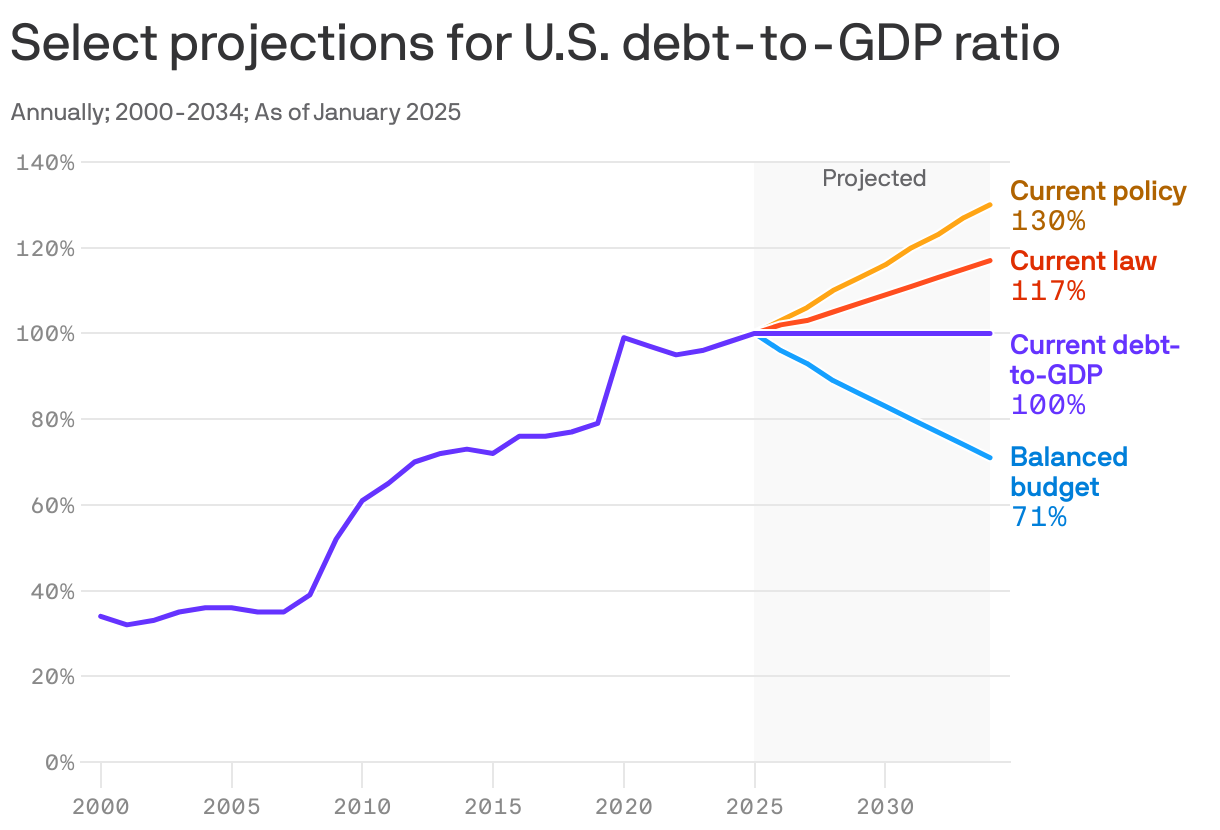
- Depending on where the debate ends up, it could raise America's debt-to-GDP ratio by 47 percentage points, per a Congressional Budget Office (CBO) analysis.
How it works: Congress controls the U.S. fiscal trajectory. The big debate is over what the baseline for that trajectory is — or, to put it another way, what kind of legislation would have zero budgetary impact.
Zoom out: The whole concept of "budgetary impact," while relatively clear in terms of CBO scoring, is much gnarlier on a philosophical level.
- The insight was first formulated by Nelson Goodman, in his 1954 book "Fact, Fiction, and Forecast."
- Goodman shows that simply changing terms — in his case, from "green" to "grue," or in this case, from "law" to "policy" — can have an enormous effect on what we expect the future to look like.
Where it stands: The CBO uses "current law" as its baseline — which is to say, it assumes that everything will continue according to the laws the Congress has already passed, unless they're changed.
- Current law, however, is discontinuous. Most of the tax cuts from President Trump's first term in office expire at the end of this year, and if Congress doesn't change that, the result will feel like a tax hike to most taxpayers.
- As a result, the U.S. Chamber of Commerce and most Republicans, including Treasury Secretary Scott Bessent, prefer the "current policy" baseline — where the tax code remains in its present form, without any mandated expirations.
- Were that current policy baseline in place, the Chamber writes, "merely avoiding a scheduled tax increase" would no longer "be considered to have a budgetary impact."
Yes, but: The current policy baseline increases deficits by about $4 trillion per year, per the CBO, while also resulting in lower GDP overall.
- The whole reason the tax cuts are scheduled to expire is that making them permanent would have been too expensive. (When the cuts were passed in 2017, Republicans also didn't expect that Trump would be president in 2025.)
Zoom in: Even a budget that the CBO would score as having $0 of impact would create trillions of dollars in deficits and an inexorably rising debt-to-GDP ratio that hits 156% in 2055, per projections released yesterday.
- That's because the CBO uses "current law" as its baseline, and current law — even after the Trump tax cuts expire — spends much more than the IRS collects in tax revenue.
The bottom line: Congress has already chosen, for better or for worse, which baseline it wants to use — and that's current law.
- "If you're going to have a standard, the standard should be consistent," Kent Smetters, who runs the Penn Wharton Budget Model, tells Axios.
2. Quoted: CBO on the impact of tariffs


Axios Markets