Axios Markets

April 12, 2022

1 big thing: 💰Russia’s gusher

Russia's cash flows soared during the first quarter, despite economic sanctions imposed by the West. The nation benefited from soaring energy prices brought on by its attack on Ukraine, Matt and Emily write.
Why it matters: Russia's surprisingly healthy finances show its continued sales of oil and gas remain a formidable economic tool for President Vladimir Putin's regime.
Driving the news: During the first quarter, the Russian Federation posted a record surplus in its current account — a broad measure of its trade with the world — as surging energy prices translated into a gusher of export revenues.
- The surplus for the first three months of 2022 rose to $58.2 billion, from $22.5 billion during the first quarter last year, according to figures published yesterday by the Russian central bank.
- The Institute of International Finance, a research group, projects that Russia will post a record $250 billion surplus this year.
- A surplus of that size could essentially make up for the entirety of the Russian central bank reserves that Western powers froze through sanctions, says Elina Ribakova, deputy chief economist at IIF.
Details: While Russia remains effectively severed from much of the world economy by Western sanctions, its big account surplus means it can get the money it needs to finance its war, pay government employees, and stabilize its currency by intervening in foreign exchange markets.
Reality check: Russia's ruble, which plunged by roughly 75% after fresh Western sanctions were imposed in late February, has now more than fully recovered — a sign that Russia is finding ways to adjust to its new status as an economic pariah.
Yes, but: A large current account surplus doesn't mean that the Russian economy, or its population, is thriving. The surplus — exports minus imports — in part reflects the fact that imports into the country have fallen sharply.
- That's because of moves by Western companies to pull out of the country, and the ruble weakness over much of the quarter. Combined, that's left Russian consumers unable to buy foreign goods, resulting in a worsening standard of living.
- Investors also fled the country, as net capital outflows soared by 270% compared to the prior year. About $64.2 billion in capital headed for the exits, according to yesterday's report.
- That's bad for Russia's long-term economic health, but almost certainly won't dissuade Putin from pursuing his chosen path in Ukraine.
The bottom line: Russia's financial resilience underscores the fact that if the West really wants to impose pain on Putin, Europe will need to cut off energy purchases.
2. Catch up quick
3. Global food prices hit record high
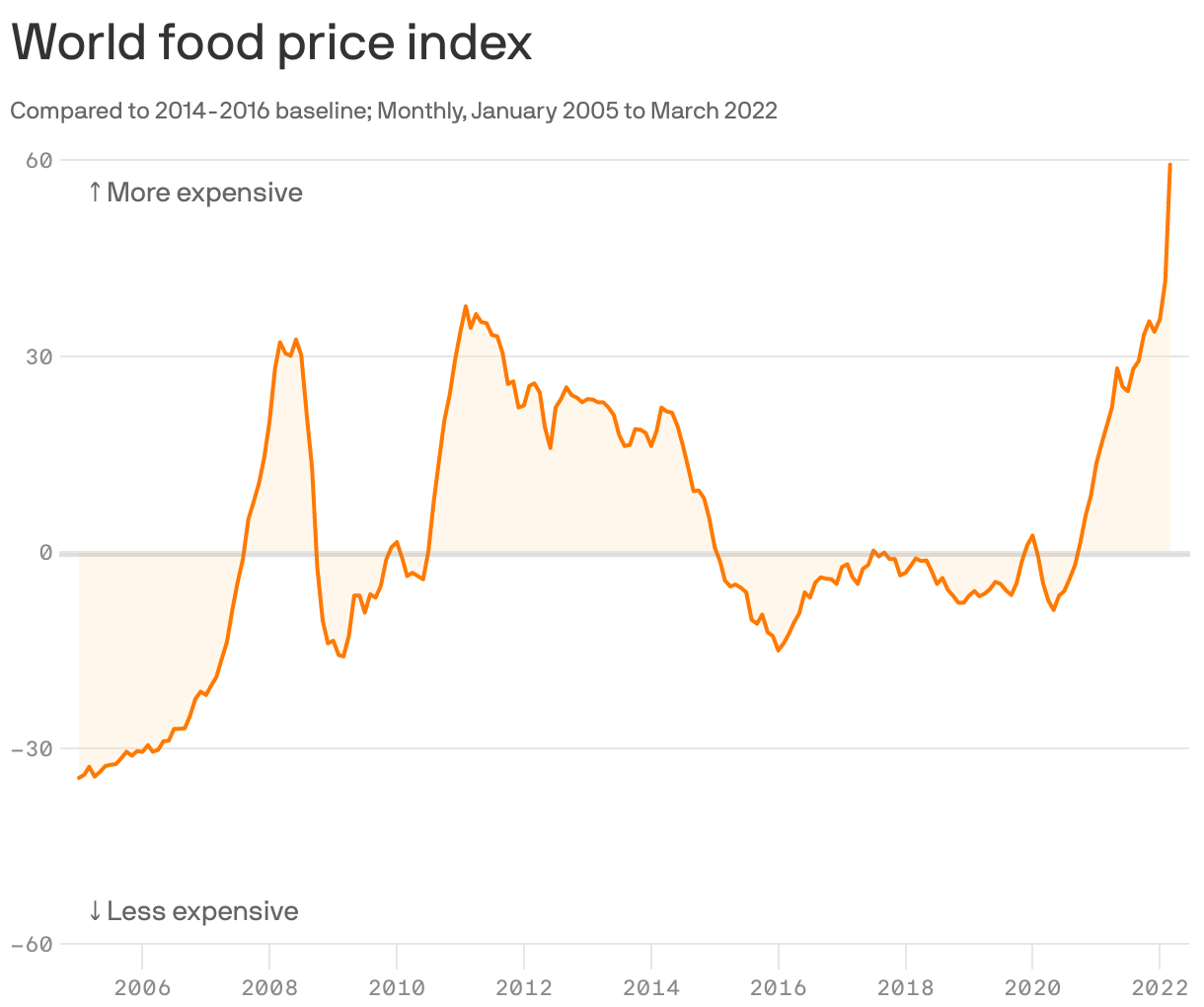
Food prices soared to record highs last month, as the war in Ukraine exacerbated what was already a global crisis, Emily writes.
- In March, the food price index published by the United Nations Food and Agriculture Organization surged to its highest level since the index's inception in 1990.
Why it matters: In poorer countries where folks spend upward of 50% or more of their income on food, these numbers are devastating.
State of play: The tools that central banks are using to fight inflation — rate hikes, quantitative tightening — are meant to curtail demand, but can do little to address global supply problems.
- "Raising rates will not resolve the war or address the supply chain," said Jean Boivin, head of the BlackRock Investment Institute.
Behind the numbers: The index tracks a basket of commodities including cereals, vegetable oils, dairy, meat and sugar.
- The prices of wheat and sunflower oil, in particular, are rising because of the war. Some Ukrainian ports are closed and others face disruptions.
- Issues will certainly drag into next year as some farmers in Ukraine — the leading sunflower-oil exporter and a top grains supplier — are unable to plant crops.
What's next: The U.S. is also struggling with rising food prices. Expect to hear more about that later this morning, when the March Consumer Price Index is released.
4. China's lockdown woes


Chinese stocks suffered their worst tumble in weeks yesterday amid growing COVID-19 lockdowns throughout the country, Matt writes.
Why it matters: Lockdowns in China, a manufacturing behemoth, could weaken both its economy and the world’s, and add fresh snarls to global supply chains.
State of play: China has imposed a hard lockdown in Shanghai, a city of 25 million and a major economic hub, for roughly a month. Some now fear lockdowns could also spread to the manufacturing center of Guanzhou.
- Hong Kong's Hang Seng index sank 3% yesterday and the Shanghai Composite fell 2.6%. (Though, they recovered some of those losses today.)
- Yesterday also brought fresh Chinese inflation stats, including the Producer Price Index for March. The index, which measures wholesale prices charged by Chinese factories, showed a higher-than-expected year-over-year increase of 8.3%, as lockdowns and international energy prices continued to push wholesale prices upward.
Background: Chinese stocks had been rallying in recent weeks, despite a worsening COVID-19 picture, as investors appeared to be betting that the government would be forced to print and spend money to shore up an economy that was locking down.
What we're watching: Higher-than-expected inflation, such as the kind detailed in Monday's data, could make Chinese policymakers leery of delivering the kind of help — fiscal spending and monetary easing — that they were able to offer in the early days of the virus.
Go deeper: A modern city starves
5. Charted: Eastern Europe funding pause

In one of the many knock-on effects the war in Ukraine has had on global markets, corporate bond issuance in Eastern Europe all but came to a halt for a time after Russia's invasion, Axios’ Kate Marino writes.
The big picture: A broad selloff in emerging market bonds sent yields higher, making it more expensive and difficult for companies that need to raise capital.
- A prolonged period of outflows from emerging market mutual funds and ETFs drove the selling pressure on EM bonds, especially those from Eastern Europe, says Sergey Goncharov, emerging markets portfolio manager at Vontobel’s Fixed Income Boutique.
- Year to date, EM debt funds as a whole experienced an average weekly net outflow of $201 million, according to Lipper FMI. That compares to a $77 million average weekly inflow during the full year of 2021.
But, but, but: It’s not just war-contagion fears driving yields higher in the region, says Christine Phillpotts, emerging markets portfolio manager at AllianceBernstein.
- The rapid move upward in U.S. Treasuries — a global benchmark — has also sent yields on bonds around the world zooming higher, she notes.
What to watch: The market for Eastern European debt appears to be thawing — at least for better quality companies.
- “I think there’s starting to be a differentiation,” between stronger companies and those that are more vulnerable, Phillpotts says.
- The last few weeks have delivered some "green shoots," Goncharov adds.
Axios Markets

Stay on top of the latest market trends and economic insights