Axios Markets

April 01, 2025

🤡 It may be April Fools' Day, but rest assured, we're not joking around here. (Maybe some puns, but the news is all real.)
📉 We're back on tariff watch, and Americans really don't like what they're seeing. Plus, stocks have a lousy quarter, and what's at stake in DOGE's push for privatization.
👀 Situational awareness: The White House is now looking at leveraging the debt ceiling "X date" this summer to force a budget reconciliation bill through Congress. "Gun to the head, the whole agenda, and the country's credit rating and global depression all rolled into one," an official says. Go deeper.
All in 840 words, a 3-minute read.
1 big thing: Americans dislike tariffs

Sometime tomorrow, the Trump administration is supposed to announce a raft of new tariffs, part of "Liberation Day."
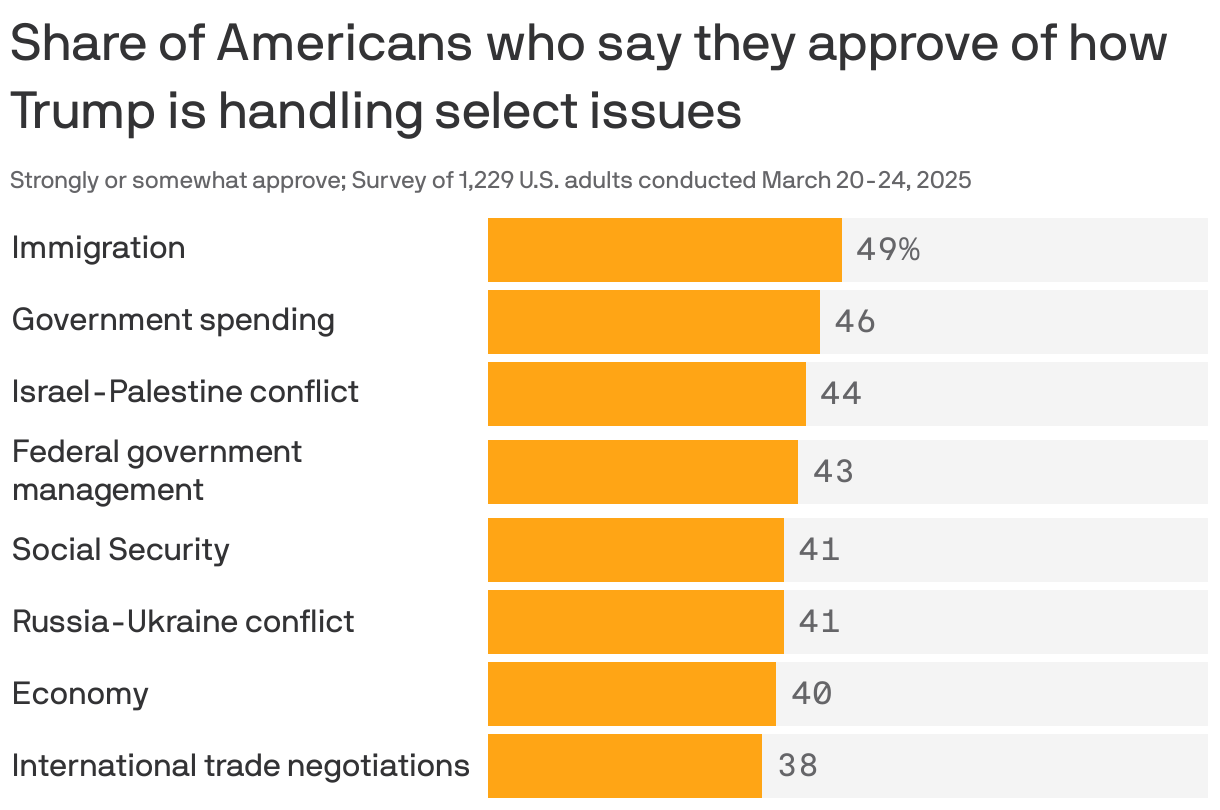
Why it matters: Americans don't seem to be into this tariff stuff. The Trump administration's trade policies are pretty unpopular, per a new poll released yesterday by the Associated Press-NORC Center for Public Affairs Research.
By the numbers: While nearly half of respondents to the survey said they approved of the administration's efforts on immigration, only 38% support Trump's trade negotiations with other countries.
Context: A separate survey from CBS News found 72% of Americans believe tariffs will raise prices in the short term, and 47% said prices would be up for the long term.
The big picture: Americans could really feel these new levies.
- If the White House goes through with a reported policy option of 20% broad-based tariffs, it'll cost the average household between $3,400 to $4,200 in lost purchasing power, per an estimate out yesterday from the Yale Budget Lab.
- The higher estimate takes into account the likelihood that other countries retaliate. Lower-income households will disproportionally bear the brunt, with their income dropping nearly three times as much as those at the top, per the analysis.
Between the lines: President Trump was voted into office on the belief that he would be a better steward of the economy than his predecessor. Immigration and the economy were priorities for voters who supported Trump.
- Still, former President Biden often got worse grades. In 2023, a low of 3 in 10 Americans approved of his handling of the economy.
The bottom line: No one knows exactly what kind of tariffs are on the way, and the suspense isn't sitting well with the public.
Go deeper: How Trump's tariffs are different this time
2. Stonks stank in the first quarter


Tariff uncertainty, combined with recession fears, just drove U.S. stocks to one of their worst quarters in years.
Why it matters: A sharp decline in stocks was once enough to get Trump to change his policy positions, but these are different times.
By the numbers: The S&P 500 ended the first quarter down 4.6%, while the tech-heavy Nasdaq dropped 10.4% and the broad Russell 3000 fell 5%.
- It was the worst performance since 2022 for all three.
The intrigue: U.S. stocks badly underperformed the world to start the year.
- The MSCI World ex USA Index, which tracks all large developed markets other than the U.S., rose 5.5% in the quarter.
3. Worries over DOGE privatization push
It's not just tariffs changing the way America works. Elon Musk also wants to take the federal government private, part of the DOGE-led effort to shrink the bureaucracy.
Why it matters: Pushing more of the federal government's work into the private sector could lead to greater efficiency, but the downsides could cost taxpayers in other ways.
- Because the priorities are different — public interest for the government and profits for businesses — privatization can mean everyday services run differently than people are accustomed to. But it can also mean they cost more and don't work as well.
Zoom out: "We should privatize anything that can reasonably be privatized," Musk said at a recent tech conference.
- Privatization doesn't have to mean completely moving something into private sector hands. It can also mean more work is contracted out.
- Musk himself benefits from this kind of semi-privatization, like NASA's increasing reliance on SpaceX, says Michael Strain, an economist at the conservative American Enterprise Institute.
Where it stands: So far three entities — long targeted by conservatives — are in the administration's sights: Amtrak, the Postal Service and mortgage giants Fannie Mae and Freddie Mac, says Joe Brusuelas, chief economist at RSM.
- There's also been a drumbeat of reports warning that privatization is coming, from various news outlets.
Reality check: Musk's statements are not policy, and until Trump makes a real announcement it's hard to predict what happens next.
- The White House did not respond to a request to talk about privatization.
Zoom in: There are successful examples of government services, like rails and mail, being turned over to private companies in Europe, says Ernie Tedeschi, director of economics at the Yale Budget Lab.
- "Privatization has been wielded productively," says Tedeschi, who worked in the White House under President Biden.
- But even those sometimes run aground. The U.K. is in the process of renationalizing its rail service, which was privatized in the 1990s. In a recent report, Amtrak pointed to the U.K. as a cautionary tale.
Examples of successful U.S. privatization efforts are harder to come by.
- Fannie Mae and Freddie Mac, for instance, were once private sector companies carrying out a vital public service. They wound up in deep trouble in the 2008 financial crisis, and the U.S. government took over.
- The Post Office is already quasi-private, since it's mostly self-funded, only relying on a very small subsidy from the federal government. And Amtrak already runs on tracks owned by the private sector.
The bottom line: The real worry for most critics is corruption.
- Famously, the Russian oligarchy was born in the rush to privatize state-owned firms after the fall of the Soviet Union.
Thanks to Ben Berkowitz for editing and Anjelica Tan for copy editing. See you tomorrow!
Sign up for Axios Markets