Axios Markets

November 19, 2026


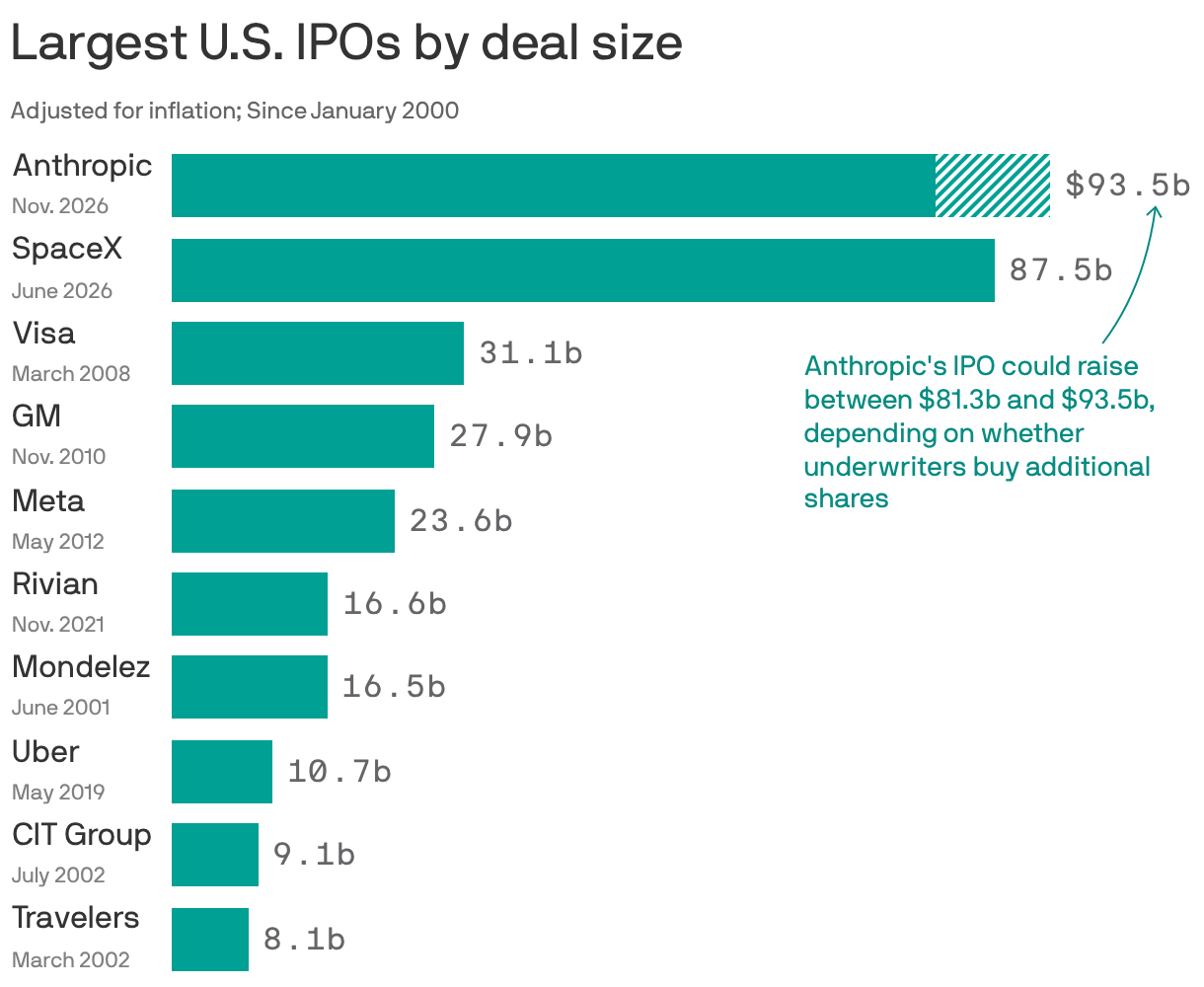
🐜 ANT is on the march. Anthropic is set to start trading sometime today under the ticker ANT, in what will be a major milestone for the AI boom.
🗓️ Today, Emily is looking at some of the biggest holders of the company's shares. Surprise: It's other tech giants! Matt, on the other hand, relays a contrarian take on what one analyst calls the "most underappreciated risk" of AI.
Do, or do not. There is no try. In 1,033 words, a 4-minute read.
1 big thing: New company, old guard

Anthropic's stock market debut today signals the dawn of a new era in tech, with one twist: Amazon and Google, the key players of the current era, will own nearly 30% of Anthropic after it goes public.
Why it matters: The companies that AI was supposed to disrupt are among the biggest financial beneficiaries of its rise.
Catch up quick: Amazon and Google each invested in Anthropic when it was private, and their shares will convert to a special nonvoting class of stock when the AI company starts trading.
- After the debut, Amazon will hold 14.7% of shares in Anthropic, per a filing earlier this week — and could exercise the right to convert more outstanding notes into stakes in the company.
- Google will hold 13.7% — that includes the purchase of $10 billion in additional Anthropic stock through a private placement accompanying the IPO.
- These are nonvoting shares, so technically that would limit the tech giants' influence.
The latest: Anthropic yesterday priced its long-awaited IPO at $83 per share, which would give the Claude maker an initial market cap of $1.08 trillion and a fully diluted value of around $1.5 trillion.
The intrigue: The Big Tech companies don't just own stock. They also sell compute and other infrastructure to Anthropic.
- This is an example of the so-called "circular financing" arrangements that have troubled some critics: Tech companies pour capital into the frontier AI firms, and the firms then route some of that capital back through purchases of cloud and compute capacity.
Anthropic's prospectus acknowledges the complications these entanglements entail:
- "Our relationships with our strategic partners—whether with Amazon, Google, or Microsoft, which simultaneously serve as our investors, customers, distribution partners, and competitors, or with Broadcom which simultaneously serves as a supplier and lessor — create potential conflicts of interest that are difficult to fully anticipate or mitigate." (Emphasis added.)
Between the lines: The concern is that Big Tech's ownership stakes and commercial relationships could undermine competition, limit consumer choice, keep prices high and make it harder for startups to enter the AI space.
- "We need the AI industries and the tech platforms to be fighting with each other, not cooperating," Columbia law professor Tim Wu said at a conference in San Francisco this week.
Yes, but: All these companies do face competition in the AI space — the industry is particularly worried over open-source models and competition from China.
- And there is still certainly some competition: Claude and Google Gemini are competing for customers, for example.
Flashback: The Federal Trade Commission, under then-chair Lina Khan, flagged the connections between Big Tech companies and Anthropic and OpenAI in a report issued just before President Trump returned to office.
- The agency found that partnerships between the AI firms and the Big Tech companies could make it harder for the startups to switch cloud providers, and give the tech companies access to sensitive information and influence over partners' decisions.
- Andrew Ferguson, a commissioner at the time, who now heads the agency, said in a statement then: "AI may also be the most significant challenge to Big Tech firms' dominance since they achieved dominance."
State of play: I asked Khan about Amazon's stake in Anthropic at a conference in San Francisco earlier this week.
- She mentioned last year's report and acknowledged "the deep kind of conflicts that can emerge from a lot of these strategic investments across the ecosystem."
Charted: That's 1 big ANT
2. Dominance could goeth before a fall

Giant tech companies seem to control the commanding heights of the emerging AI economy at this stage of the AI trade.
Why it matters: Owning the hyperscalers has been one of the most popular positions on Wall Street, but some argue they actually may be more vulnerable than they look.
The big picture: They've got all the money they need, via cash from their massively profitable business models and relatively cheap debt.
- Hyperscalers are also in a prime strategic spot, as they can sell wholesale computing power and AI services, as well as consumer and enterprise applications like Meta's Muse or Alphabet's Gemini Tasks.
Reality check: If this whole AI thing goes down in a flaming crash, hyperscalers will essentially be fine. They'll write down a few hundred billion in investment losses and go back to their pastime of minting money and plowing it into share buybacks.
- Plus, if things do get ugly, people are going to want to own giant blue chips with durable cash flows and fat profit margins. You know, Microsoft, Alphabet, Apple. Big Tech.
- (And then there's the situation that Emily laid out for us, above, in which hyperscalers control giant slugs of stock in companies like Anthropic, which could mitigate potential competitive threats.)
Zoom out: For all those reasons, sometimes it does seem like the strongest Big Tech companies really can't lose.
Yes, but: Not everybody agrees.
- "I think the most underappreciated risk when it comes to AI is the disruption risk to the big tech incumbents," Ulrike Hoffmann-Burchardi, head of global equities at UBS Global Wealth Management, told Axios Tuesday at a UBS event to discuss its 2027 outlook.
What they're saying: She said she is telling clients that market bounces could be opportunities "to balance exposure and to balance and diversify away from the largest index weights."
The bottom line: It was an interesting view. And it seemed consistent with wrinkles we noticed in the recent crop of earnings, which included surprising weakness in the core businesses of giants like Alphabet and Amazon, for example.
Thanks for reading. We'd love to hear from you. Drop us a line at [email protected] and [email protected] or reply to this email.
Thanks to George Moriarty for editing and Carlin Becker for copy editing this edition.
Tell your colleagues, family members and tech stock buyers to sign up here.
Sign up for Axios Markets