Axios Markets

August 29, 2022
It's Monday. And summer is quickly slipping away, along with any momentum the market had going for it during the bear market rally. Let's get to it.
Today's newsletter, edited by Javier E. David, is 949 words, or 3.5 minutes.
1 big thing: Who student loan relief helps
Student loan debtors who stand to benefit most from the relief plan announced last week aren't exactly the latte-sipping elite, Emily writes.
Reality check: First, nearly 90% of those benefiting from the policy earn less than $75,000, according to Dept. of Education numbers cited by the White House. Second, a significant percentage of student loan debtors didn't get a four-year degree. That means they also don't get the income boost of a bachelor's degree.
- "Many Americans understandably, but mistakenly, assume that the vast majority of student loan debtors have 4-year degrees, when in fact about half do not," said Aaron Sojourner, a labor economist at the Upjohn Institute.
What they're saying: βYou are ensuring that your little brothers and sisters have what they need for school,β Gabrielle Perry, a 29-year-old African American woman told the AP. βYou are helping your parents pay off their rent, their house. So your quote-unquote wealth doesnβt even have time to be built because youβre trying to help your family survive.β
- In fact, Black borrowers are disproportionately burdened by student loan debt. A typical Black borrower will still owe 95% of their student loan 20 years after starting college, compared with 6% for a white borrower, according to a 2019 analysis.
Of note: Women hold two-thirds of the student loan debt in the U.S., according to a widely cited estimate from the American Association of University Women (AAUW)β with Black women holding the most.
Bottom line: The two-plus years of the student loan moratorium did benefit a lot of higher-income folks, but the policy announced last week by the Biden administration will mainly serve those who could use the help.
3. Powell's wet blanket

In a closely watched speech last week, Federal Reserve jefe Jerome Powell said the central bank is far from convinced inflation is beaten and may keep hiking rates for a while, Matt writes.
What it means: This is the Fed's way of telling the market that it has been overly optimistic in expecting the Fed to declare victory on inflation and then start lowering interest rates over the next year or so.
- Signs of slowing inflation had some in the market predicting the Fed could do just that. Such hopes boosted the stock market over the summer.
Catch up fast: Powell's Jackson Hole address threw a big, wet blanket over Wall Street.
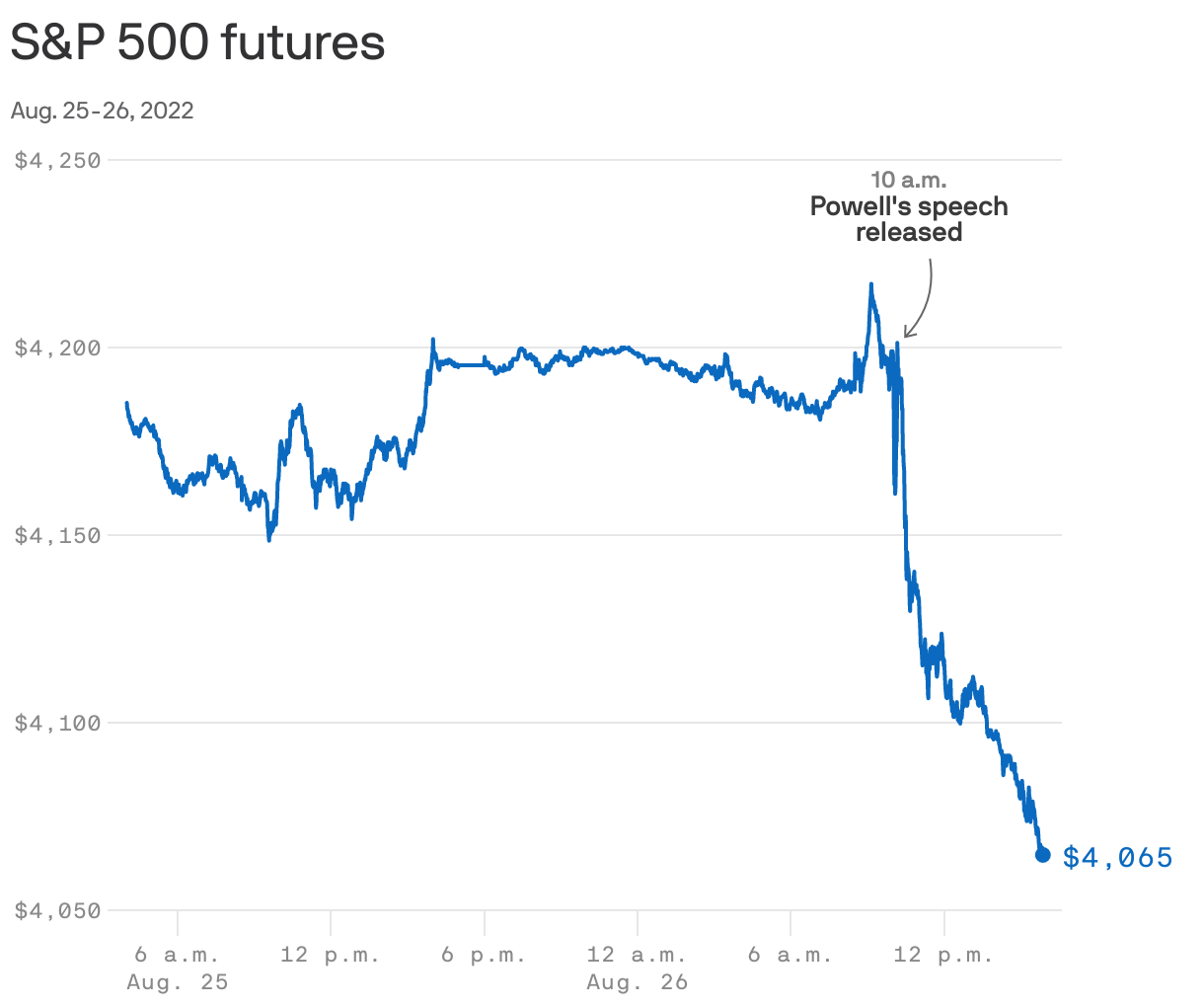
- The release of the prepared text at 10 a.m. EDT clobbered the market, sending the S&P 500 down 3.4%, its worst day since the middle of June.
What's next: The jobs report for August, out Friday, will show if the economy continues to shrug-off already significant rate hikes the Fed has imposed.
4: Energy crisis dims lights across Europe

Cologne's gothic cathedral is no longer lit overnight, a step Germany is taking to limit energy consumption amid the Russian gas crisis. Photo: Marius Becker/picture alliance via Getty Images
Amid an energy crisis, the lights are going out all over Europe, Matt writes.
What it means: The impact of Russia's war in Ukraine β and the combination of sanctions and embargoes drastically curbing Russian gas supplies β is beginning to have real effects on the West's standard (and cost) of living.
Big picture: In late July, the European Union's 27 member states agreed to voluntarily cut gas consumption by 15% between August and March 2023.
- As part of the agreement, mandatory cuts could be imposed if the supply situation worsens.
What's happening: A range of government-imposed restrictions, akin to the kind of restraints seen during wartime, are underway.
In Germany: Cologne's magnificent cathedral β normally lit throughout the night β now goes dark over night, along with public buildings, museums and other landmarks like Berlin's Brandenburg Gate.
- Hanover last month became one of the first big cities to cut off hot water at public buildings. The city wants consumption cut by 15%.
- The southern city of Augsburg shut its fountains and is considering turning off some traffic lights.
Spain: Temperature limitations β air conditioning no cooler than 27 degrees Celsius (or nearly 81 degrees Fahrenheit), went into effect this month for commercial buildings.
- After 10 p.m. shop windows and unoccupied public buildings won't be lit.
Italy: Air conditioning in schools and public buildings has already been limited in what the government labeled "Operation Thermostat," which commenced in the spring.
France: Shopkeepers will now be fined for keeping doors open and air conditioning running, a common practice. Illuminated signs will be banned between 1 a.m. and 6 a.m.
- While roughly 70% of its energy comes from nuclear power, France has committed to cutting natural gas consumption as well.
What we're watching: Whether the discomfort of the energy crisis β which could worsen during winter β reduces public support for sanctions on Russia in response to its brutal invasion of a smaller neighbor.
5. Hiring "pivot shift" ahead

The surge in hiring we've seen over the past year may slow a bit in the coming quarter, Emily writes.
Why it matters: A slowdown in the overheated labor market could help the Federal Reserve engineer that soft landing we keep hearing about.
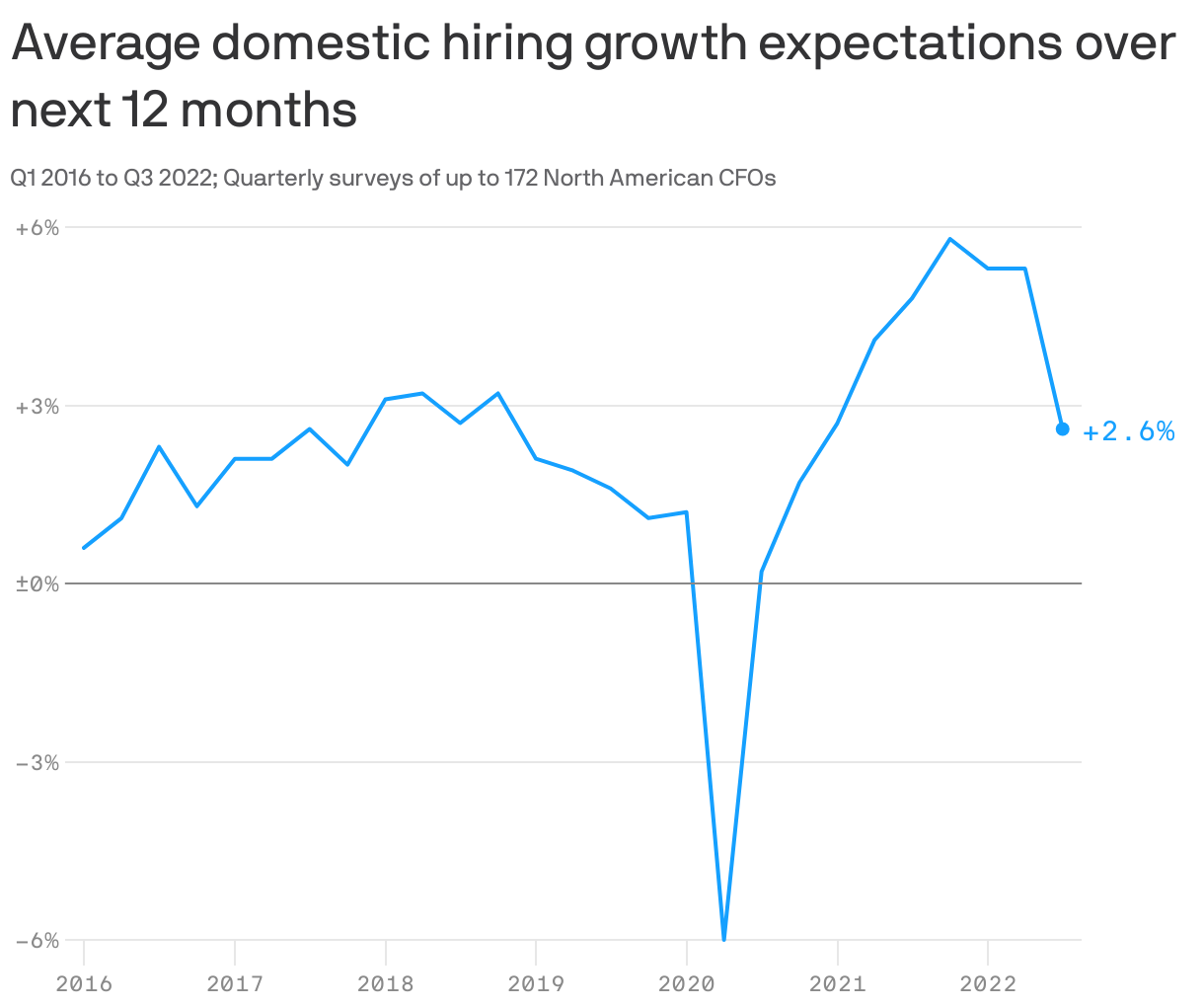
What's happening: In a survey released by Deloitte this morning, CFOs predict a 2.6% increase in hiring over the next year βΒ a big slowdown from what they were saying three months ago when hiring growth was at 5.3%.
- "A bit of a pivot shift," Stephen Gallucci, a managing partner at Deloitte, said of the survey of 112 CFOs.
- But that's still a higher number than the same time frame in 2019.
Big picture: Deloitte's been surveying CFOs for 13 years, believing that these C-suite execs have a good sense of what's going on in their company, and the economy.
- In Q3, CFOs were more concerned about inflation than the possibility of a recession.
οΈβ‘ Axios Markets was copyedited by Lisa Hornung.
Sign up for Axios Markets

Stay on top of the latest market trends and economic insights