Axios Markets

April 28, 2026

1 big thing: American CEOs are getting older


It's not just Congress — the corner office is graying, too, with the average American CEO now 61, up from around 51 two decades ago, a new working paper finds.
Why it matters: It's a mixed bag: Older leaders tend to manage businesses that grow more slowly and are less likely to radically innovate, the study finds, in line with prior research.
- But they also appear to be better at managing companies through more uncertain economic times.
By the numbers: The researchers looked at a database of more than 50,000 leaders. They found that the tendency to hire older leaders is more predominant among smaller, privately held companies.
- Bigger corporations are more able to promote from within — as Apple just did, bringing on 50-year-old John Ternus to replace 65-year-old Tim Cook.
Zoom in: For that reason, leaders at the biggest companies, S&P 500 CEOs, are a bit younger, 58.5 on average in 2023, notes Bloomberg — up from 56 in 2000, in line with the rest of the working population.
The intrigue: This trend isn't simply a matter of leaders sticking around longer.
- The average age when a CEO nabs the job rose as well, to 55 from around 47.
- And yes, the U.S. population is graying, but this trend isn't simply about demographics.
- The average age of a college-educated worker rose only two years over the same period, write the authors, economists at Princeton and the University of Bonn.
The big picture: Companies, particularly small ones, appear to want older leaders with longer and more diverse career paths.
- The study finds that today's CEOs hold more jobs, across more companies, before ascending to the top job.
- These "generalists" are really good at managing, Farzad Saidi, an economist at the University of Bonn who coauthored the report, tells Axios.
- The analysis finds that rising economic uncertainty and complexity make generalist skills more valuable.
Between the lines: Even though these generalists are prized at the top of the ladder — and have been for more than a decade, other research finds — companies are fostering fewer of them now, as entry level hiring has slowed.
- That means the value of older generalist CEOs is only rising.
- "The premium will only increase," Saidi says.
State of play: This isn't just a business thing. The next generation is finding its path to the top blocked across a range of careers.
- The current Congress is the third oldest ever.
- The average age at which Ph.D. scientists get their first grant — a sign of success for "young" researchers — has gone up, too.
- And we haven't even mentioned the situation with homeownership.
The bottom line: For many regular workers, ageism is a drag that eventually knocks them out of the workforce or keeps them from climbing the ladder — but a select group of the 55+ crowd is finding its way to the top.
2. 😓 Record share of Americans feel worse off


The share of Americans who say their financial situation is getting worse is higher now than at any point in the past 25 years, per new Gallup data out Tuesday morning.
Why it matters: Americans are struggling after years of higher inflation and a recent surge in gas prices due to the Iran war — a major challenge for President Trump and Republicans as the midterm elections come into view.
By the numbers: 55% of respondents to a poll conducted April 1-15 said their financial situation is getting worse; that's up from 53% last year and 47% in 2024.
- The number is higher than at any point since 2001, even compared with recessions during the pandemic or in the wake of the financial crisis.
Friction point: This is the fifth consecutive year that more Americans say their finances are worsening rather than improving.
Zoom in: When asked to identify their most important financial problem, 31% cited the cost of living.
- Energy costs are mentioned by 13% of Americans, up 10 percentage points from last year and the highest since 2008.
Reality check: Inflation is still elevated from where it was the last time Trump was in office, but it's certainly lower than at its peak in 2022.
The big picture: Still, the recent surge in gas prices has increased the pressure on American pocketbooks.
- The average price of a gallon of gas is $4.11, says AAA. It was under $3 before the war started on Feb. 28.
- Many Americans blame Trump for the increase.
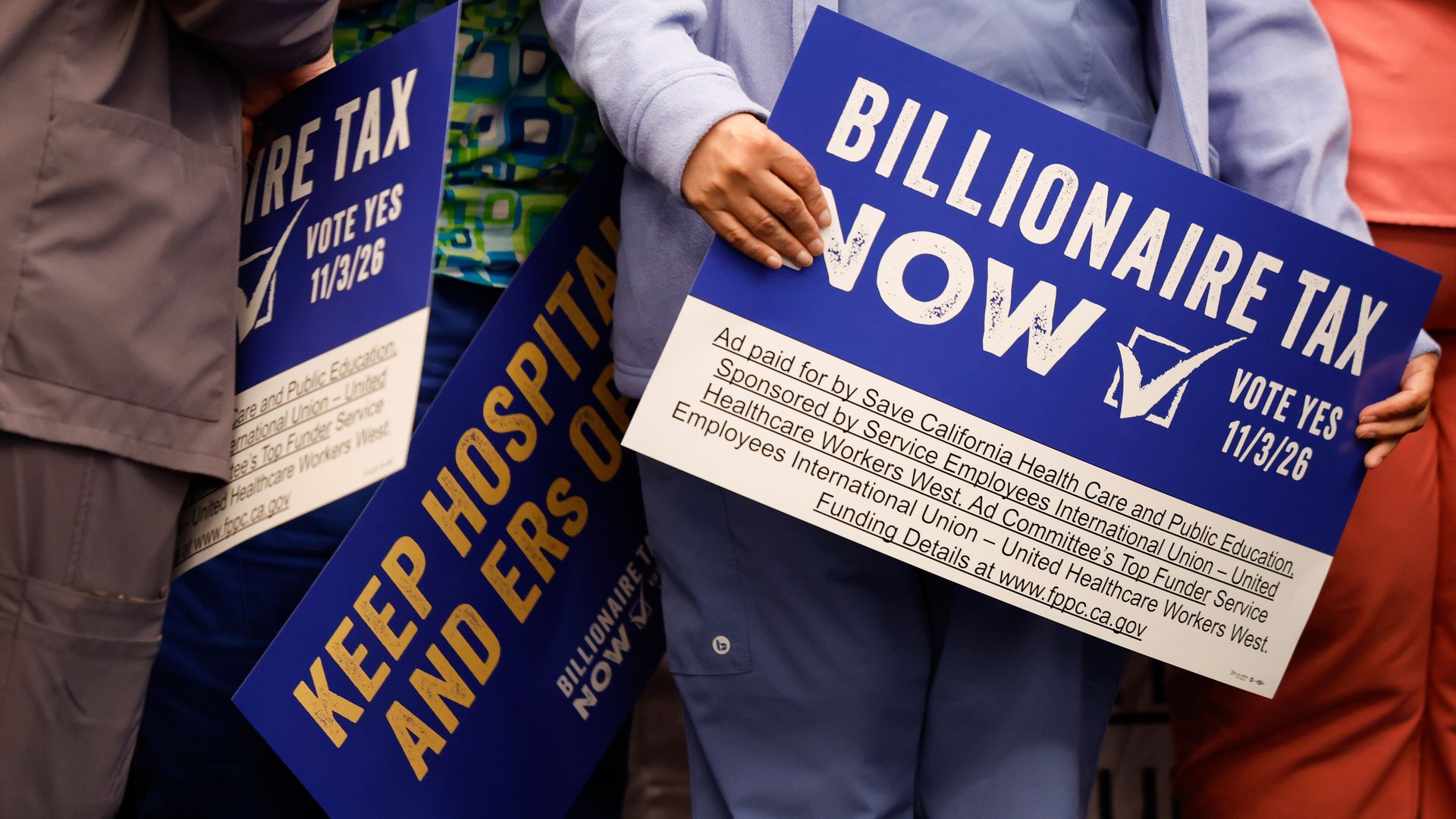
3. 💰 Billionaire tax on track for California ballot

Axios Markets